Wikimedia Commons
Amazon becomes the fourth company valued at $3 trillion as US stocks rally near a record on falling oil prices Amazon's market value closed above $3 trillion for the first time, joining a small club of the world's most valuable companies as AI and cloud growth powered a broad rally. US stock indexes climbed near record highs after oil prices fell sharply, easing Wall Street's worries about inflation. The Dow closed at a record. Analogies Crassus, the richest man in Rome For at the outset he was possessed of not more than three hundred talents; ... when he made a private inventory of his property before his Parthian expedition, he found that it had a value of seventy-one hundred talents. ... And though he owned numberless silver mines, and highly valuable tracts of land with the labourers upon them, nevertheless one might regard all this as nothing compared with the value of his slaves.
Plutarch, Life of Crassus, ch. 2, trans. Bernadotte Perrin (Loeb, 1916); Perseus Digital Library, Tufts University → Charter of the Dutch East India Company (VOC), 1602 — the first megacorporation As the prosperity of the united Netherlands consists principally of the navigation, trade and commerce, which have been carried on from these countries from time immemorial, and which from time to time have been praiseworthily increased ... some principal merchants of the aforementioned countries, lovers of navigation, trade and commerce on foreign countries ... have taken in hand the very praiseworthy navigation, trade and commerce on the East Indies.
Charter granted by the States-General of the United Netherlands, 20 March 1602; English translation, Wikisource → Swift on the South Sea Bubble: 'What magick makes our money rise' Ye wise philosophers, explain / What magick makes our money rise, / When dropt into the Southern main; / Or do these jugglers cheat our eyes? ... Put in your money fairly told; / Presto! be gone — 'Tis here again: / Ladies and gentlemen, behold, / Here's every piece as big as ten.
Jonathan Swift, 'The South-Sea Project' (1721), in The Works of the Rev. Jonathan Swift, Vol. 7; Wikisource → Melmotte, 'the very navel of the commercial enterprise of the world' It seemed that there was but one virtue in the world, commercial enterprise,—and that Melmotte was its prophet. ... at that time, Melmotte was not the strong rock, the impregnable tower of commerce, the very navel of the commercial enterprise of the world,—as all men now regarded him.
Anthony Trollope, The Way We Live Now (1875); Project Gutenberg (eBook #5231) → Hogarth, 'The South Sea Scheme' (1721) Often called the first editorial cartoon, Hogarth's crowded scene turns the 1720 speculative mania into a carnival of folly: a merry-go-round of stock-jobbers whirls beside a monument to the ruin the bubble caused, while Honesty is broken on the wheel and a mob scrambles for worthless paper fortunes. It is a portrait of a market intoxicated by its own soaring valuations — and of the reckoning that follows.
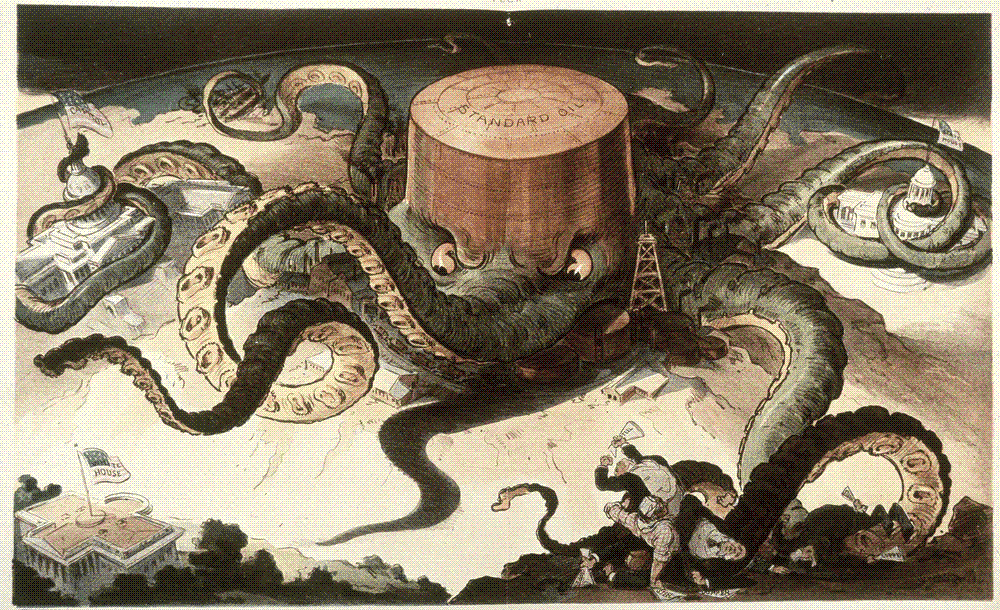
William Hogarth, 'Emblematical Print on the South Sea Scheme,' engraving, 1721; Wikimedia Commons → 'Next!' — the Standard Oil octopus and the anatomy of monopoly Keppler draws the Standard Oil combine as a bloated octopus, its tentacles already coiled around the steel, copper and shipping industries and around a state capitol and the U.S. Capitol, with one arm stretching hungrily toward the White House. It is the definitive image of a single commercial colossus outgrowing the marketplace and reaching for the machinery of government itself.
Udo J. Keppler, 'Next!', chromolithograph, Puck, 7 September 1904; Library of Congress, Prints & Photographs Division →