AP
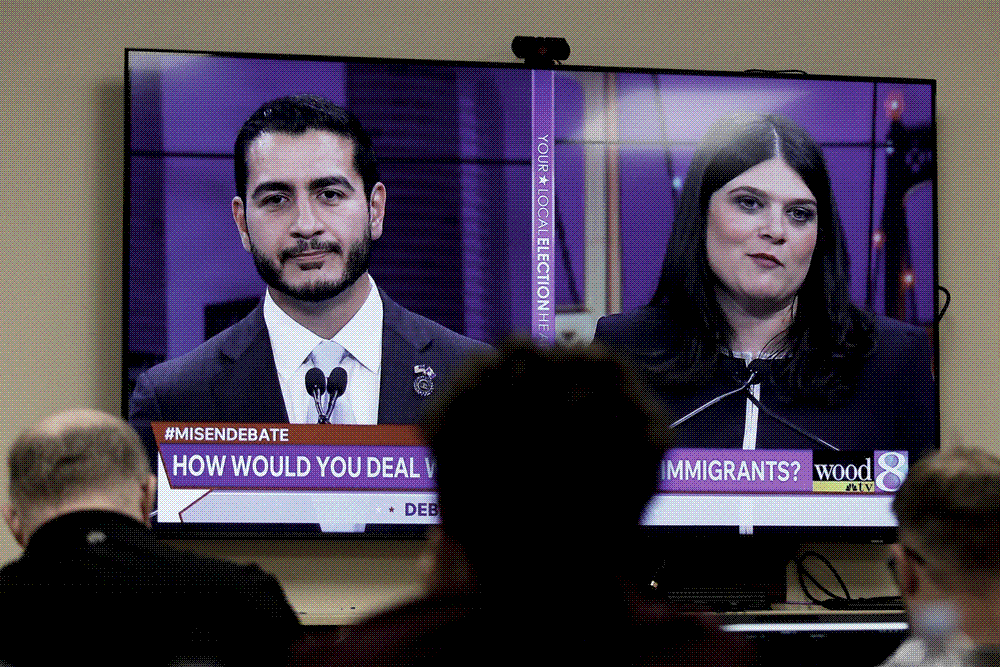
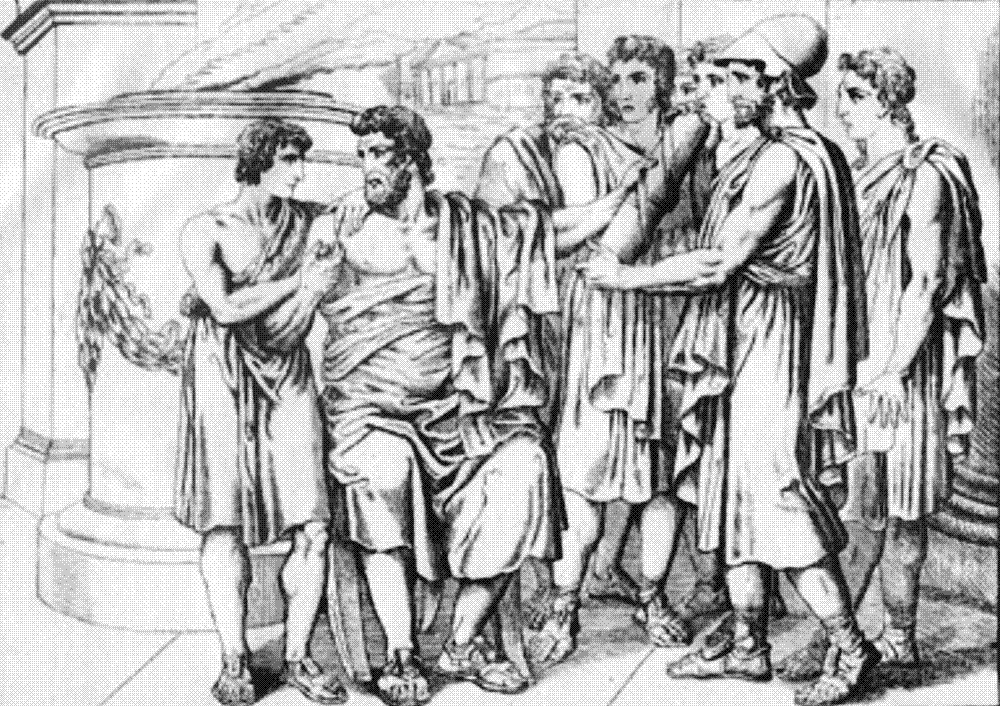
Politics AP · AP · Aug 4, 2026 Voters in five states hold primaries on 4 August, with Michigan's Democratic Senate contest the clearest test yet of the party's direction Michigan Democrats choose between Abdul El-Sayed, backed by Senator Bernie Sanders, and four-term Representative Haley Stevens, backed by Senate Democratic leader Chuck Schumer, for the seat left open by the retiring Gary Peters; the winner faces Republican Mike Rogers. Michigan voters are also picking nominees to succeed term-limited Governor Gretchen Whitmer. Kansas, Missouri, Virginia and Washington state are settling primaries too, including a bitter Democratic House rematch in Missouri. Analogies Sparta chose its elders by measuring the shouting An assembly of the people having been convened, chosen men were shut up in a room near by so that they could neither see nor be seen, but only hear the shouts of the assembly. For as in other matters, so here, the cries of the assembly decided between the competitors. These did not appear in a body, but each one was introduced separately, as the lot fell, and passed silently through the assembly. ... Whoever was greeted with the most and loudest shouting, him they declared elected.
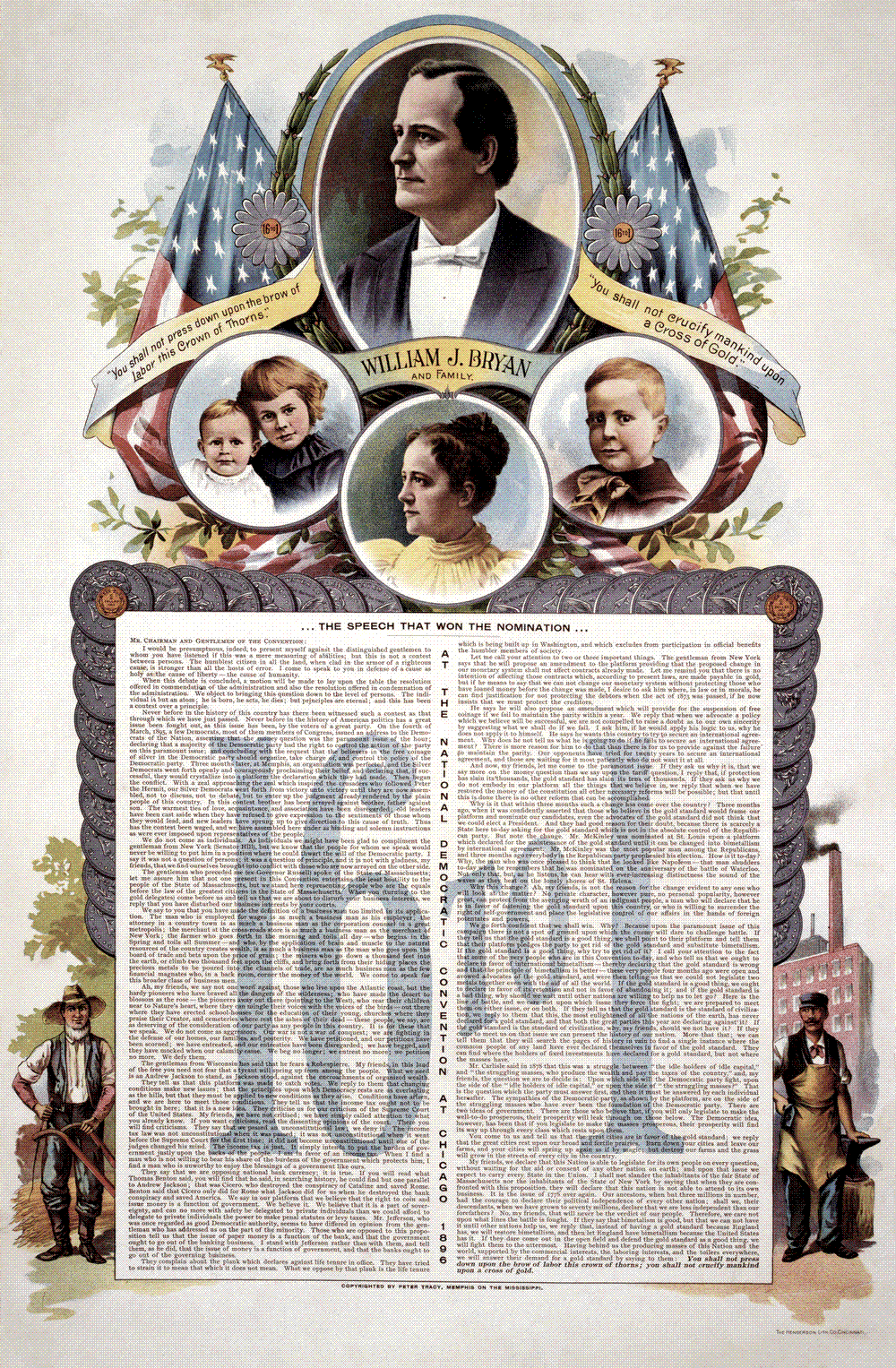
Plutarch, Life of Lycurgus, ch. 26 (c. AD 100), in Plutarch's Lives, with an English translation by Bernadotte Perrin, Cambridge, MA: Harvard University Press / London: William Heinemann, 1914; hosted by the Perseus Digital Library, Tufts University. → 1896: an insurgent faction declares it will take charge of the party On the fourth of March, 1895, a few Democrats, most of them members of Congress, issued an address to the Democrats of the nation, asserting that the money question was the paramount issue of the hour; declaring that a majority of the Democratic party had the right to control the action of the party on this paramount issue; and concluding with the request that the believers in the free coinage of silver in the Democratic party should organize, take charge of, and control the policy of the Democratic party.
William Jennings Bryan, "Cross of Gold" speech concluding debate on the Chicago Platform at the Democratic National Convention, Chicago, 9 July 1896; transcription hosted by Wikisource. → Coriolanus begs for the voices he despises, because custom calls him to it Most sweet voices! Better it is to die, better to starve, Than crave the hire which first we do deserve. Why in this wolvish toge should I stand here To beg of Hob and Dick that does appear Their needless vouches? Custom calls me to’t. What custom wills, in all things should we do’t? ... Here come more voices. Your voices! For your voices I have fought; Watched for your voices; for your voices bear Of wounds two dozen odd.
William Shakespeare, The Tragedy of Coriolanus (c. 1608), Act II, scene iii; Project Gutenberg eBook #1535, prepared by the PG Shakespeare Team. → Mr Pickwick's rule for a town split in two: shout with the largest ‘Slumkey for ever!’ roared the honest and independent. ‘Slumkey for ever!’ echoed Mr. Pickwick, taking off his hat. ‘No Fizkin!’ roared the crowd. ‘Certainly not!’ shouted Mr. Pickwick. ... ‘Who is Slumkey?’ whispered Mr. Tupman. ‘I don’t know,’ replied Mr. Pickwick, in the same tone. ‘Hush. Don’t ask any questions. It’s always best on these occasions to do what the mob do.’ ‘But suppose there are two mobs?’ suggested Mr. Snodgrass. ‘Shout with the largest,’ replied Mr. Pickwick.
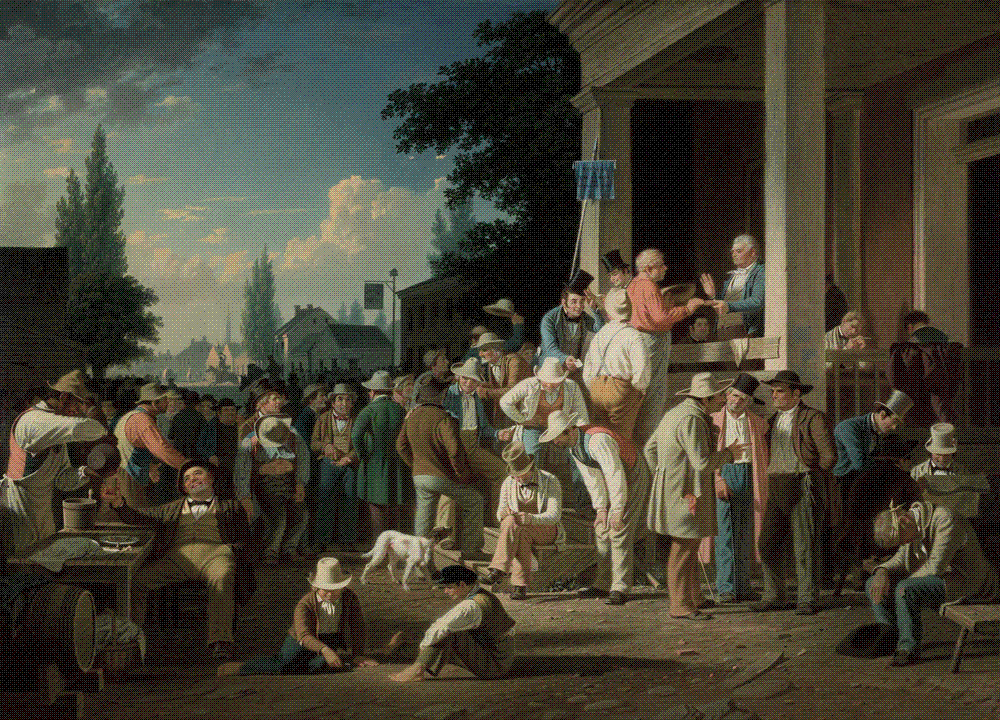
Charles Dickens, The Posthumous Papers of the Pickwick Club, ch. XIII, "Some Account of Eatanswill; of the State of Parties therein; and of the Election of a Member to serve in Parliament for that ancient, loyal, and patriotic Borough" (serialised 1836–37); Project Gutenberg eBook #580. → Bingham puts the whole apparatus of a party contest on one courthouse step Bingham, a Whig who had himself lost a Missouri legislative seat and then won it back, crowds more than a hundred men onto a single courthouse portico. At the top of the steps a voter swears his oath with his hand raised before the seated judge while the candidate in the blue coat doffs his hat behind him; below, a party worker in a top hat presses a ticket into a wavering elector's fingers. Cider barrel and punch bowl do their own canvassing at the left, one citizen too drunk to stand is hauled up to vote, and another nurses a head bloodied in a brawl. Hung from the portico, a pale blue banner carries the painting's deadpan caption: The Will of the People the Supreme Law. In the dust in front, two boys play, entirely indifferent.
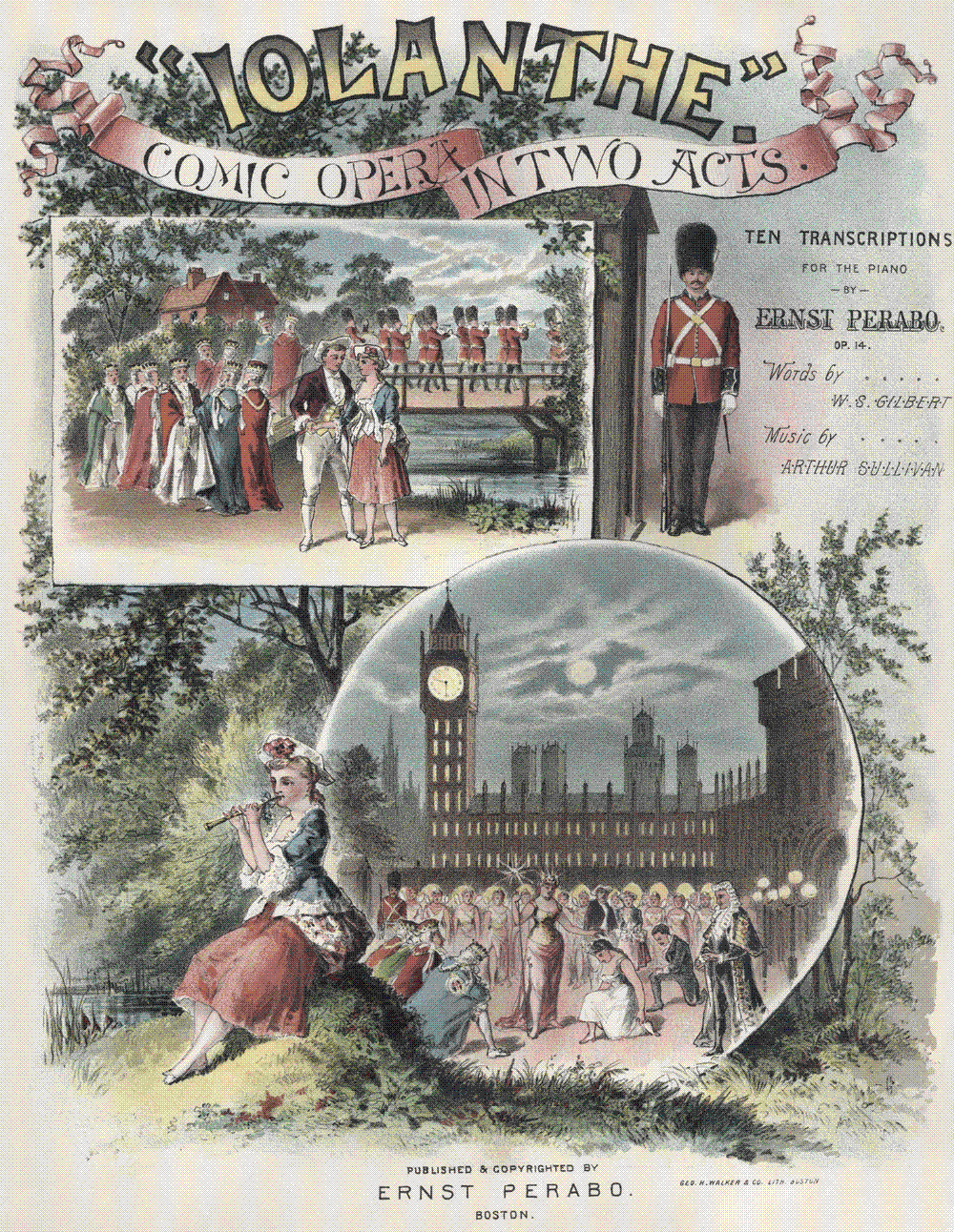
George Caleb Bingham (American, 1811–1879), The County Election, 1852, oil on canvas, 38 x 52 in. (96.5 x 132.1 cm), Saint Louis Art Museum, object number 44:2001, Gift of Bank of America; museum object page at slam.org. → Sullivan sets the joke to music: born a little Liberal or a little Conservative I often think it's comical—Fal, lal, la! How Nature always does contrive—Fal, lal, la! That every boy and every gal, That's born into the world alive, Is either a little Liberal, Or else a little Conservative! Fal, lal, la! When in that house M.P.s divide, If they've a brain and cerebellum, too, They've got to leave that brain outside, And vote just as their leaders tell 'em to.
Arthur Sullivan (music) and W. S. Gilbert (words), Iolanthe; or, The Peer and the Peri, comic opera in two acts, first performed at the Savoy Theatre, London, 25 November 1882; Act II, Private Willis's song "When all night long a chap remains." Full score, vocal score and parts at IMSLP / Petrucci Music Library (linked); the sung text quoted here is verified against the Wikisource transcription of the libretto at https://en.wikisource.org/wiki/Iolanthe/Act_II. →