Wikimedia Commons
Myanmar's military releases photos of detained former leader Aung San Suu Kyi meeting a Red Cross official, her first confirmed outside contact in about two and a half years Myanmar's military government released photographs showing Aung San Suu Kyi, 81, meeting an official of the International Committee of the Red Cross, her first confirmed contact with the outside world since early 2024. The Nobel laureate has been held largely incommunicado since the 2021 coup and is serving decades-long prison sentences. Rights groups have repeatedly demanded proof of her wellbeing. Analogies Boethius awaiting execution in his cell 'Ah! why,' I cried, 'mistress of all excellence, hast thou come down from on high, and entered the solitude of this my exile? Is it that thou, too, even as I, mayst be persecuted with false accusations?'
'Could I desert thee, child,' said she, 'and not lighten the burden which thou hast taken upon thee through the hatred of my name, by sharing this trouble?'
Boethius, The Consolation of Philosophy, written c. 524 AD while imprisoned at Pavia awaiting execution; translated into English prose and verse by H. R. James (1897). Project Gutenberg eBook #14328. → The Red Cross reaches Mandela on Robben Island Like the ICRC photograph now released from Myanmar, the Red Cross visits to apartheid South Africa's political prisoners were often the sole confirmed channel between a detained leader and the outside world. From 1967 to 1986, ICRC delegates saw Nelson Mandela repeatedly, first on Robben Island and later at Pollsmoor, pressing for humane conditions and carrying word of his condition beyond the prison walls when the state kept him otherwise cut off. Their reports made an isolated, incommunicado prisoner visible again, echoing exactly the role a Red Cross official plays for Aung San Suu Kyi.
International Committee of the Red Cross, 'A tribute to Nelson Mandela' (ICRC official record of its 1967-1986 prison visits). → Lovelace: stone walls do not a prison make Stone walls doe not a prison make,
Nor iron bars a cage;
Mindes innocent and quiet take
That for an hermitage;
If I have freedome in my love,
And in my soule am free,
Angels alone that sore above
Enjoy such liberty.
Richard Lovelace, 'To Althea, from Prison' (written 1642 during his imprisonment; published in Lucasta, 1649). Wikisource. → Wilde's prisoner and the tent of blue I never saw a man who looked
With such a wistful eye
Upon that little tent of blue
Which prisoners call the sky,
And at every drifting cloud that went
With sails of silver by.
Oscar Wilde, 'The Ballad of Reading Gaol' (1898), written after his own imprisonment. Project Gutenberg eBook #301. → Van Gogh: the prisoners' round Painted in 1890 while Van Gogh was himself confined at the asylum in Saint-Remy, 'Prisoners Exercising' shows inmates trudging in an endless circle at the bottom of a sheer, blue-walled shaft, hemmed in on every side with no sky in view. The tiny, bowed figures and the crushing verticality of the walls make visible the years of enforced isolation behind Aung San Suu Kyi's detention, and the single upturned face suggests the smallest gesture toward the outside world.
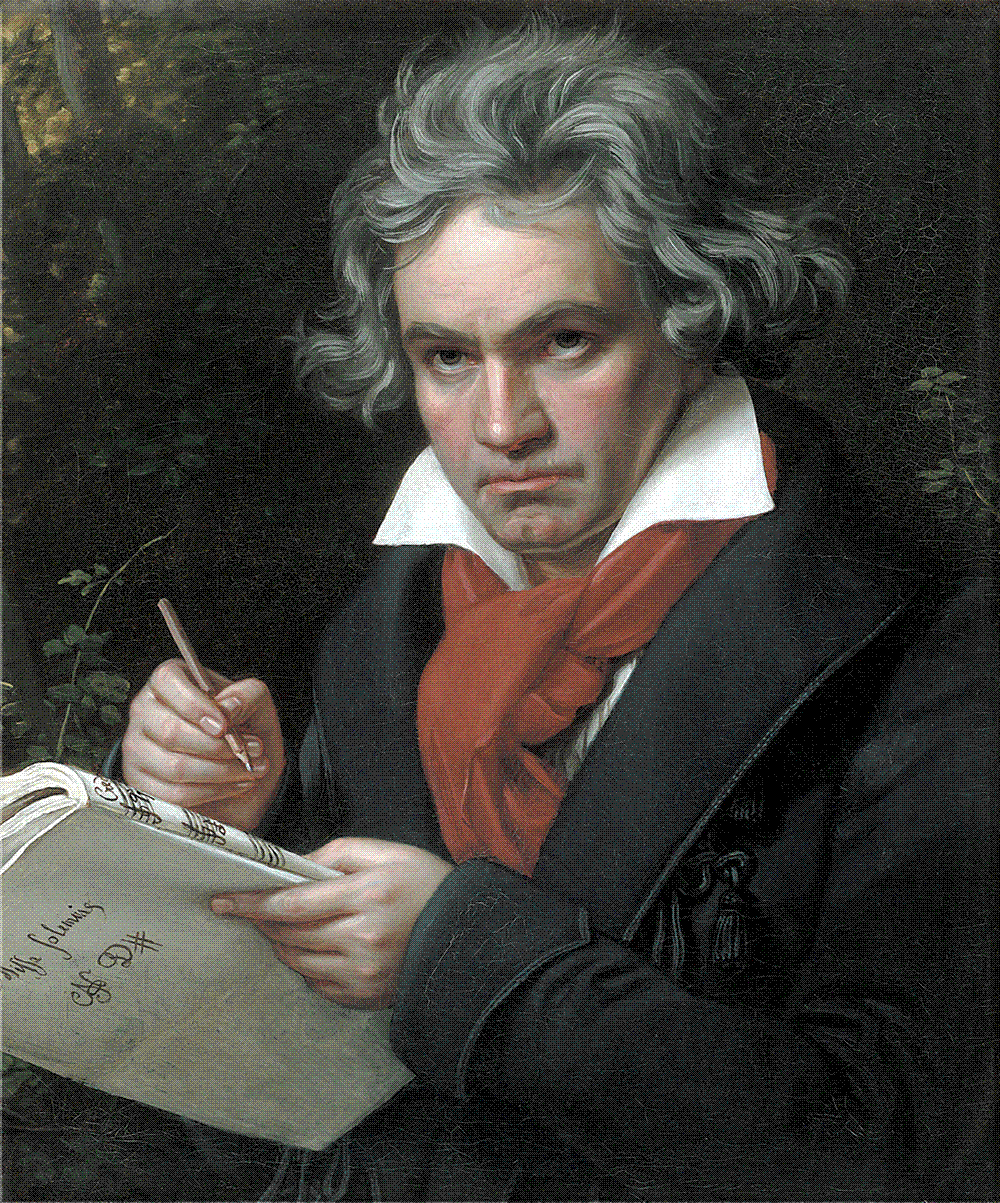
Vincent van Gogh, Prisoners Exercising (Prisoners' Round, after Gustave Dore), 1890, oil on canvas, Pushkin Museum of Fine Arts, Moscow. → Beethoven's prisoners, briefly in the light In the Prisoners' Chorus of Beethoven's only opera, Fidelio, captives are let up from their dungeon into the open air for a single stolen moment and sing tremulously of light and freedom before being driven back below. Composed in a Vienna shadowed by tyranny, it turns a brief, monitored glimpse of the outside world into one of music's great emblems of hope for the unjustly detained, the same fragile opening the released ICRC photograph represents for Aung San Suu Kyi.
Ludwig van Beethoven, Fidelio, Op. 72 (1805, rev. 1814); Prisoners' Chorus, 'O welche Lust'. Full scores at IMSLP. Portrait: Joseph Karl Stieler, 1820, Beethoven-Haus, Bonn. →