Wikimedia Commons
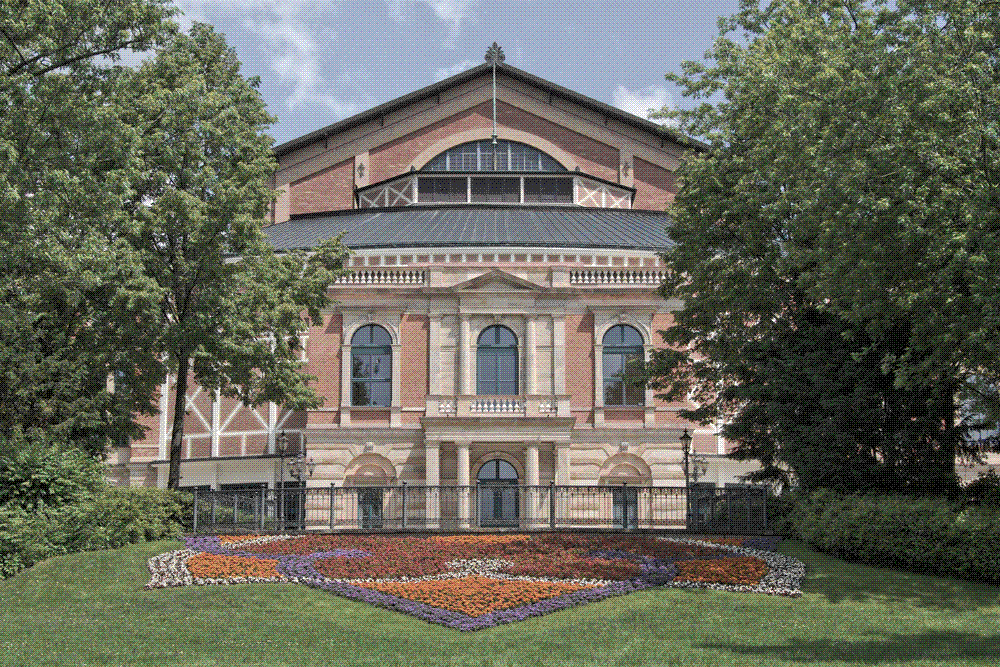
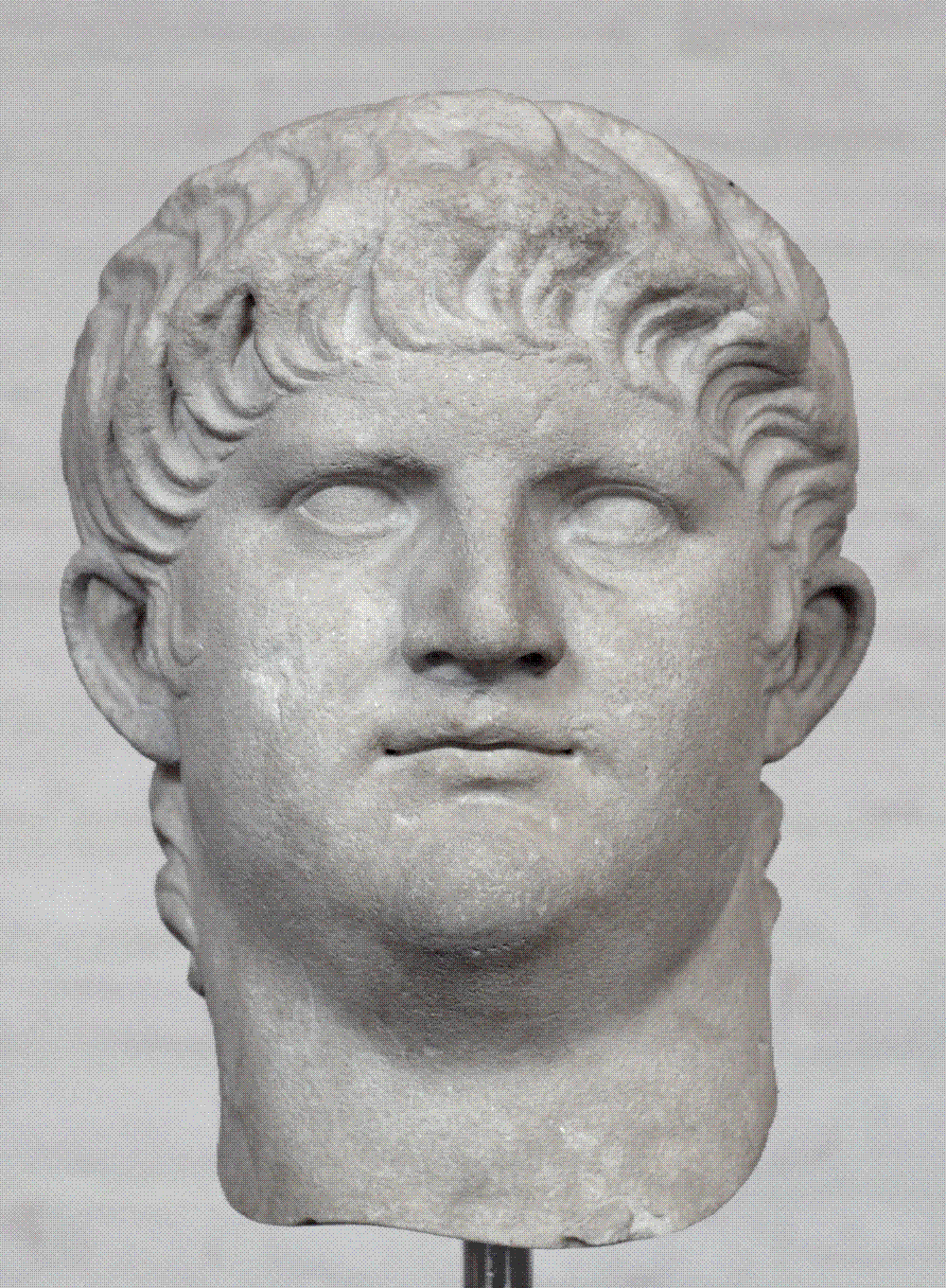
An artificial-intelligence staging of Wagner's Ring draws boos at the Bayreuth Festival's 150th anniversary The production, titled '10010110' - 150 written in binary - and subtitled 'From Myth to Code', combined about a dozen AI models and used Stable Diffusion to generate imagery from the 1876 designs of Gotthold and Max Bruckner, then to select images to match the text and the music. Singers stood, often motionless, between two screens measuring 20 by 60 metres, across 14 and a half hours over four nights. The conductor Christian Thielemann and the cast drew a 17-minute ovation, but roughly 30 seconds of boos and whistles greeted the production team at their bows. Analogies In AD 66-67 the emperor Nero sang in the theatres of Greece with the doors barred, and no one in the audience was allowed to leave until he had finished While he was singing no one was allowed to leave the theatre even for the most urgent reasons. And so it is said that some women gave birth to children there, while many who were worn out with listening and applauding, secretly leaped from the wall, since the gates at the entrance were closed, or feigned death and were carried out as if for burial. The trepidation and anxiety with which he took part in the contests, his keen rivalry of his opponents and his awe of the judges, can hardly be credited.
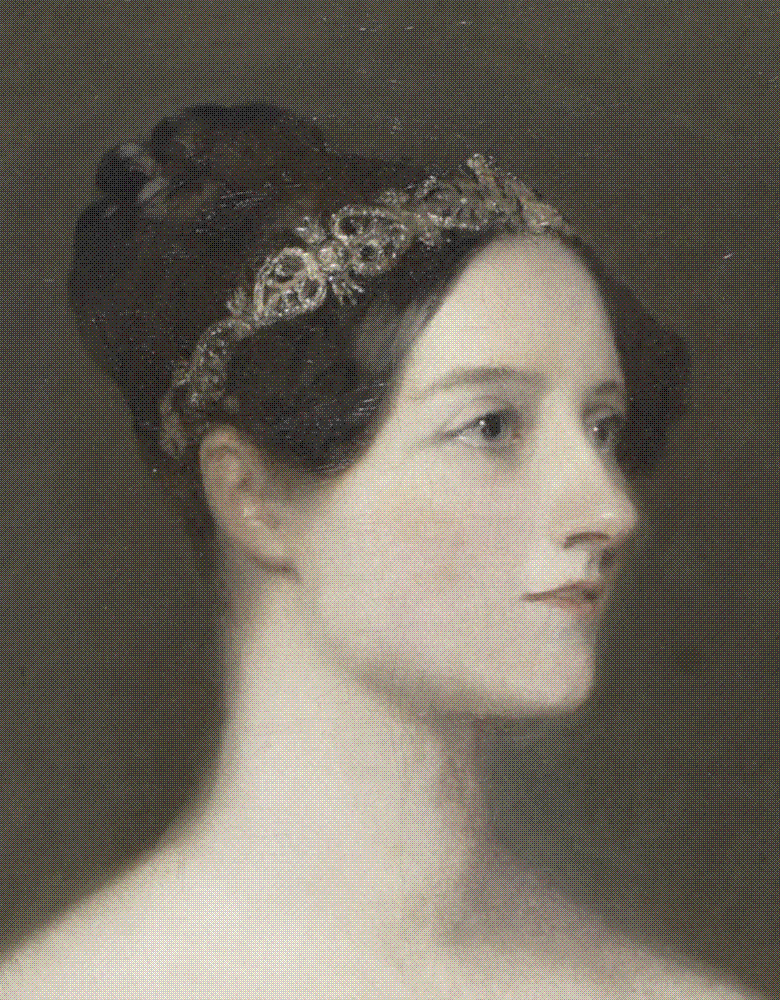
Gaius Suetonius Tranquillus, The Lives of the Twelve Caesars, "Nero", chapter 23, translated by J. C. Rolfe (Loeb Classical Library, London: William Heinemann / New York: Macmillan, 1914); transcription hosted by Wikisource. → In 1843 Ada Lovelace published the first prediction that a machine, Babbage's Analytical Engine, might compose music of any degree of complexity Again, it might act upon other things besides number, were objects found whose mutual fundamental relations could be expressed by those of the abstract science of operations, and which should be also susceptible of adaptations to the action of the operating notation and mechanism of the engine. Supposing, for instance, that the fundamental relations of pitched sounds in the science of harmony and of musical composition were susceptible of such expression and adaptations, the engine might compose elaborate and scientific pieces of music of any degree of complexity or extent.
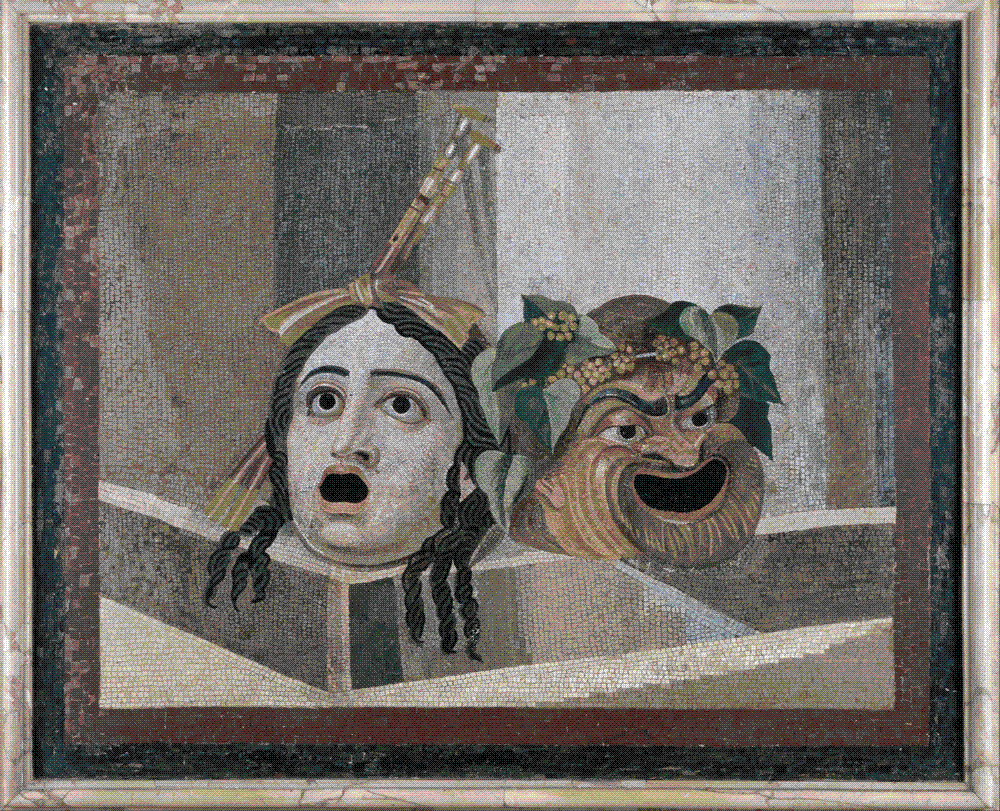
Augusta Ada Lovelace, "Notes by the Translator", Note A, appended to L. F. Menabrea, "Sketch of the Analytical Engine invented by Charles Babbage, Esq.", in Scientific Memoirs, Selected from the Transactions of Foreign Academies of Science and Learned Societies, vol. 3 (London: Richard and John E. Taylor, 1843), pp. 666-731; transcription hosted by Wikisource. → Aristotle's Poetics ranks spectacle last among the parts of tragedy and hands it to the costumier rather than the poet Of the other elements which "enrich" tragedy the most important is song-making. Spectacle, while highly effective, is yet quite foreign to the art and has nothing to do with poetry. Indeed the effect of tragedy does not depend on its performance by actors, and, moreover, for achieving the spectacular effects the art of the costumier is more authoritative than that of the poet.
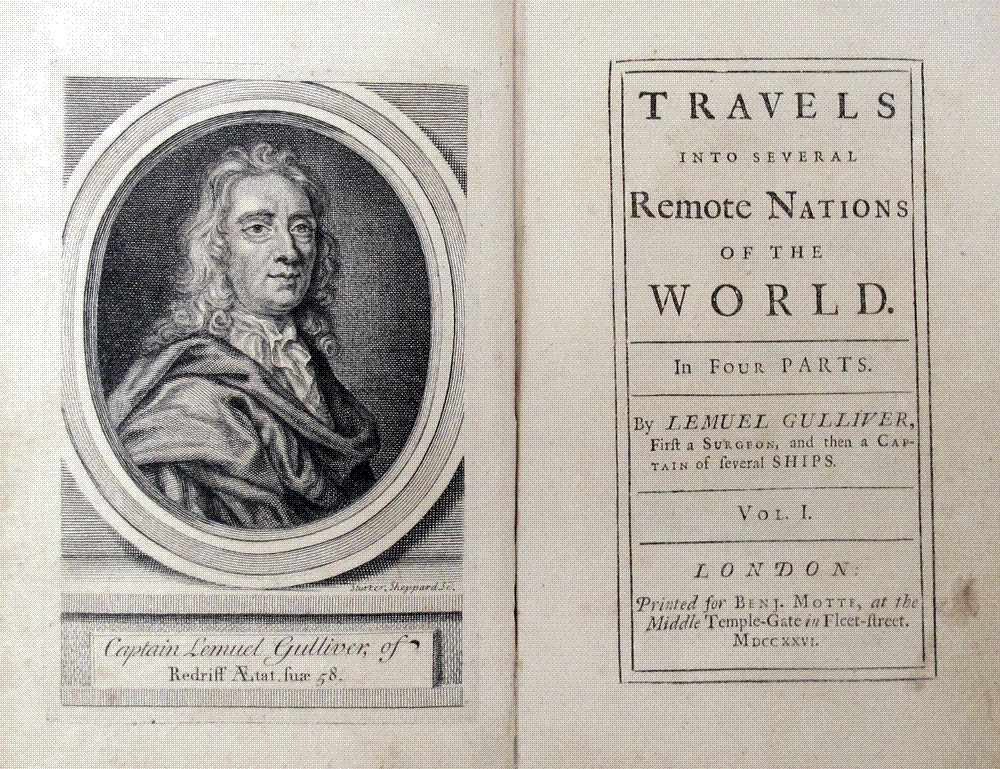
Aristotle, Poetics 1450b, in Aristotle in 23 Volumes, vol. 23, translated by W. H. Fyfe (Cambridge, MA: Harvard University Press; London: William Heinemann, 1932); Perseus Digital Library, Tufts University. → The Engine of Lagado in Swift's Gulliver's Travels (1726) writes books by mechanically recombining every word in the language Every one knew how laborious the usual method is of attaining to arts and sciences; whereas, by his contrivance, the most ignorant person, at a reasonable charge, and with a little bodily labour, might write books in philosophy, poetry, politics, laws, mathematics, and theology, without the least assistance from genius or study.” He then led me to the frame, about the sides, whereof all his pupils stood in ranks. It was twenty feet square, placed in the middle of the room. The superficies was composed of several bits of wood, about the bigness of a die, but some larger than others. They were all linked together by slender wires.
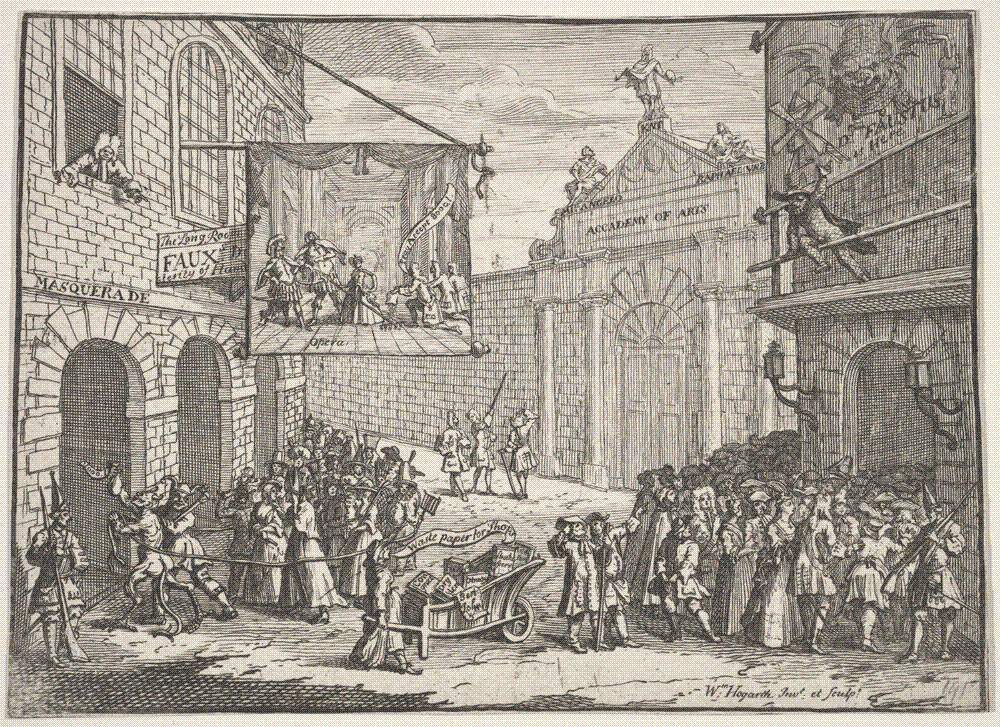
Jonathan Swift, Travels into Several Remote Nations of the World (Gulliver's Travels), Part III, "A Voyage to Laputa, Balnibarbi, Luggnagg, Glubbdubdrib, and Japan", chapter 5 (London: Benjamin Motte, 1726); Project Gutenberg eBook no. 829. → William Hogarth's print Masquerades and Operas (1724) shows Shakespeare and Congreve wheeled away as waste paper while London crowds into opera and pantomime Hogarth's first independently published satire stages the quarrel between spectacle and drama as a street scene. On the left a fool and a devil drag a rope of masqueraders into the Haymarket opera house, where a banner reading "Pray Accept 8000l." hangs over a platform of Italian singers; on the right a crowd presses in to see the pantomime Doctor Faustus. Between them a small figure trundles a wheelbarrow labelled "Waste paper for shops", loaded with the bound volumes of Congreve, Dryden, Otway, Shakespeare and Ben Jonson, while Lord Burlington's new "Accademy of Arts" rises behind with William Kent enthroned on the pediment above Michelangelo and Raphael.
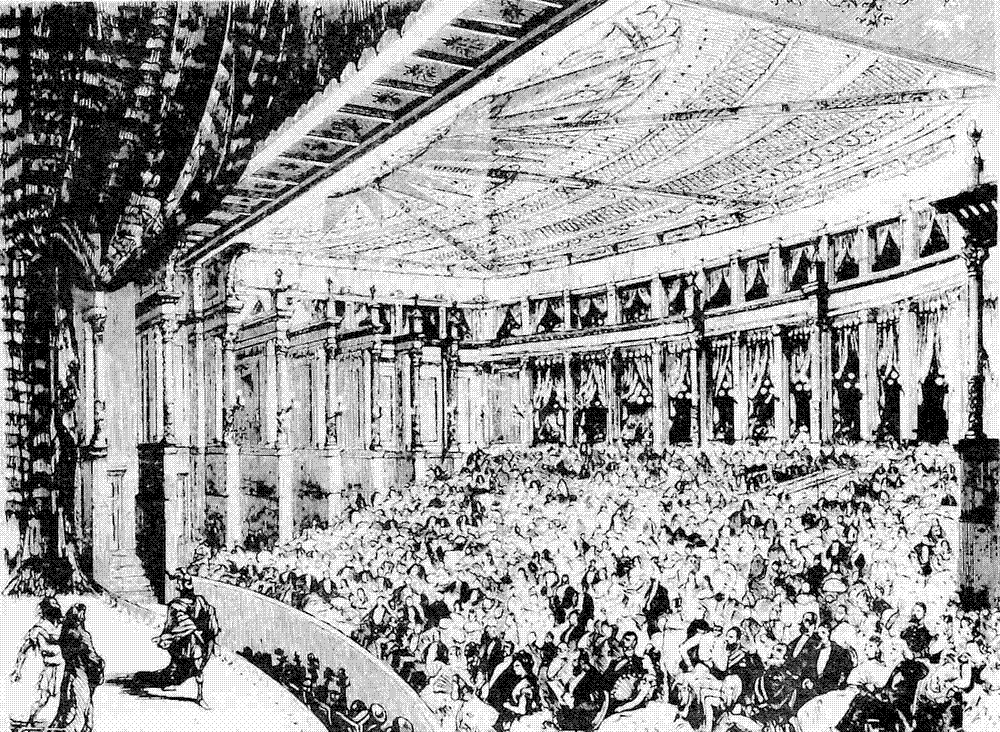
William Hogarth, Masquerades and Operas, 1724, etching and engraving, second state of three, sheet 12.5 x 17.5 cm, accession no. 32.35(80), Harris Brisbane Dick Fund, 1932, Department of Drawings and Prints, The Metropolitan Museum of Art, New York. → Wagner's own first complete Ring, at the opening of the Bayreuth Festspielhaus in August 1876, was acclaimed as music and derided as scenery The four dramas of Der Ring des Nibelungen were given complete for the first time at Bayreuth between 13 and 17 August 1876, in a theatre Wagner had built for that single purpose, with the orchestra sunk out of sight beneath the stage. The music and the players carried the occasion; the scenery did not. The swimming machines that carried the Rhinemaidens, the steam that failed to hide the scene changes and the papier-mache dragon Fafner, whose neck had gone astray in transit, were mocked by visiting critics, and Wagner is reported to have told his singers afterwards that next year everything would be done differently. The painted illusion the festival was built on became, almost immediately, the part of it that its own creator wanted to disown.
Richard Wagner, Das Rheingold, WWV 86A, first part of Der Ring des Nibelungen; first-edition full score (Mainz: B. Schott's Sohne, 1873), first complete cycle performed at the Bayreuth Festspielhaus, 13-17 August 1876; International Music Score Library Project / Petrucci Music Library. →