Wikimedia Commons
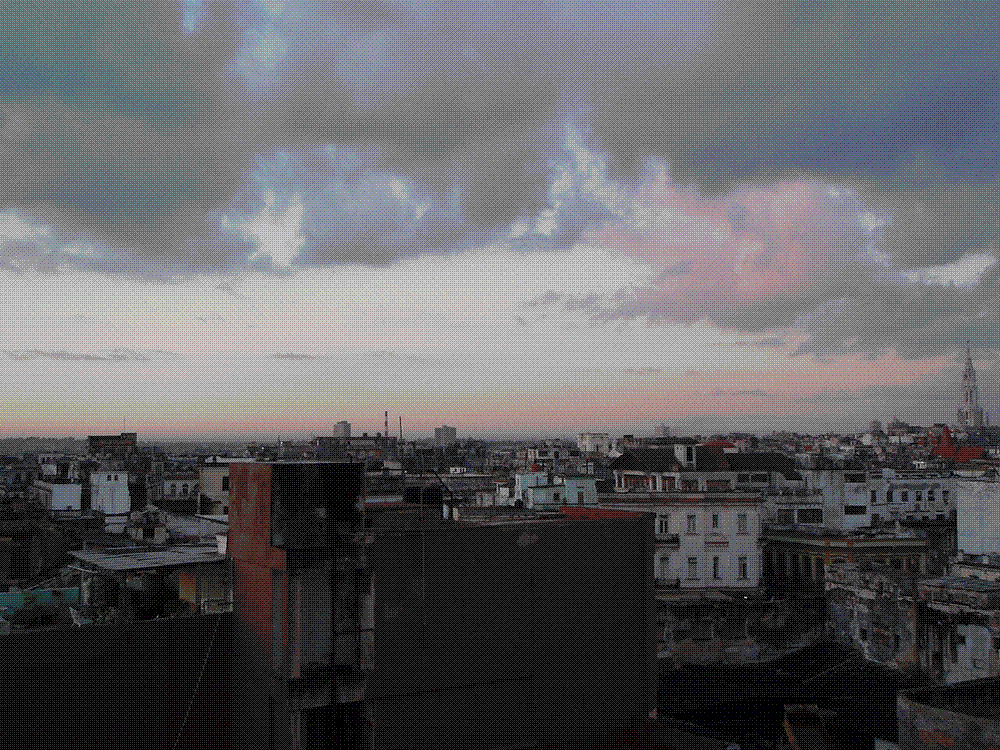
Cuba's national electricity grid collapses, plunging the island's roughly 10 million people into darkness in the country's sixth nationwide blackout of 2026 Cuba's National Electric System disconnected entirely at about 10:43 p.m. on Sunday, the state Electric Union said, cutting power across the island of some 10 million people for the sixth time this year. The grid has repeatedly failed in 2026 amid chronic shortages of fuel and spare parts and breakdowns at thermoelectric plants, some more than 30 years old. Havana has struggled to import fuel since the loss of its main ally, Venezuela, and amid renewed US pressure. Analogies A Darkness Like a Sealed Room We had scarcely sat down when night was upon us,—not such as we have when there is no moon, or when the sky is cloudy, but such as there is in some closed room when the lights are extinguished. You might hear the shrieks of women, the monotonous wailing of children, the shouts of men.
Pliny the Younger, Letters, Book VI (second letter to Cornelius Tacitus on the eruption of Vesuvius, AD 79), English translation, in 'Pliny's Letters,' Chapter 2. Wikisource. → The Dark Day of 1780 We were here at the time the 'dark day' happened, (19th of May;) it has been said that the darkness was not so great in New-Jersey as in New-England. How great it was there I do not know, but I know that it was very dark where I then was in New-Jersey; so much so that the fowls went to their roosts, the cocks crew and the whip-poor-wills sung their usual serenade; the people had to light candles in their houses to enable them to see to carry on their usual business; the night was as uncommonly dark as the day was.
Joseph Plumb Martin, The Adventures of a Revolutionary Soldier (A Narrative of Some of the Adventures, Dangers and Sufferings of a Revolutionary Soldier, 1830), Chapter VI. Wikisource. → The Bright Sun Was Extinguished I had a dream, which was not all a dream.
The bright sun was extinguished, and the stars
Did wander darkling in the eternal space,
Rayless, and pathless, and the icy Earth
Swung blind and blackening in the moonless air;
Morn came and went—and came, and brought no day,
And men forgot their passions in the dread
Of this their desolation; and all hearts
Were chilled into a selfish prayer for light:
And they did live by watchfires—and the thrones,
The palaces of crownéd kings—the huts,
The habitations of all things which dwell,
Lord Byron, 'Darkness' (1816), in The Works of Lord Byron, Vol. IV. Project Gutenberg eBook No. 20158. → Darkness Which May Be Felt And the LORD said unto Moses, Stretch out thine hand toward heaven, that there may be darkness over the land of Egypt, even darkness which may be felt. And Moses stretched forth his hand toward heaven; and there was a thick darkness in all the land of Egypt three days: They saw not one another, neither rose any from his place for three days: but all the children of Israel had light in their dwellings.
The Holy Bible, King James Version, Exodus 10:21–23. Wikisource. → Nocturne on a Darkened River Whistler drains a great city at night down to a few strokes of blue-black and faint gold: the pier of Old Battersea Bridge looms as a silhouette over a Thames barely distinguishable from the sky, with only distant sparks of light to mark that a metropolis is there at all. The painting turns a darkened urban waterfront into something hushed and near-formless, an apt mirror for an island whose skyline vanishes when the grid fails.
James McNeill Whistler, Nocturne: Blue and Gold – Old Battersea Bridge (c. 1872–1875), oil on canvas, Tate Britain, London. Public domain via Wikimedia Commons. → The Representation of Chaos Haydn opens The Creation with 'The Representation of Chaos,' an orchestral prelude that refuses to settle: dissonances, drifting harmonies and unresolved phrases evoke a formless, lightless void before order exists—until the chorus finally erupts on the words 'and there was Light.' It is a portrait of the moment before power returns, the exact suspension a darkened nation lives through waiting for the current to come back. The composer is shown here in Thomas Hardy's 1791 portrait, painted during Haydn's London years.
Joseph Haydn, 'The Representation of Chaos,' opening of the oratorio The Creation (Die Schöpfung, 1798); illustrated by Thomas Hardy's portrait of Haydn (1791), Royal College of Music. Public domain via Wikimedia Commons. →