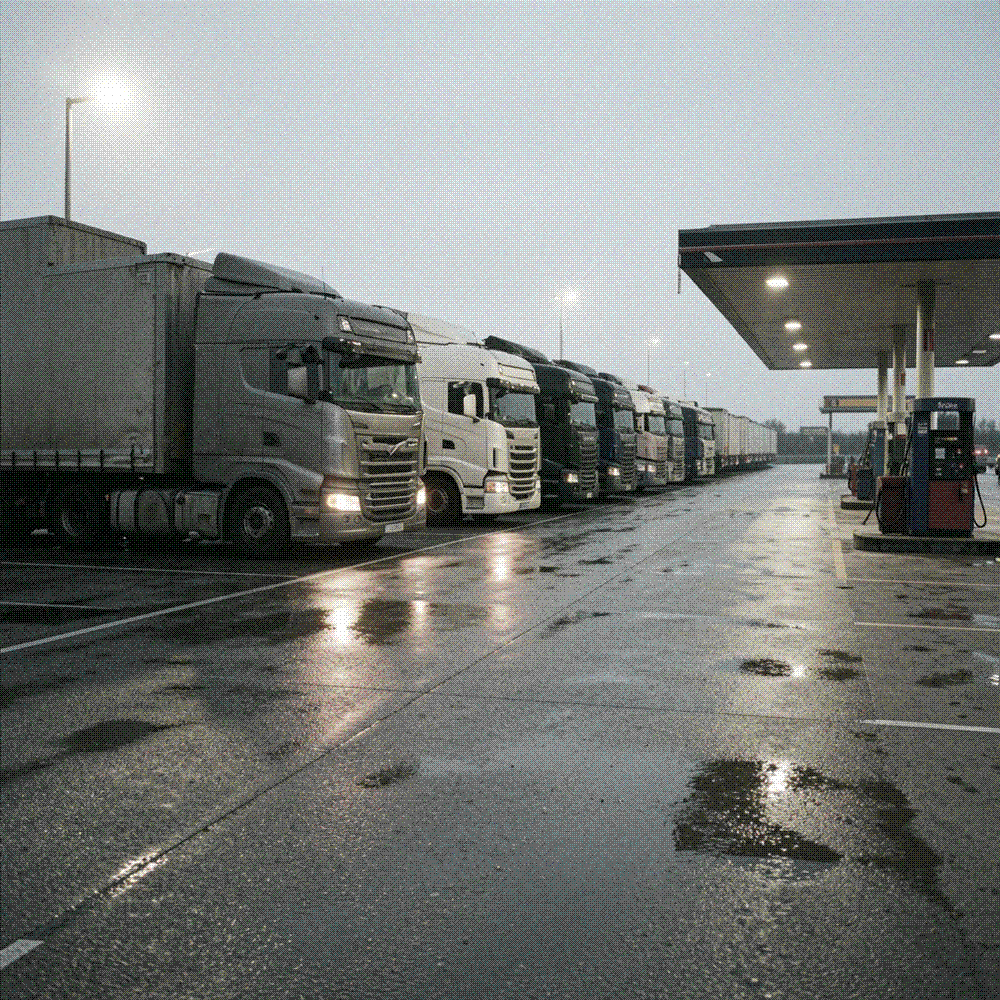
Heavy lorries parked on wet tarmac at an empty service area before dawn, fuel pumps under a lit canopy to one side

AI-generated

EconomyBBC · AP · ReutersSep 24, 2026

Record diesel prices squeeze hauliers on both sides of the Atlantic as Washington argues over an export ban

British pump prices reached their highest since 2022, pushed up by the war in the Middle East, and the businesses that feel it first said so: tow-truck operators, taxi drivers and small hauliers whose margins are the fuel bill. In the United States the same rise had become political. Diesel at record levels rattled Republicans with midterm elections approaching; reports said the administration had prepared a plan for a 90-day ban on diesel exports; diesel futures fell on the report; the White House denied the plan and the energy secretary, Chris Wright, said a ban would not work. Trump then said he would support one anyway. By Thursday Wright was asking refiners directly for help holding prices down, with analysts pointing out that the options available to any American administration — releasing reserves, leaning on refiners, restricting exports — are small against a war that has disrupted the flow through the Strait of Hormuz, and that the last of them tends to raise prices elsewhere and eventually at home.
Analogies

November 1973: with the embargo on, a US president promises independence from foreign energy inside seven years

Let us set as our national goal, in the spirit of Apollo, with the determination of the Manhattan Project, that by the end of this decade we will have developed the potential to meet our own energy needs without depending on any foreign energy sources.
Richard Nixon, 'Address to the Nation About Policies To Deal With the Energy Shortages', 7 November 1973; American Presidency Project, University of California, Santa Barbara. →
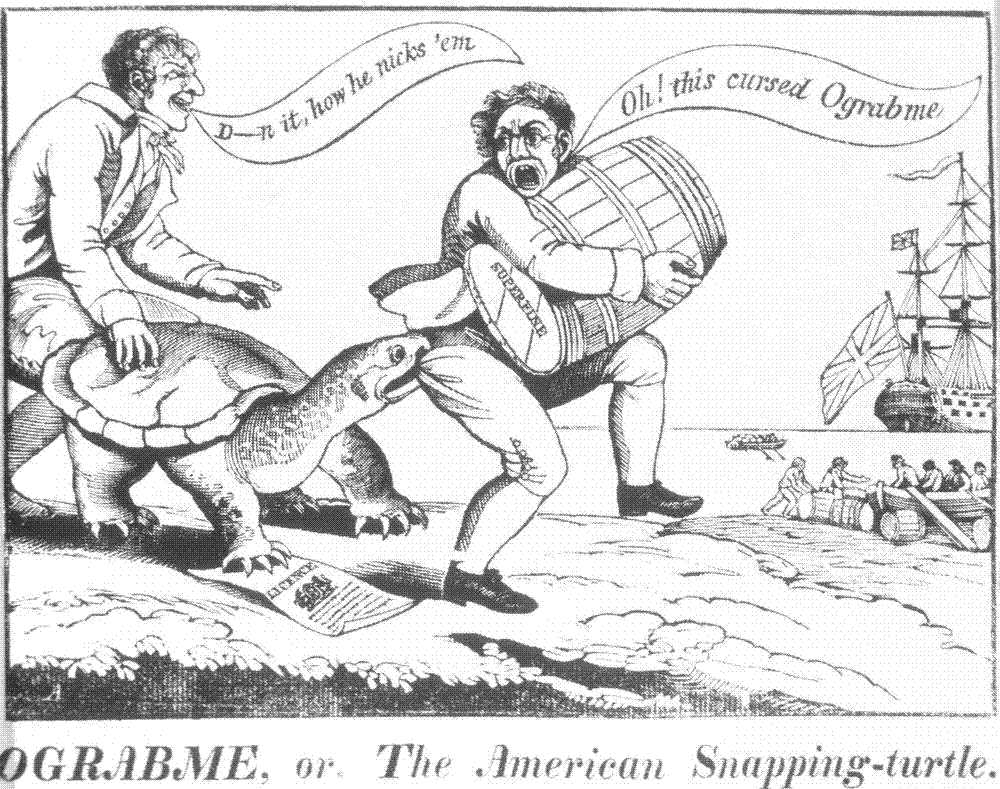
The 1807 American cartoon 'Ograbme', showing a snapping turtle seizing a smuggler by the trousers

Jefferson's embargo of 1807 shows what happens when a government tries to control trade by stopping its own ships

and that no clearance be furnished to any ship or vessel bound to such foreign port or place, except vessels under the immediate direction of the President of the United States
An Act laying an Embargo on all ships and vessels in the ports and harbours of the United States, 22 December 1807, 2 Stat. 451; United States Statutes at Large, vol. 2, 10th Congress, 1st session, ch. 5. →
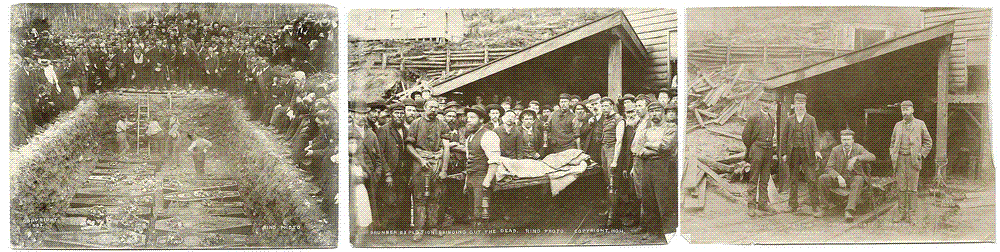
A photograph of a coal mine with its winding gear and pithead buildings

Zola's 'Germinal' (1885) is about the price of the fuel and who pays it

Then his father, Nicolas Maheu, called Le Rouge, when hardly forty years of age had died in the pit, which was being excavated at that time: a landslip, a complete slide, and the rock drank his blood and swallowed his bones.
Émile Zola, Germinal, part I, ch. I, trans. Havelock Ellis (London: Lutetian Society, 1894); Project Gutenberg ebook 56528. →

Sandburg's 'Chicago' (1914) names a city by the freight it moves

Hog Butcher for the World, Tool Maker, Stacker of Wheat, Player with Railroads and the Nation's Freight Handler;
Carl Sandburg, 'Chicago', Poetry magazine, March 1914; in Chicago Poems (New York: Henry Holt, 1916). →
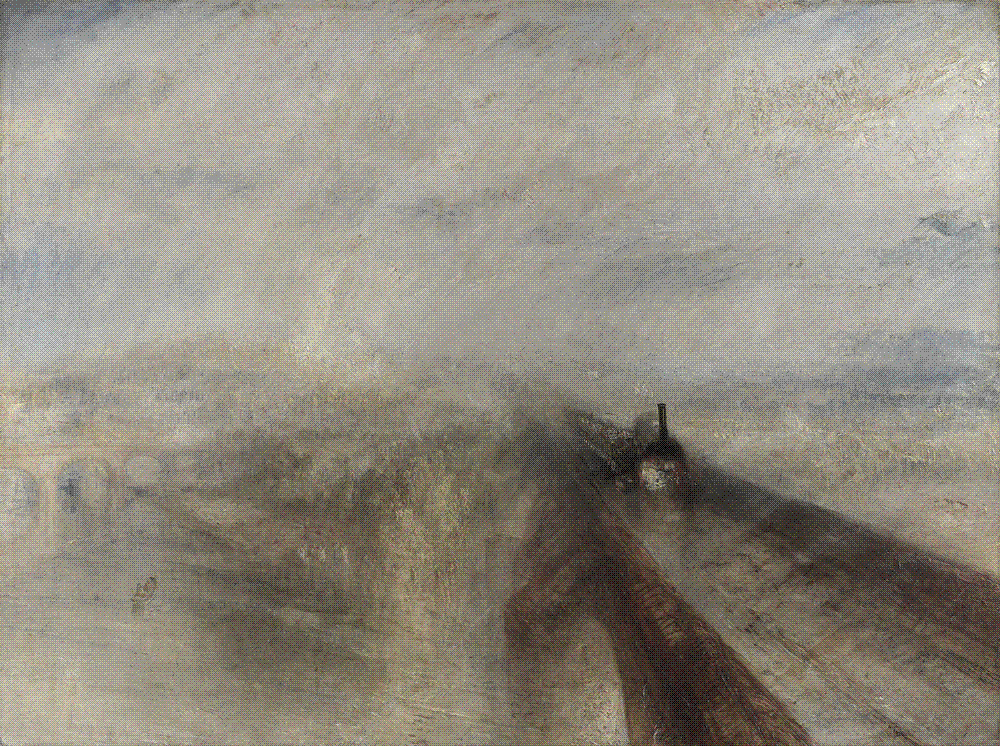
Turner's painting of a locomotive crossing a bridge through driving rain, the scene dissolved in golden light

Turner's 'Rain, Steam, and Speed' (1844) paints the first engine that ran on bought fuel and changed what distance cost

A locomotive comes head-on across Brunel's bridge at Maidenhead through driving rain, its firebox the one hard point of colour in a picture otherwise dissolved into weather. Everything Turner puts beside it — a ploughman, a hare running ahead of the train, a rowing boat on the river — belongs to the older economy the engine is about to make marginal. He exhibited it in 1844, when the railway boom was converting cheap coal into speed, and speed into money.
J. M. W. Turner, Rain, Steam, and Speed — The Great Western Railway, 1844, oil on canvas, 91 × 121.8 cm; National Gallery, London, NG538. →
Boccioni's painting of a huge red horse charging through a construction site, men straining to hold it

Boccioni's 'The City Rises' (1910) makes a whole canvas out of hauled energy

A great red draught horse surges out of the centre of the picture, dragging men off their feet, while scaffolding and half-built tenements blur behind it. Boccioni called the picture a study of work and motion; what it actually shows is a city expanding at the exact speed of the power available to move its materials — muscle straining at the moment it was about to be replaced by engines, and the whole scene painted as one continuous kinetic smear.
Umberto Boccioni, La città che sale (The City Rises), 1910, oil on canvas, 199.3 × 301 cm; Museum of Modern Art, New York. →