Wikimedia Commons
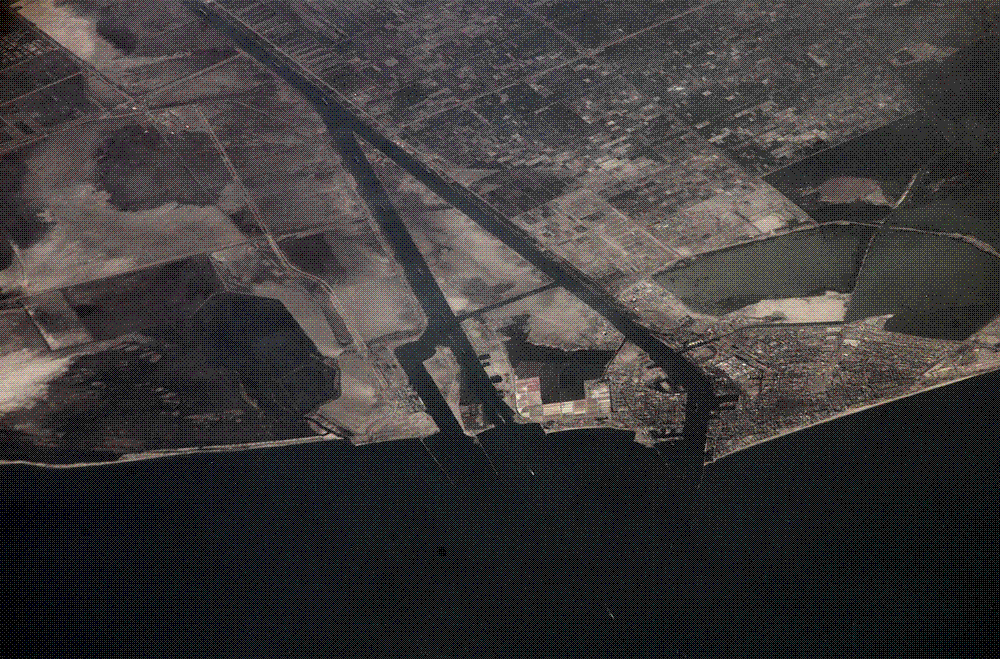
A magnitude 5.6 earthquake strikes near the northern end of the Suez Canal in Egypt, shaking Cairo, Alexandria and neighbouring countries but causing no serious damage An earthquake measured at magnitude 5.6 struck about 40 km north of Suez, near the northern mouth of the Suez Canal, shortly after 3 a.m. local time, Egypt's seismology institute said. Tremors were felt across Cairo, the Nile Delta, Alexandria and Port Said, and as far as Gaza, Jordan and Lebanon, followed by several aftershocks. Authorities reported one injury and no significant damage, and the Red Crescent activated its response plan. Analogies Thucydides on the Sea That Fled and Returned About the same time that these earthquakes were so common, the sea at Orobiae, in Euboea, retiring from the then line of coast, returned in a huge wave and invaded a great part of the town, and retreated leaving some of it still under water; so that what was once land is now sea; such of the inhabitants perishing as could not run up to the higher ground in time. A similar inundation also occurred at Atalanta, the island off the Opuntian Locrian coast, carrying away part of the Athenian fort and wrecking one of two ships which were drawn up on the beach. The cause, in my opinion, of this phenomenon must be sought in the earthquake. At the point where its shock has been the most violent, the sea is driven back and, suddenly recoiling with redoubled force, causes the inundation. Without an earthquake I do not see how such an accident could happen.
Thucydides, History of the Peloponnesian War, Book III, ch. 89 (426 BC), trans. Richard Crawley. Project Gutenberg. → Darwin Feels the Solid Earth Turn to Liquid, 1835 This day has been memorable in the annals of Valdivia, for the most severe earthquake experienced by the oldest inhabitant. I happened to be on shore, and was lying down in the wood to rest myself. It came on suddenly, and lasted two minutes, but the time appeared much longer. [...] A bad earthquake at once destroys our oldest associations: the earth, the very emblem of solidity, has moved beneath our feet like a thin crust over a fluid;—one second of time has created in the mind a strange idea of insecurity, which hours of reflection would not have produced.
Charles Darwin, Journal of Researches (The Voyage of the Beagle), ch. XVI, on the great Chilean earthquake of 20 February 1835 (1839; text of 1845 edition). Project Gutenberg. → The Ruin of Lisbon in 'Candide' Scarcely had they reached the city, lamenting the death of their benefactor, when they felt the earth tremble under their feet. The sea swelled and foamed in the harbour, and beat to pieces the vessels riding at anchor. Whirlwinds of fire and ashes covered the streets and public places; houses fell, roofs were flung upon the pavements, and the pavements were scattered. Thirty thousand inhabitants of all ages and sexes were crushed under the ruins.
Voltaire, Candide, ch. 5 (1759), on the Lisbon earthquake of 1755, English translation. Project Gutenberg. → The Sixth Seal: A Great Earthquake And I beheld when he had opened the sixth seal, and, lo, there was a great earthquake; and the sun became black as sackcloth of hair, and the moon became as blood; And the stars of heaven fell unto the earth, even as a fig tree casteth her untimely figs, when she is shaken of a mighty wind. And the heaven departed as a scroll when it is rolled together; and every mountain and island were moved out of their places.
Revelation 6:12–14, King James Version (1611). Wikisource. → Bryullov, 'The Last Day of Pompeii' Karl Bryullov floods a collapsing city with the lurid red of an erupting Vesuvius, columns toppling and statues pitching from their pedestals as families shield their heads and flee. Lightning and volcanic glare pick out mothers clutching children, a fallen woman beside her infant, and citizens frozen between terror and tenderness. It is the classic Romantic image of a proud city undone in an instant by the trembling earth.
Karl Bryullov, The Last Day of Pompeii (1830–1833), oil on canvas, State Russian Museum, St Petersburg. Public domain via Wikimedia Commons. → John Martin, 'The Destruction of Pompeii and Herculaneum' John Martin dwarfs tiny human figures beneath a vast apocalyptic panorama: a black sky split by lightning, the cone of Vesuvius spewing fire, and the twin cities engulfed in cataract of ash and molten rock. The scale is deliberately overwhelming, the people mere specks against the machinery of geological catastrophe. Martin turns a natural disaster into a sublime vision of nature's indifference to civilisation.
John Martin, The Destruction of Pompeii and Herculaneum (1822), oil on canvas, Tate, London. Public domain via Wikimedia Commons. →