BBC
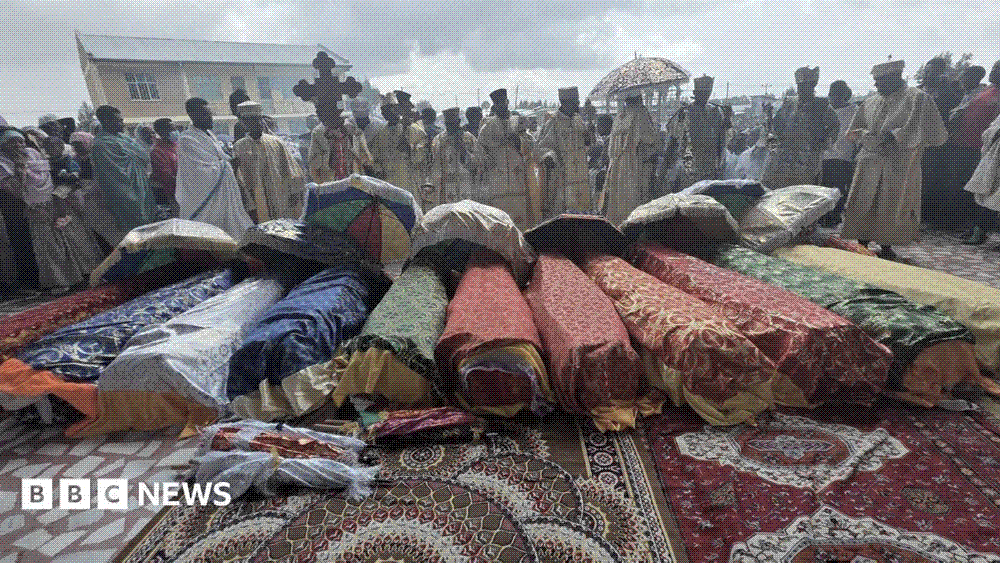
Climate BBC · AP · Aug 4, 2026 A landslide at an Ethiopian mountain monastery kills 14 worshippers during an overnight prayer service A hillside above the Tsadqane Debre Mitmaq St Mary Monastery in the northern Amhara region gave way in the early hours of Monday after a night of heavy rain, sending rock and earth onto pilgrims gathered in a prayer chamber carved into the mountainside for a holy-water healing ritual. Seven people were found injured, five of them seriously, and the search for others has been called off. Eleven of the dead have been buried at the monastery. Analogies Antioch, 526: the earth opens on a city swollen with pilgrims for the Feast of the Ascension An impulsive or vibratory motion was felt, enormous chasms were opened, huge and heavy bodies were discharged into the air, the sea alternately advanced and retreated beyond its ordinary bounds, and a mountain was torn from Libanus, and cast into the waves… Two hundred and fifty thousand persons are said to have perished in the earthquake of Antioch, whose domestic multitudes were swelled by the conflux of strangers to the festival of the Ascension.
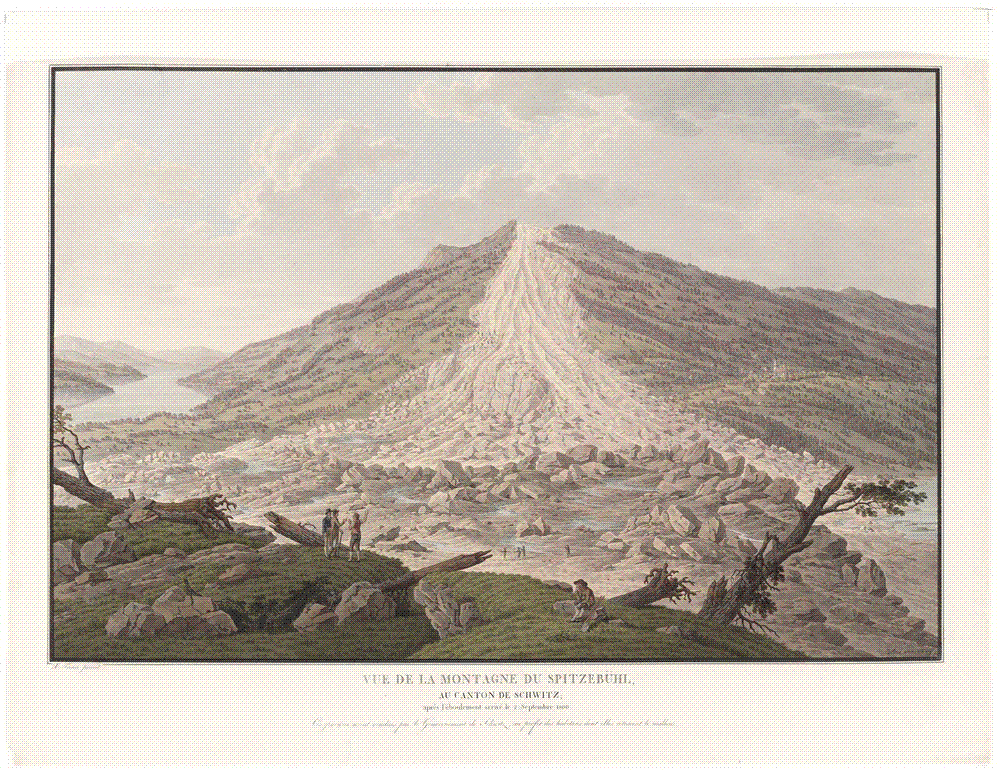
Edward Gibbon, The History of the Decline and Fall of the Roman Empire, chapter XLIII (first published 1788), J. B. Bury edition; transcribed on Wikisource → Goldau, 2 September 1806: after weeks of rain the Rossberg gives way, and a peasant is still begging for holy water when it falls The preceding years had been unusually wet, the filtering waters had loosened the Nagelfluh, or coarse conglomerate of which the mountain is composed, and the rains having latterly been almost continuous, a great part of the mountain, undermined by the subterranean action of the waters, at length gave way and was hurled into the valley below… the superstitious peasant, fancying he heard the jubilee of demons, hastened down to Arth, on the bank of the lake of Zug, and begged the parish priest, with tears and lamentations, to accompany him, and exorcise the evil spirits with a copious sprinkling of holy water. While he was still speaking, the catastrophe took place.
Georg Hartwig, The Subterranean World (London: Longmans, Green & Co., 1871), chapter on landslips: 'The Destruction of Goldau in 1806'; Project Gutenberg ebook #52466 → 'Or those eighteen, upon whom the tower in Siloam fell' — the oldest refusal to read disaster as verdict There were present at that season some that told him of the Galileans, whose blood Pilate had mingled with their sacrifices. And Jesus answering said unto them, Suppose ye that these Galileans were sinners above all the Galileans, because they suffered such things? I tell you, Nay: but, except ye repent, ye shall all likewise perish. Or those eighteen, upon whom the tower in Siloam fell, and slew them, think ye that they were sinners above all men that dwelt in Jerusalem? I tell you, Nay: but, except ye repent, ye shall all likewise perish.
The Gospel according to St Luke 13:1–5, King James Bible, 1772 Oxford edition (vol. 2), proofread transcription on Wikisource → Thornton Wilder sends a friar to count the dead and find the plan behind them On Friday noon, July the twentieth, 1714, the finest bridge in all Peru broke and precipitated five travellers into the gulf below… There was a great service in the Cathedral. The bodies of the victims were approximately collected and approximately separated from one another, and there was great searching of hearts in the beautiful city of Lima… If there were any plan in the universe at all, if there were any pattern in a human life, surely it could be discovered mysteriously latent in those lives so suddenly cut off. Either we live by accident and die by accident, or we live by plan and die by plan.
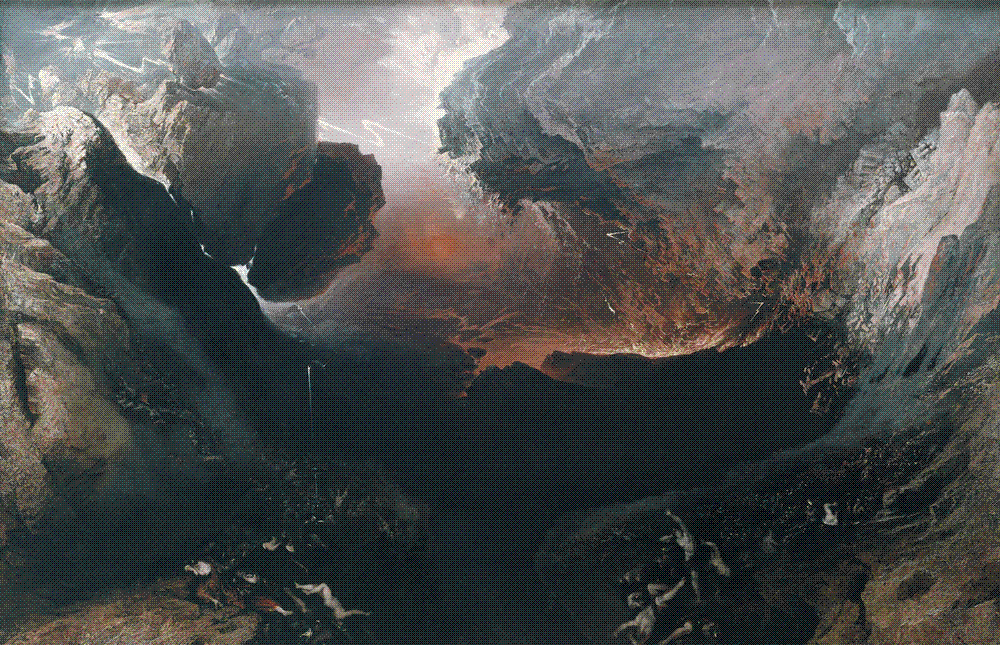
Thornton Wilder, The Bridge of San Luis Rey (New York: Albert & Charles Boni, 1927), Part One: 'Perhaps an Accident'; Project Gutenberg ebook #69768 (public domain in the United States) → John Martin paints the moment the mountains themselves come down on the crowd Martin's vast apocalypse shows the solid world losing its footing: a whole cliff face tips out of the darkness and topples toward the viewer, a city sliding off it in fragments, while lightning opens a red seam across the sky. At the bottom of the canvas, small human figures are swept together in a heap of bodies at the base of the falling rock, too small to be individuals and too many to be counted. It is the pictorial extreme of the fear that outlives every landslide — that the ground under a holy place is not a promise, and that stone can be an instrument as easily as a shelter.
John Martin (1789–1854), The Great Day of His Wrath, oil on canvas, 1851–53, Tate, London, accession N05613 (presented by Mrs Frank Ll. Harris, 1945) → Haydn writes music for a chapel cut under the ground, and ends it with an earthquake Man überzog an dem bestimmten Tage die Wände, Fenster und Pfeiler der Kirche mit schwarzem Tuche, und nur eine in der Mitte hängende Lampe von großem Umfange erleuchtete das heilige Dunkel. Zu einer bestimmten Stunde wurden alle Thüren verschlossen, und die Musik begann. [Translation: On the appointed day the walls, windows and pillars of the church were covered with black cloth, and only a single large lamp hanging in the middle lit the holy darkness. At an appointed hour all the doors were shut, and the music began.] The nine movements close with 'Il Terremoto' — the earthquake — marked Presto e con tutta la forza.
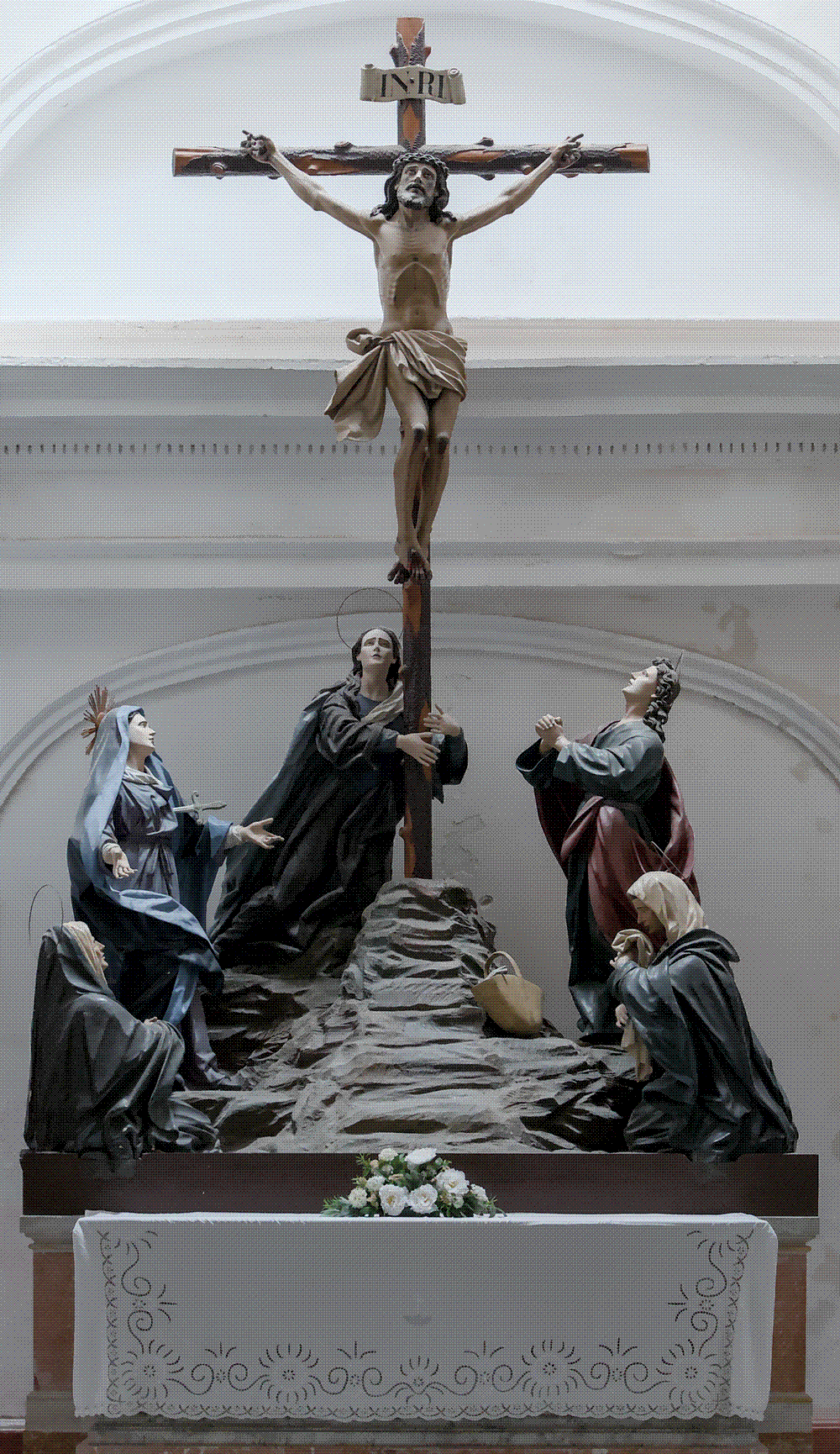
Joseph Haydn, Die sieben letzten Worte unseres Erlösers am Kreuze, Hob. XX:1 (1785–87), composed for the subterranean Oratorio de la Santa Cueva, Cádiz; score hosted at IMSLP / Petrucci Music Library. Quoted words are Haydn's own account of the Cádiz performance, given in his preface to the 1801 Breitkopf & Härtel edition and reprinted by his biographer Georg August von Griesinger, Biographische Notizen über Joseph Haydn (Leipzig, 1810). →