Wikimedia Commons
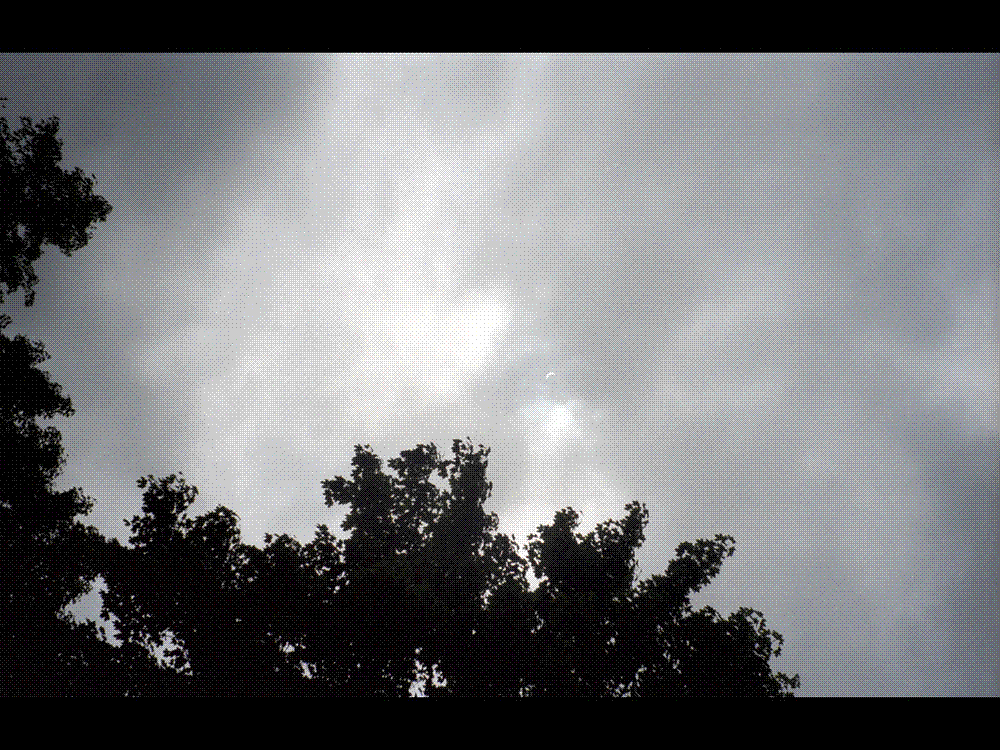
A total solar eclipse crosses Spain and Iceland, the region's most significant since 1999 The Moon's shadow crossed Europe on 12 August — totality tracking over Iceland, Greenland and northern Spain, with Portugal grazed and a deep partial eclipse across the UK and Ireland — the region's most significant solar eclipse since 1999. The week before it was a study in modern anticipation: eclipse glasses sold out across Britain and beyond, broadcasters published viewing guides and safety explainers, forecasters handicapped the cloud cover along the path, and towns in the totality band braced for the largest crowds in their history. The event itself is the oldest spectacle there is, the one that once stopped battles and made kings consult priests; what has changed is entirely on our side of it. An eclipse is now a timetable — predicted to the second, mapped to the meter, safe to watch through certified film — and still, for the minutes of totality, none of that domestication holds. The sky goes wrong in daylight, and every generation discovers that the knowledge does not blunt the awe. Analogies The Eclipse That Stopped a Battle, 28 May 585 BC in the sixth year a battle took place in which it happened, when the fight had begun, that suddenly the day became night. And this change of the day Thales the Milesian had foretold to the Ionians laying down as a limit this very year in which the change took place. The Lydians however and the Medes, when they saw that it had become night instead of day, ceased from their fighting and were much more eager both of them that peace should be made between them.
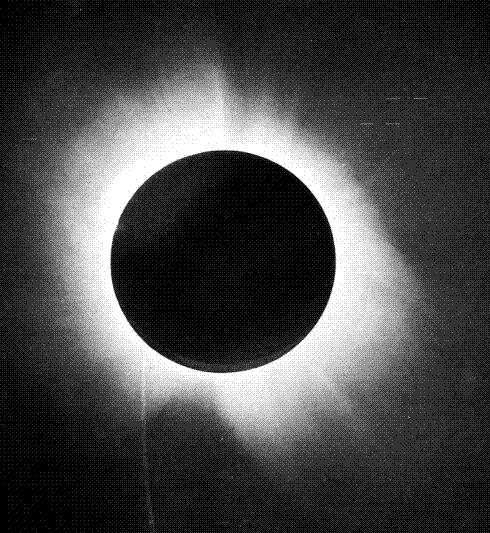
Herodotus, The Histories, Book I.74, translated by G. C. Macaulay (Project Gutenberg) → Weighing Light: Eddington at Príncipe, 29 May 1919 Our shadow-box takes up all our attention. There is a marvellous spectacle above, and, as the photographs afterwards revealed, a wonderful prominence-flame is poised a hundred thousand miles above the surface of the sun. We have no time to snatch a glance at it. We are conscious only of the weird half-light of the landscape and the hush of nature, broken by the calls of the observers, and beat of the metronome ticking out the 302 seconds of totality.
Arthur Eddington, Space, Time and Gravitation (1920), ch. VII, "Weighing Light" (Wikisource) → Hank Morgan Commands the Sun I waited two or three moments; then looked up; he was standing there petrified. With a common impulse the multitude rose slowly up and stared into the sky. I followed their eyes, as sure as guns, there was my eclipse beginning! The life went boiling through my veins; I was a new man! The rim of black spread slowly into the sun’s disk, my heart beat higher and higher, and still the assemblage and the priest stared into the sky, motionless.
Mark Twain, A Connecticut Yankee in King Arthur's Court (1889), ch. VI, "The Eclipse" (Project Gutenberg) → These Late Eclipses Portend No Good These late eclipses in the sun and moon portend no good to us: though the wisdom of Nature can reason it thus and thus, yet nature finds itself scourged by the sequent effects. Love cools, friendship falls off, brothers divide: in cities, mutinies; in countries, discord; in palaces, treason; and the bond cracked ’twixt son and father.
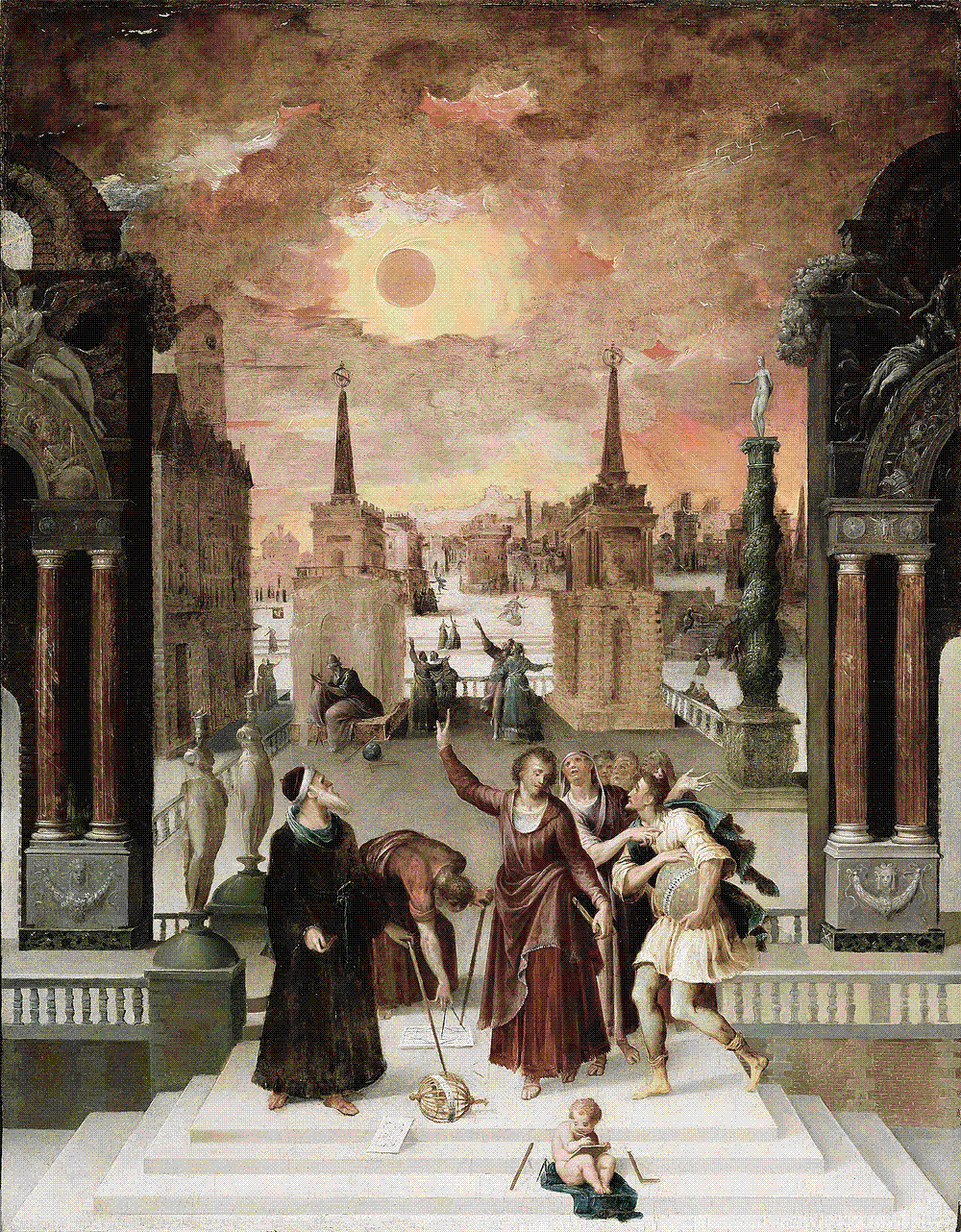
William Shakespeare, King Lear, Act I, Scene 2 (Project Gutenberg) → Antoine Caron, Dionysius the Areopagite Converting the Pagan Philosophers (Astronomers Studying an Eclipse), c. 1570 Beneath an ominous darkened sun, with lightning streaking a storm-filled sky, robed philosophers crowd a marble terrace to point, measure, and dispute around an armillary sphere and a celestial globe carried up the steps. Caron's nominal subject is the legendary eclipse at the Crucifixion that Dionysius read as a sign in Athens, but the painting's real fascination is the instruments themselves — a Renaissance court imagining the omen as something to be calculated. Terror fills the sky; geometry occupies the foreground.
J. Paul Getty Museum, Los Angeles, 85.PB.117 → Gustav Holst, The Planets, Op. 32 (1914–16) Composed in the same years astronomers were preparing to weigh starlight at an eclipse, Holst's suite sets the solar system for orchestra: the mechanized pounding of Mars, the slow tolling procession of Saturn, and in "Neptune, the Mystic" a wordless offstage women's chorus that fades to silence behind a slowly closed door, the cosmos receding beyond earshot. Holst insisted his planets were astrological characters rather than astronomical bodies — yet the music teaches the eclipse-watcher's lesson, that the sky keeps a schedule and awe survives the arithmetic.
IMSLP / Petrucci Music Library (first edition Goodwin & Tabb, 1921; public domain) →