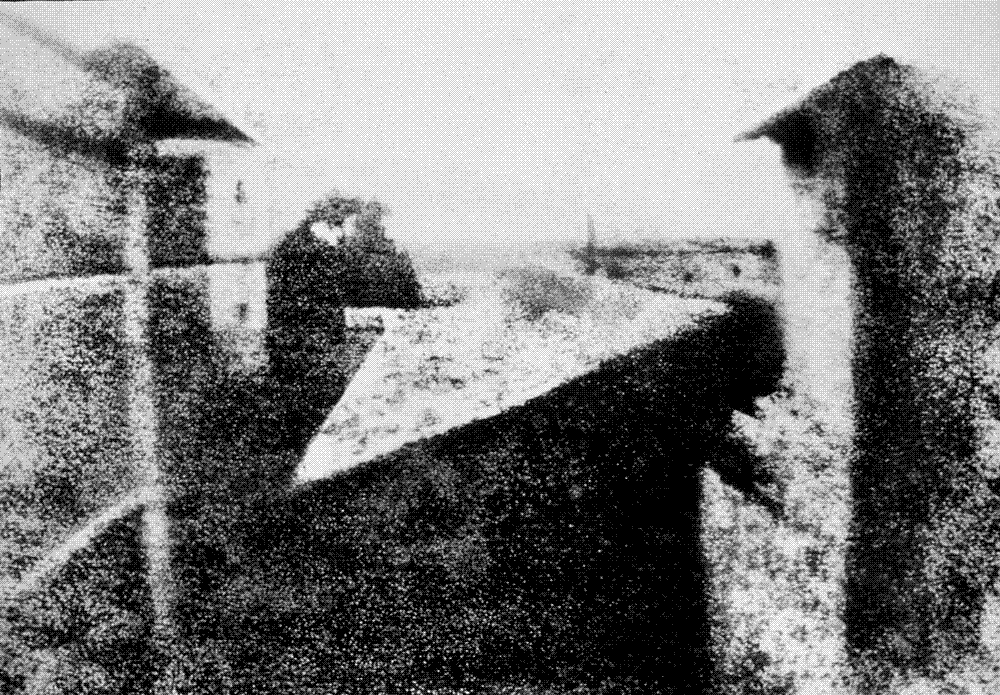
Niépce's View from the Window at Le Gras, the earliest surviving camera photograph: blurred grey shapes of rooftops and a courtyard seen from an upstairs window.

Harry Ransom Center (public domain)

CultureColossalSep 24, 2026

France marks two hundred years of photography with a series of travelling exhibitions

France launched a series of travelling themed exhibitions to celebrate two hundred years since the invention of photography, reflecting on the medium's history at a moment when digital images dominate visual culture. The anniversary is dated from the earliest surviving photograph made with a camera, the view from his window at Le Gras in Burgundy that Nicéphore Niépce fixed on a pewter plate around 1826–27, which led to the daguerreotype that the French state bought and gave to the world in 1839.
Analogies

William Henry Fox Talbot, in 'The Pencil of Nature' (1844), describes the moment in 1833 when he wished the camera's image could be made to stay

And this led me to reflect on the inimitable beauty of the pictures of nature’s painting which the glass lens of the Camera throws upon the paper in its focus—fairy pictures, creations of a moment, and destined as rapidly to fade away. It was during these thoughts that the idea occurred to me…how charming it would be if it were possible to cause these natural images to imprint themselves durably, and remain fixed upon the paper!
William Henry Fox Talbot, The Pencil of Nature (London: Longman, Brown, Green and Longmans, 1844–46), 'Brief Historical Sketch of the Invention of the Art'; Project Gutenberg ebook 33447. →
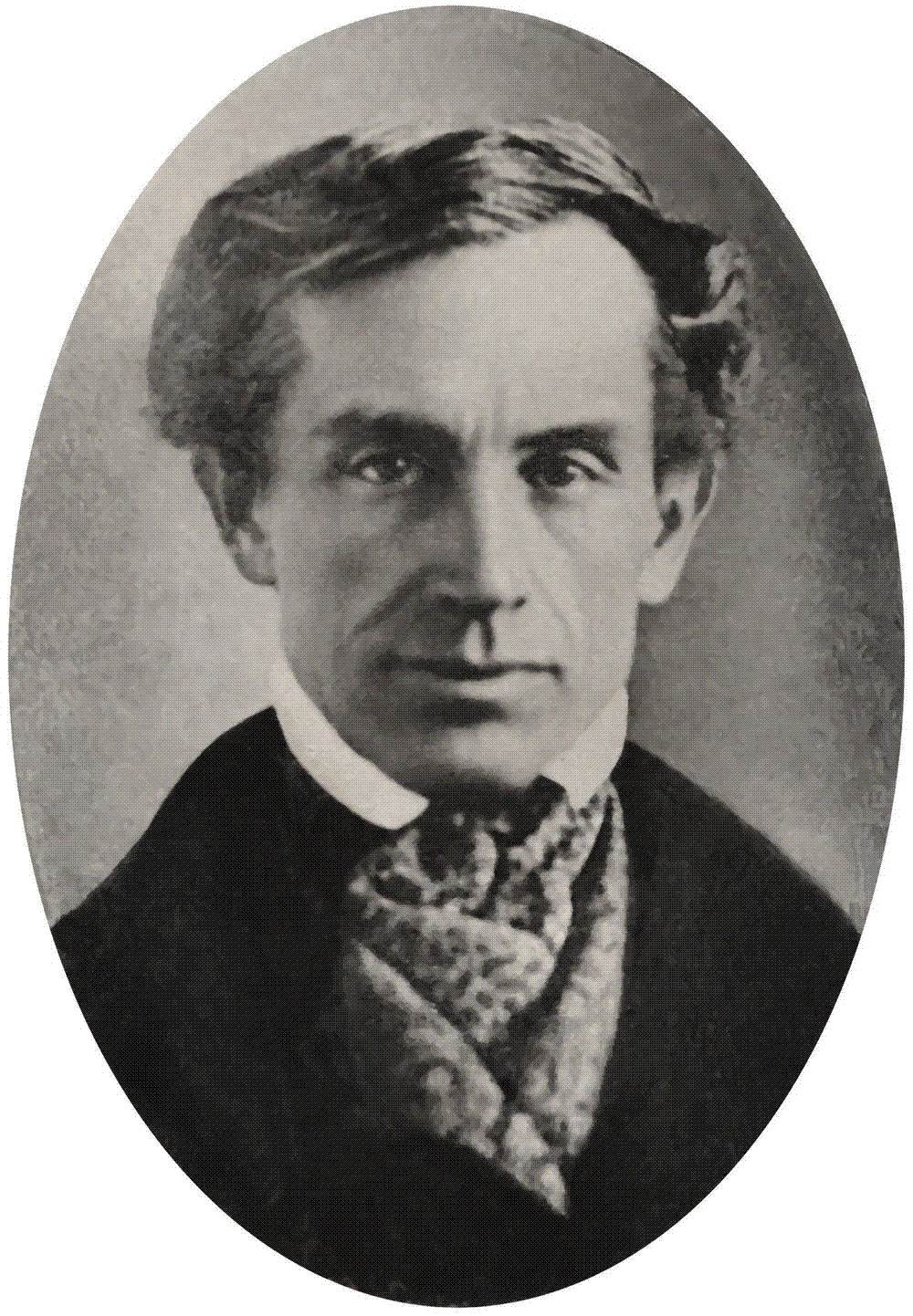
Portrait of Samuel Morse around 1840, in a dark coat and patterned cravat

Samuel Morse recalls visiting Daguerre in March 1839 — and how the next day Daguerre's studio burned with all its pictures, though not the process

On the succeeding day M. Daguerre paid me a visit to see the Telegraph and witness its operations. He seemed much gratified and remained with me perhaps two hours; two melancholy hours to him, as they afterwards proved; or while he was with me, his buildings, including his diorama, his studio, his laboratory, with all the beautiful pictures I had seen the day before, were consumed by fire. Fortunately for mankind, matter only was consumed, the soul and mind of the genius, and the process were still in existence.
Samuel F. B. Morse, recollection quoted in Henry H. Snelling, The History and Practice of the Art of Photography (New York: G. P. Putnam, 1849); Project Gutenberg ebook 168. →
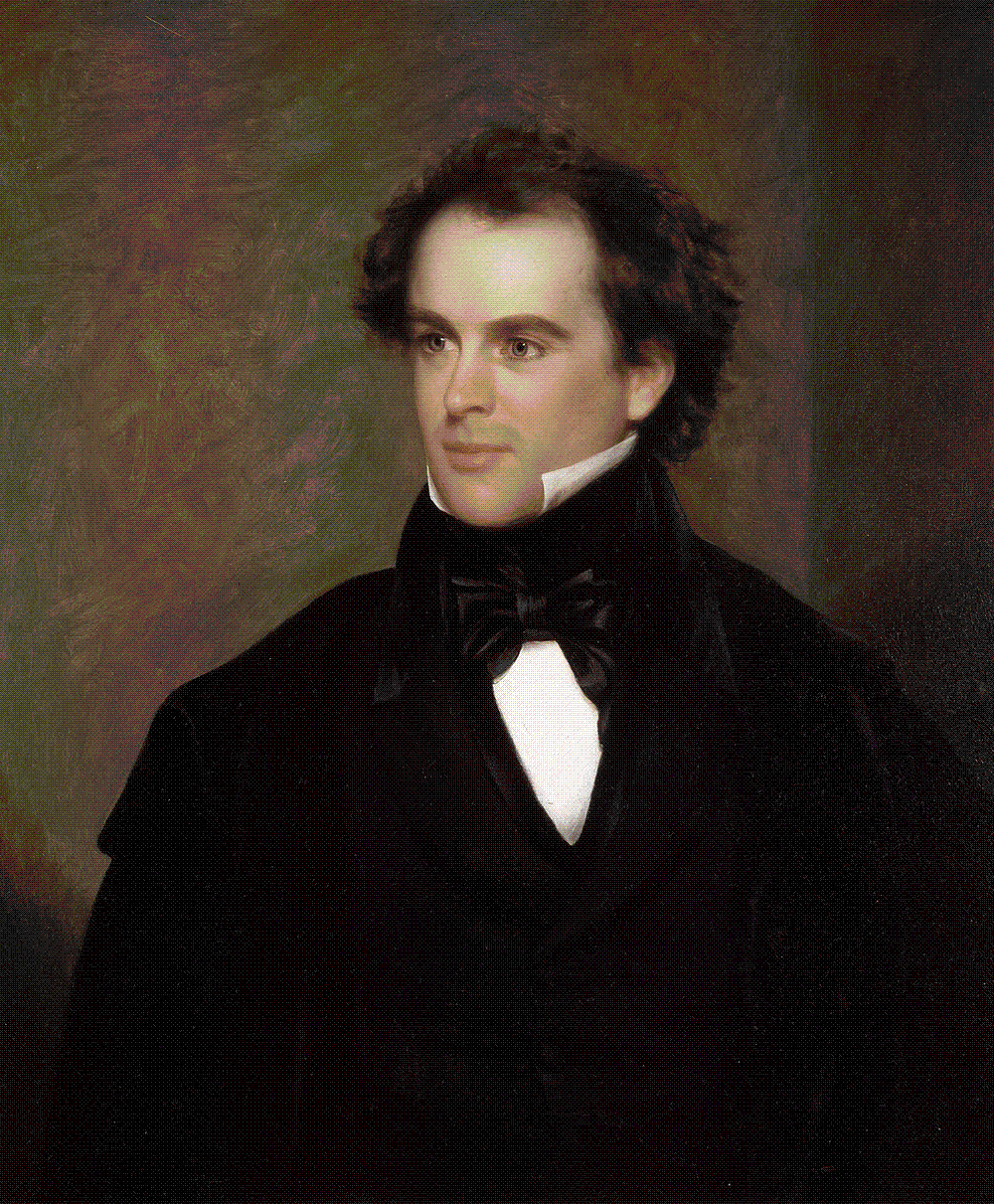
Charles Osgood's 1840 portrait of Nathaniel Hawthorne, dark-haired, in a black coat and cravat

Holgrave, the daguerreotypist in Hawthorne's 'The House of the Seven Gables' (1851), explains what sunlight reveals that a painter would not

There is a wonderful insight in Heaven’s broad and simple sunshine. While we give it credit only for depicting the merest surface, it actually brings out the secret character with a truth that no painter would ever venture upon, even could he detect it.
Nathaniel Hawthorne, The House of the Seven Gables (Boston: Ticknor, Reed, and Fields, 1851), ch. VI, 'Maule's Well'; Project Gutenberg ebook 77. →
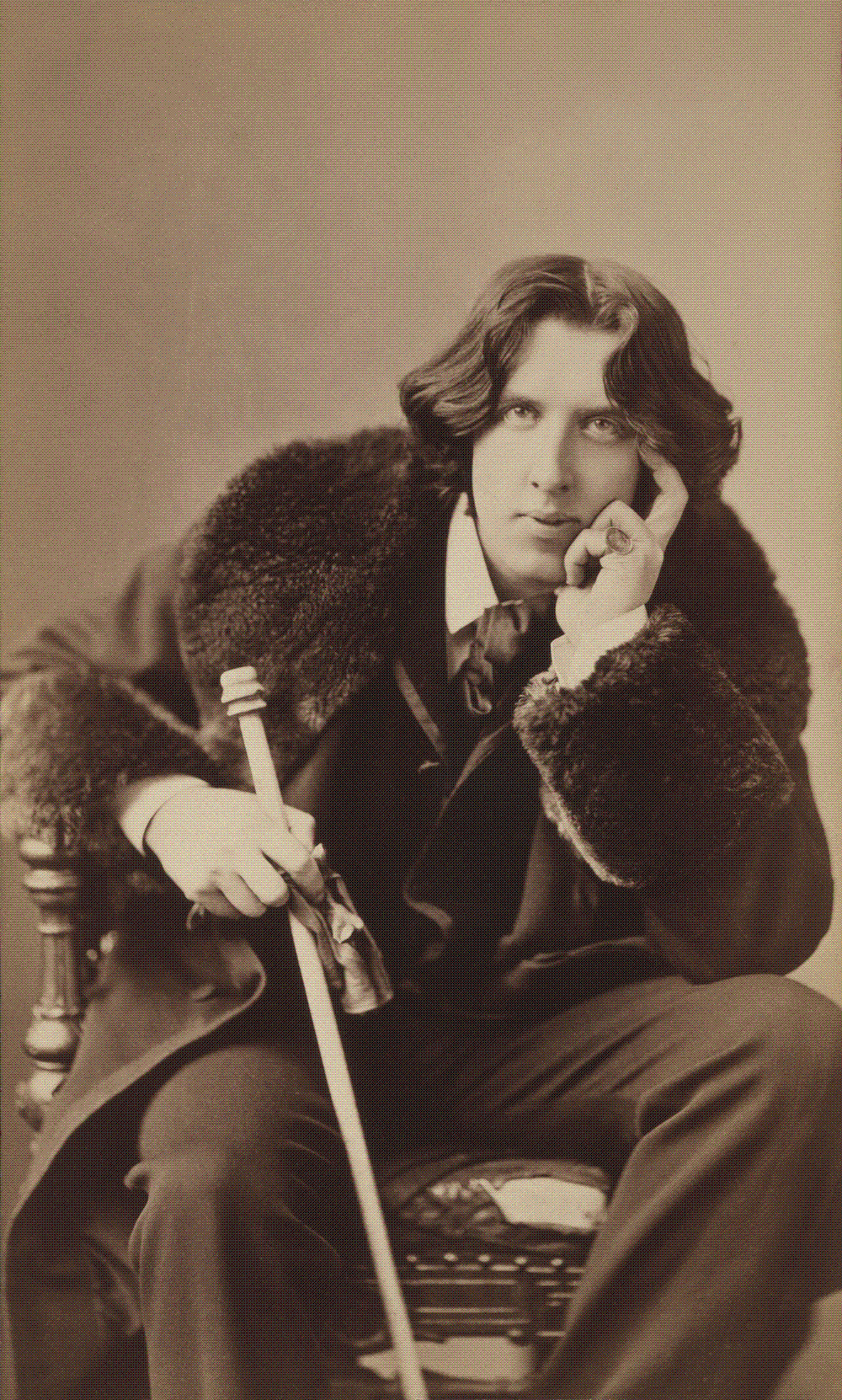
Napoleon Sarony's 1882 photograph of Oscar Wilde, seated, with long hair, in a fur-trimmed coat

In 'The Picture of Dorian Gray' (1890), Dorian wishes the picture would age instead of him — the bargain every photograph seems to offer

But this picture will remain always young. It will never be older than this particular day of June.... If it were only the other way! If it were I who was to be always young, and the picture that was to grow old! For that—for that—I would give everything! Yes, there is nothing in the whole world I would not give! I would give my soul for that!
Oscar Wilde, The Picture of Dorian Gray (London: Ward, Lock and Company, 1891), ch. II; Project Gutenberg ebook 174. →
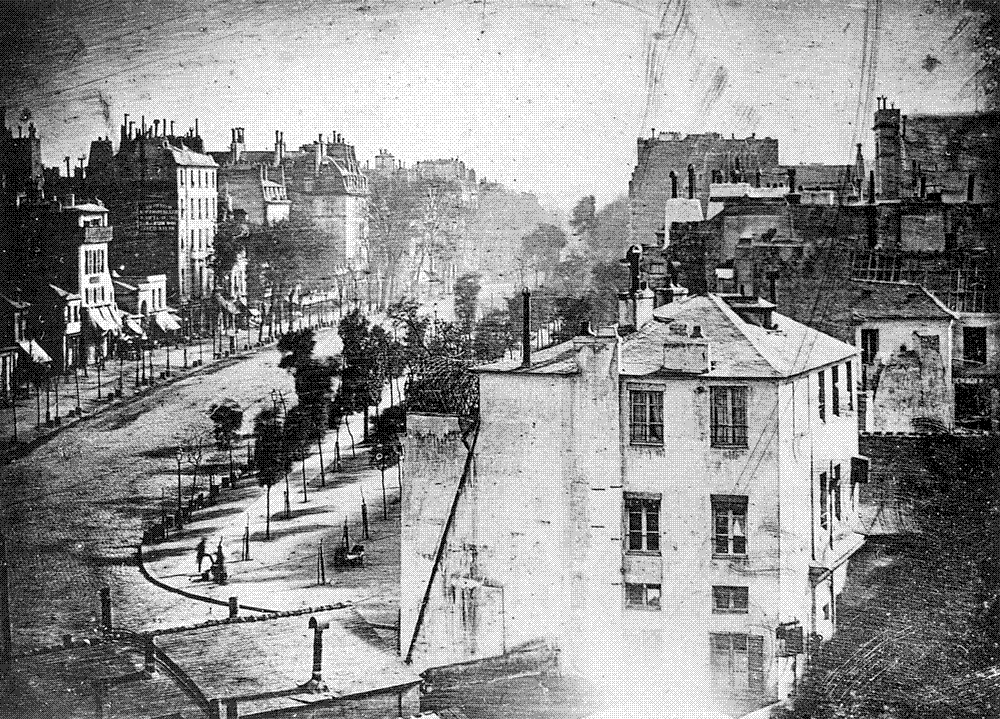
Daguerre's 1838 view down an apparently empty Paris boulevard, with a tiny figure having his boots polished at lower left

Louis Daguerre's 'Boulevard du Temple' (1838), the first photograph to show a human being

Daguerre pointed his camera from a high window down the Boulevard du Temple in Paris in 1838. The exposure lasted several minutes, so the carriages and crowds that filled the street moved too quickly to register: the boulevard appears empty. Except, at the lower left, one man stood still long enough to have his boots polished — and he and the bootblack became the first people ever photographed. It is a picture of how the medium sees: whatever stays still is kept, and whatever moves on is lost.
Louis-Jacques-Mandé Daguerre, Boulevard du Temple, Paris, 1838, daguerreotype. →
Talbot's early photograph of a broom leaning in the sunlit doorway of a stone stable, with a lantern hanging beside it

William Henry Fox Talbot's 'The Open Door' (1844), plate VI of 'The Pencil of Nature'

A stable door stands ajar in the sunlight; a broom leans against the doorway, a lantern hangs on the wall, and the shadow of the broom falls across the old stone. Talbot published the image as plate VI of The Pencil of Nature, the first commercially published book illustrated with photographs, and admitted that it was a picture in the manner of the Dutch painters. It is the first photograph made purely as a work of art — nothing is recorded that could not have been passed by unnoticed.
William Henry Fox Talbot, The Open Door, April 1844, salted paper print from a paper negative, published as plate VI of The Pencil of Nature; impression at the Metropolitan Museum of Art. →