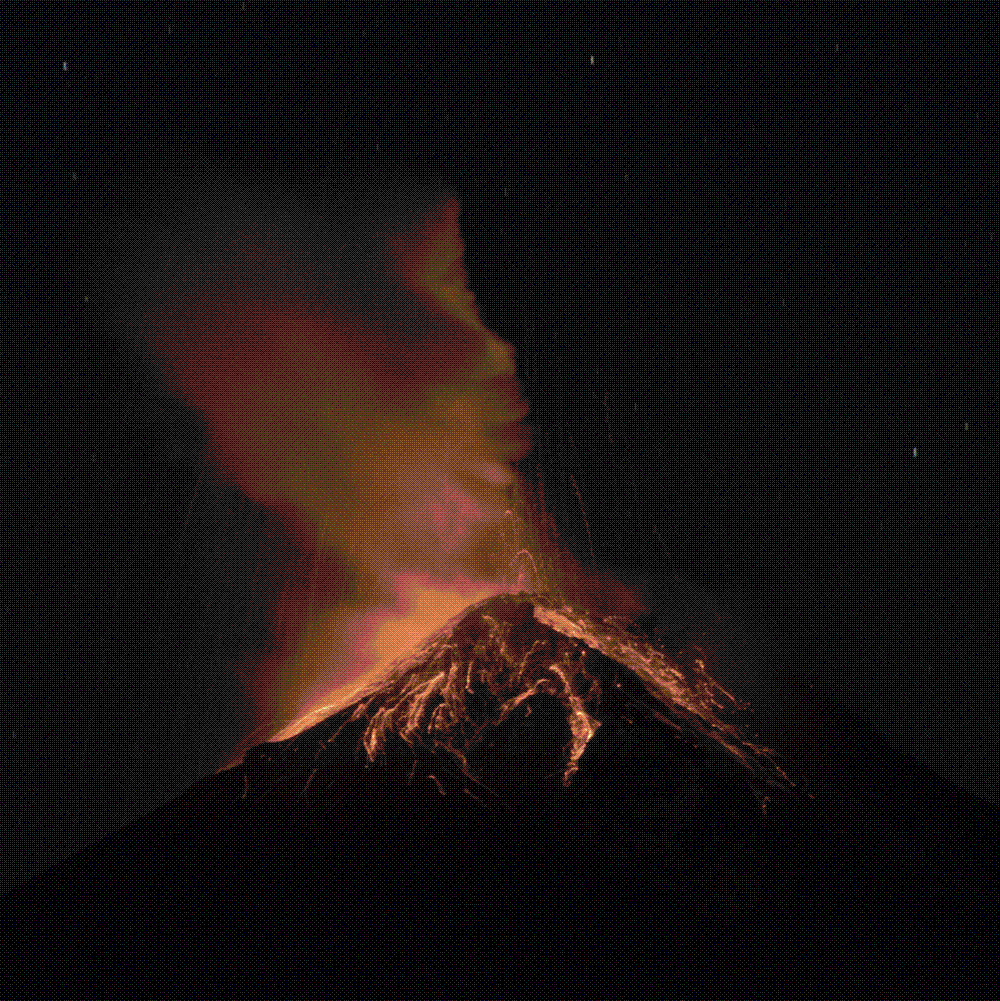
The Volcan de Fuego in Guatemala erupting at night, incandescent rock streaming down its flanks beneath a glowing ash plume.

Kieran Wood, University of Bristol via Wikimedia Commons

ScienceReuters · APAug 4, 2026

Guatemala raises its second-highest alert and evacuates 659 people from eight villages as the Fuego volcano erupts

Lava fountains 200 to 300 metres high formed over the crater and ash plumes rose about six kilometres into the air after the eruption began on Monday morning and intensified through the day. National Route 14, which passes close to the volcano some 35km from Guatemala City, was closed and the Education Ministry suspended classes in nearby towns. Officials expected about ten more communities to be evacuated.
Analogies

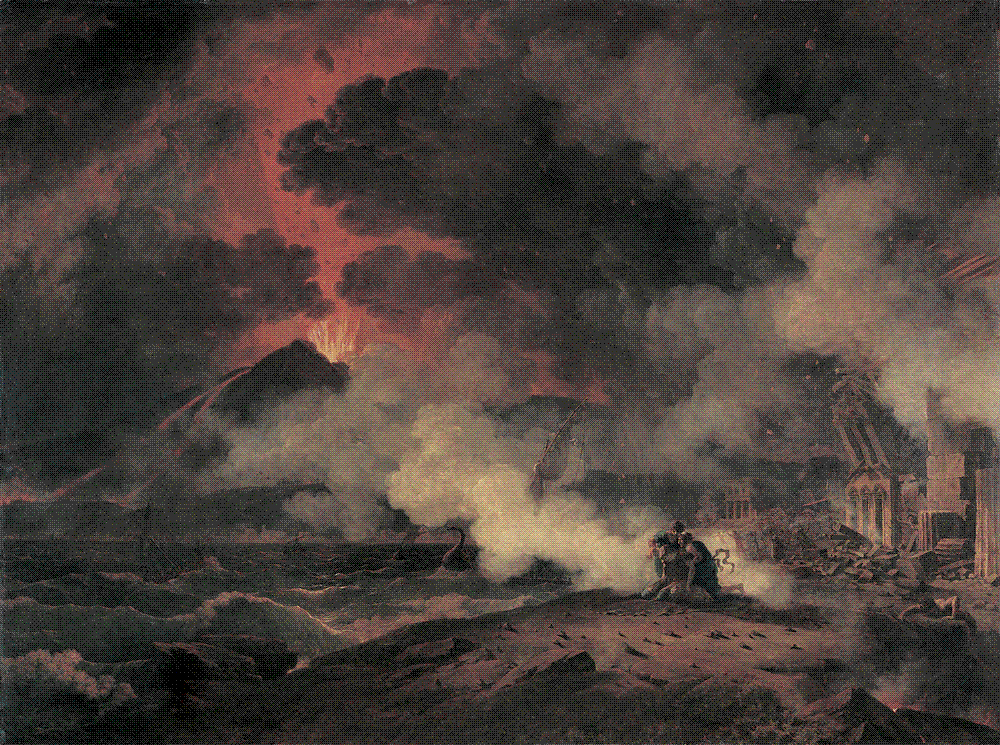
Pierre-Henri de Valenciennes, The Eruption of Vesuvius on 24 August AD 79 (1813), oil on canvas, Musee des Augustins, Toulouse: a red fire fountain above the cone, black ash clouds over the bay and figures sheltering among ruins in the foreground.

Pliny the Younger describes abandoning Misenum on foot and turning off the high road as ash fell and the sky went black during the eruption of Vesuvius in AD 79

The ashes now began to fall upon us, though in no great quantity. I looked back; a dense dark mist seemed to be following us, spreading itself over the country like a cloud. "Let us turn out of the high-road," I said, "while we can still see, for fear that, should we fall in the road, we should be pressed to death in the dark, by the crowds that are following us." We had scarcely sat down when night came upon us, not such as we have when the sky is cloudy, or when there is no moon, but that of a room when it is shut up, and all the lights put out.
Pliny the Younger, Letters, Book VI, Letter 20, to Cornelius Tacitus (numbered LXVI in this edition), translated by William Melmoth and revised by F. C. T. Bosanquet; Letters of Pliny, Project Gutenberg eBook 2811.
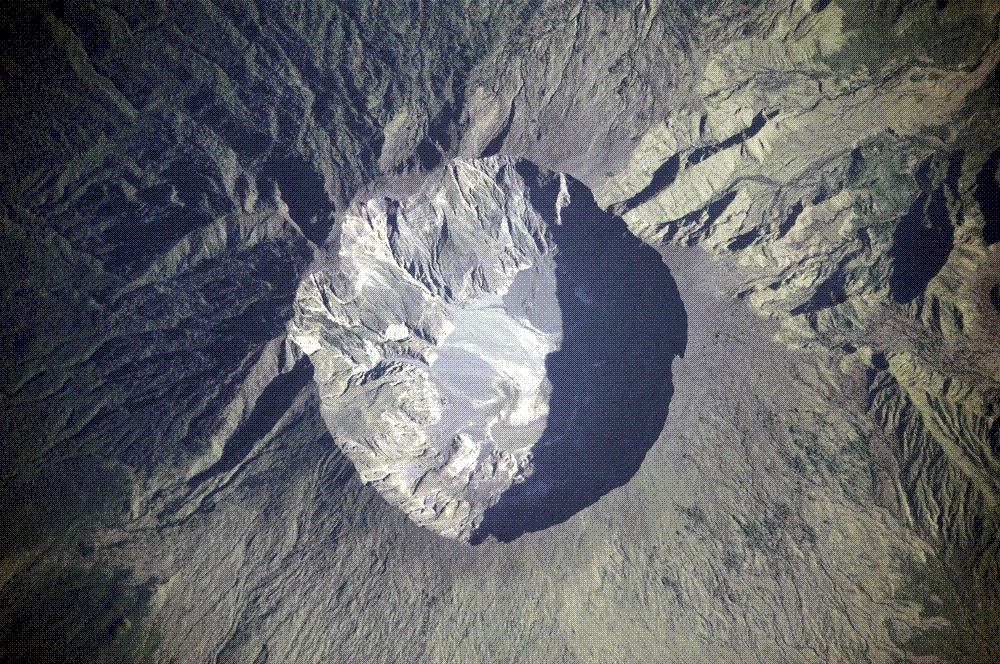
Astronaut photograph of the six-kilometre-wide summit caldera of Mount Tambora, Sumbawa, Indonesia, left behind when the mountain's peak was blown away in the eruption of April 1815 (NASA Earth Observatory).

The Rajah of Sang'ir's eyewitness report of the eruption of Mount Tambora on Sumbawa, 10 April 1815, which destroyed all but one of the villages on the mountain

About 7 p. m. on the 10th of April, three distinct columns of flame burst forth near the top of the Tomboro mountain (all of them apparently within the verge of the crater), and after ascending separately to a very great height, their tops united in the air in a troubled confused manner. In a short time, the whole mountain next Sang'ir appeared like a body of liquid fire, extending itself in every direction. The fire and columns of flame continued to rage with unabated fury, until the darkness caused by the quantity of falling matter obscured it at about 8 p. m. Stones, at this time, fell very thick at Sang'ir; some of them as large as two fists, but generally not larger than walnuts. Between 9 and 10 p. m. ashes began to fall,
Lieutenant Owen Phillips, report dated at Bima, Sumbawa (1815), transmitting the account of the Rajah of Sang'ir; printed in Sir Thomas Stamford Raffles, The History of Java, 2nd edition (London: John Murray, 1830), vol. I, note 26 on the eruption of the Tomboro mountain; Project Gutenberg eBook 49843.
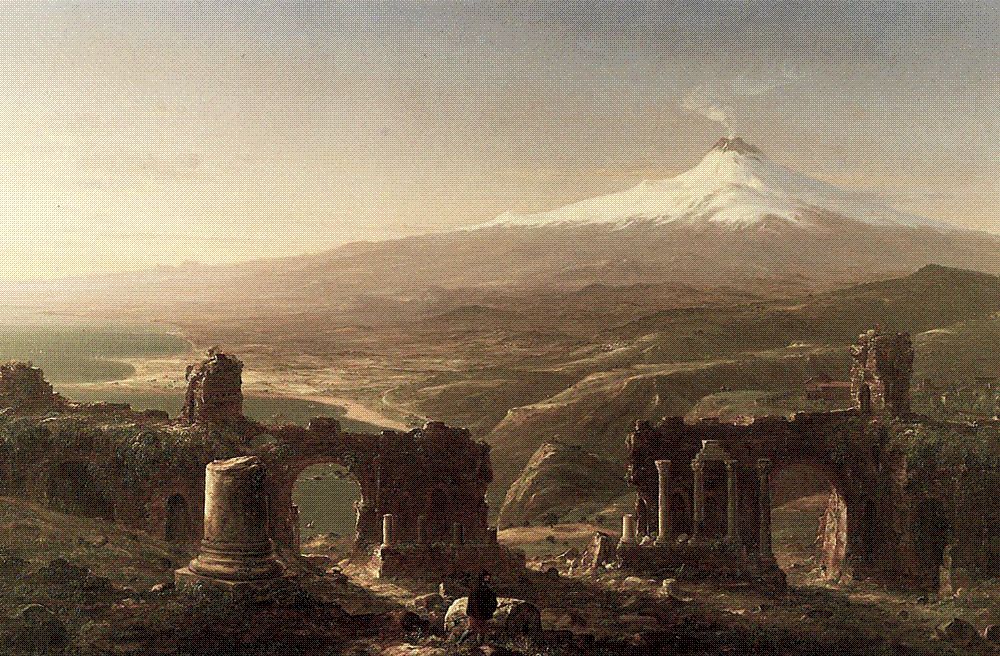
Thomas Cole, Mount Etna from Taormina (1843), oil on canvas: the snow-capped volcano trailing a thin plume of smoke above the ruins of the Greek theatre and the Sicilian coastal plain.

Virgil's Aeneid describes Aeneas and his crew anchored beneath a thundering Mount Etna that throws up pitchy cloud, hot embers and massy rocks

The port capacious, and secure from wind, Is to the foot of thund'ring Aetna join'd. By turns a pitchy cloud she rolls on high; By turns hot embers from her entrails fly, And flakes of mounting flames, that lick the sky. Oft from her bowels massy rocks are thrown, And, shiver'd by the force, come piecemeal down. Oft liquid lakes of burning sulphur flow, Fed from the fiery springs that boil below.
Virgil, Aeneid, Book III, lines 570-582 (Latin), in the verse translation of John Dryden (1697); Perseus Digital Library, Tufts University.
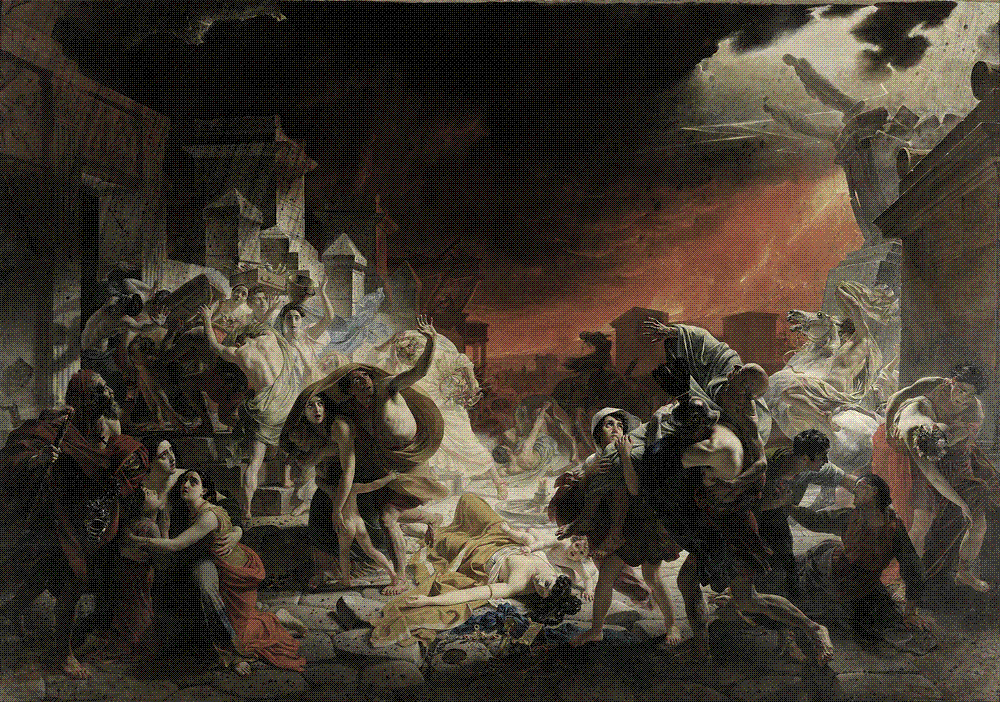
Karl Bryullov, The Last Day of Pompeii (1830-1833), oil on canvas, State Russian Museum, Saint Petersburg: crowds fleeing under a black ash cloud lit by lightning as statues topple from a temple roof. The painting was seen by Bulwer-Lytton in Milan and inspired his novel.

Edward Bulwer-Lytton's The Last Days of Pompeii (1834) imagines the townspeople wading through knee-deep ash along streets blocked by fallen rock

The ashes in many places were already knee-deep; and the boiling showers which came from the steaming breath of the volcano forced their way into the houses, bearing with them a strong and suffocating vapor. In some places, immense fragments of rock, hurled upon the house roofs, bore down along the streets masses of confused ruin, which yet more and more, with every hour, obstructed the way; and, as the day advanced, the motion of the earth was more sensibly felt—the footing seemed to slide and creep—nor could chariot or litter be kept steady, even on the most level ground.
Edward Bulwer-Lytton, The Last Days of Pompeii (1834), Book the Fifth, Chapter VII, "The Progress of the Destruction"; Project Gutenberg eBook 1565.
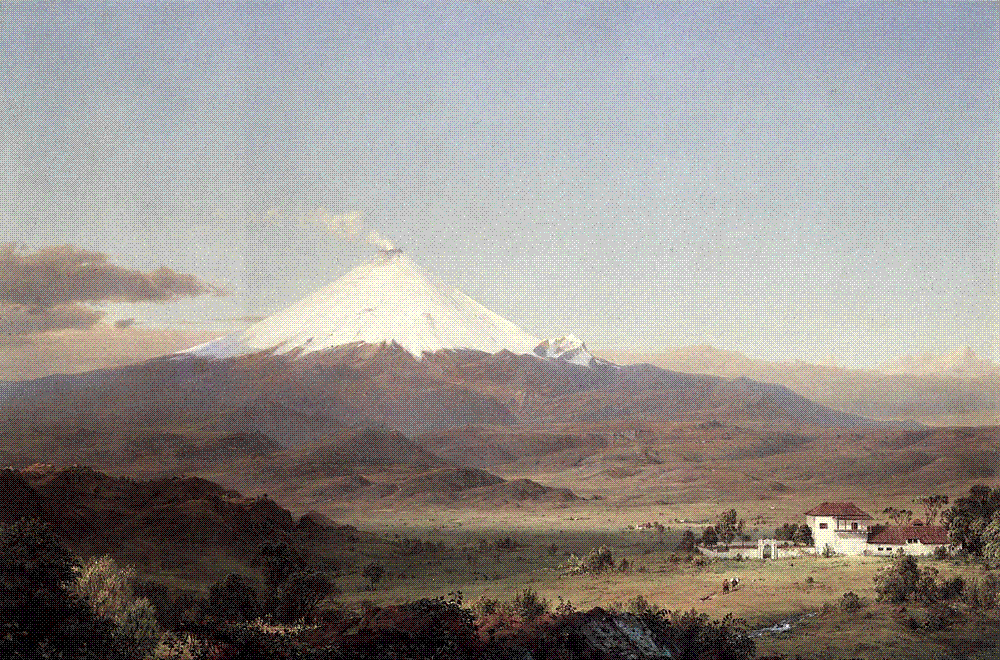
Frederic Edwin Church, Cotopaxi (1855), oil on canvas, Smithsonian American Art Museum: the snow-covered volcano releasing a single plume of smoke above a broad green valley with a hacienda and travellers in the right foreground.

Frederic Edwin Church paints Cotopaxi (1855), the Andean volcano smoking quietly above a hacienda and the valley that lives beneath it

Church painted the great Ecuadorian cone from a hacienda on the plain below, where he had waited a whole day for the clouds to lift. The mountain is at rest: only a single thin thread of smoke leaks from the summit into a clear morning sky, while cattle, a stream and a whitewashed farmstead occupy the warm foreground. The picture is a portrait of the ordinary life that goes on directly under a volcano, with the reminder of what the mountain is written in one small plume of vapour.
Frederic Edwin Church, Cotopaxi, 1855, oil on canvas, 28 x 42 in. (71.1 x 106.8 cm), Smithsonian American Art Museum, gift of Mrs. Frank R. McCoy, accession no. 1965.12.
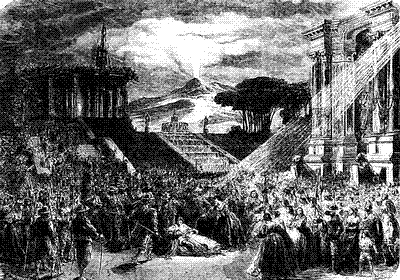
Nineteenth-century engraving of the volcanic eruption scene that ends Auber's La Muette de Portici, showing Vesuvius smoking behind the stage architecture as the crowd scatters, reproduced in Germain Bapst, Essai sur l'histoire du théâtre (1893).

The closing stage direction of Auber's opera La Muette de Portici (Paris, 29 February 1828) brings Vesuvius to life on stage, erupting over a prostrate crowd

En ce moment le Vésuve commence à jeter des tourbillons de flamme et de fumée, et Fenella parvenue au haut de la terrasse, comtemple cet effrayant spectacle. Elle s’arrête, et détache son écharpe la jette du côté d’Alphonse, lève les yeux au ciel et se précipite dans l’abîme. (Alphonse et Elvire poussent un cri d’effroi. Mais au même instant, le Vésuve rugit avec plus de fureur ; du cratère du volcan la lave enflammé se précipite. Le peuple épouvanté se prosterne.)
Eugène Scribe and Germain Delavigne, libretto of La Muette de Portici, opéra en cinq actes, music by Daniel-François-Esprit Auber, first performed at the Académie royale de musique, Paris, 29 February 1828; Act V, scene 7, final stage direction. French Wikisource (full score, E. Troupenas, Paris, 1828, at IMSLP).