BBC
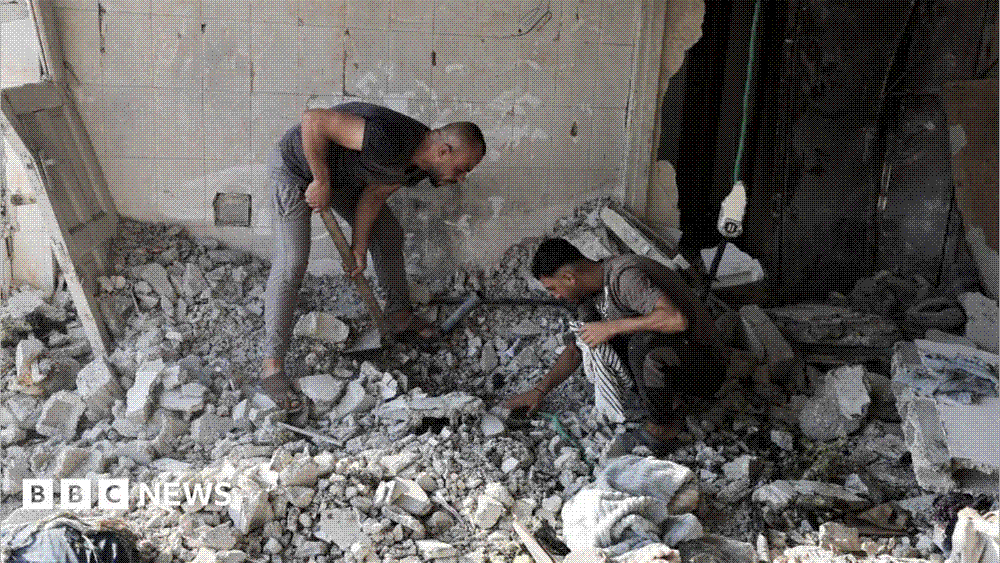
Conflict AP · BBC · Aug 2, 2026 Israeli airstrikes kill at least 13 people across Gaza in a second straight night of attacks, days after Hamas accepts a US-backed disarmament plan Israeli aircraft struck Gaza City, Khan Younis and Deir al-Balah overnight, killing at least 13 Palestinians, including a nine-year-old boy, the territory's Civil Defence Authority said. The Israeli military said it had targeted Hamas military operatives and killed two commanders, while Israel's energy minister, Eli Cohen, said no deal had been reached to stop the strikes even after Hamas this week accepted a plan to hand its weapons to a US-led 'Board of Peace.' More than 1,100 Palestinians have been killed since a supposed ceasefire took effect last October, in a territory now roughly 70% under Israeli control. Analogies The Burning of the Temple, Jerusalem, 70 AD While the holy house was on fire, every thing was plundered that came to hand, and ten thousand of those that were caught were slain; nor was there a commiseration of any age, or any reverence of gravity, but children, and old men, and profane persons, and priests were all slain in the same manner; so that this war went round all sorts of men, and brought them to destruction, and as well those that made supplication for their lives, as those that defended themselves by fighting. The flame was also carried a long way, and made an echo, together with the groans of those that were slain; and because this hill was high, and the works at the temple were very great, one would have thought the whole city had been on fire.
Flavius Josephus, The Wars of the Jews, Book VI, Chapter 5, translated by William Whiston (1737). Project Gutenberg. → "War Is Cruelty": Sherman to Atlanta, 1864 You cannot qualify war in harsher terms than I will. War is cruelty, and you cannot refine it; and those who brought war into our country deserve all the curses and maledictions a people can pour out.
William Tecumseh Sherman, Letter to James M. Calhoun, Mayor of Atlanta, and others, September 12, 1864. Wikisource. → The Children Swoon in the Streets Mine eyes do fail with tears, my bowels are troubled, my liver is poured upon the earth, for the destruction of the daughter of my people; because the children and the sucklings swoon in the streets of the city. They say to their mothers, Where is corn and wine? when they swooned as the wounded in the streets of the city, when their soul was poured out into their mothers' bosom.
Book of Lamentations 2:11-12, King James Version (1611). Wikisource. → Hecuba Binds the Wounds of a Slain Child I make thee whole;
I bind thy wounds, O little vanished soul.
This wound and this I heal with linen white:
O emptiness of aid! . . . Yet let the rite
Be spoken. This and . . . Nay, not I, but he,
Thy father far away shall comfort thee!
Euripides, The Trojan Women, translated into English rhyming verse by Gilbert Murray (1915). Project Gutenberg. → The Third of May 1808 A lantern throws its harsh light on a row of unarmed townspeople as a faceless firing squad levels its muskets; one man flings his arms wide in a last gesture of defiance and terror. The dead already lie in their own blood at his feet, and a line of the doomed stretches back into the dark. Goya lets no glory into the scene, only the machinery of killing and the human beings it consumes.
Francisco de Goya, El Tres de Mayo de 1808 en Madrid (The Third of May 1808), 1814, oil on canvas, Museo del Prado, Madrid. Public domain via Wikimedia Commons. → The Apotheosis of War Against a scorched plain and the broken walls of a ruined city stands a pyramid of human skulls, picked clean, ringed by circling crows. There are no soldiers and no banners, only the sum that war leaves behind. Vereshchagin dedicated the canvas to all conquerors, past, present and to come.
Vasily Vereshchagin, The Apotheosis of War (Apofeoz voyny), 1871, oil on canvas, Tretyakov Gallery, Moscow. Public domain via Wikimedia Commons. →