AP
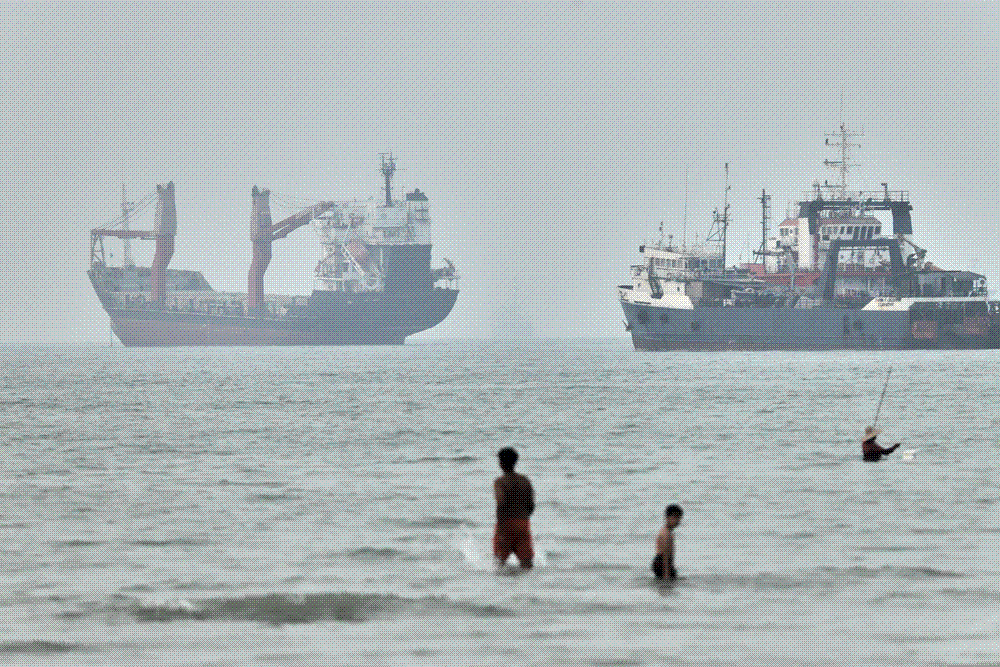
A cargo ship is hit by a projectile in the Strait of Hormuz off Oman as Washington and Tehran give conflicting accounts of talks The United Kingdom Maritime Trade Operations centre said the vessel reported being struck by an unknown projectile at 2am local time, 37km north-east of Al Khasab in Oman; the British security firm Ambrey said the ship was damaged. President Trump said the two sides were resuming talks to wind down the war, while Iran insisted it was speaking only to Oman, and only about the strait. The waterway carried a fifth of the world's oil and gas before the war and has been effectively shut since February. Analogies Athens builds a customs house on the Bosporus and taxes every ship out of the Black Sea, 410 BC From there they proceeded to Chrysopolis, in Calchedonia, and fortified it, established a custom house in the city, and proceeded to collect the tithe-duty from vessels sailing out of the Pontus; they also left there as a garrison thirty ships and two of the generals, Theramenes and Eumachus, to have charge of the fort, to attend to the outgoing ships, and to harm the enemy in any other way they could.
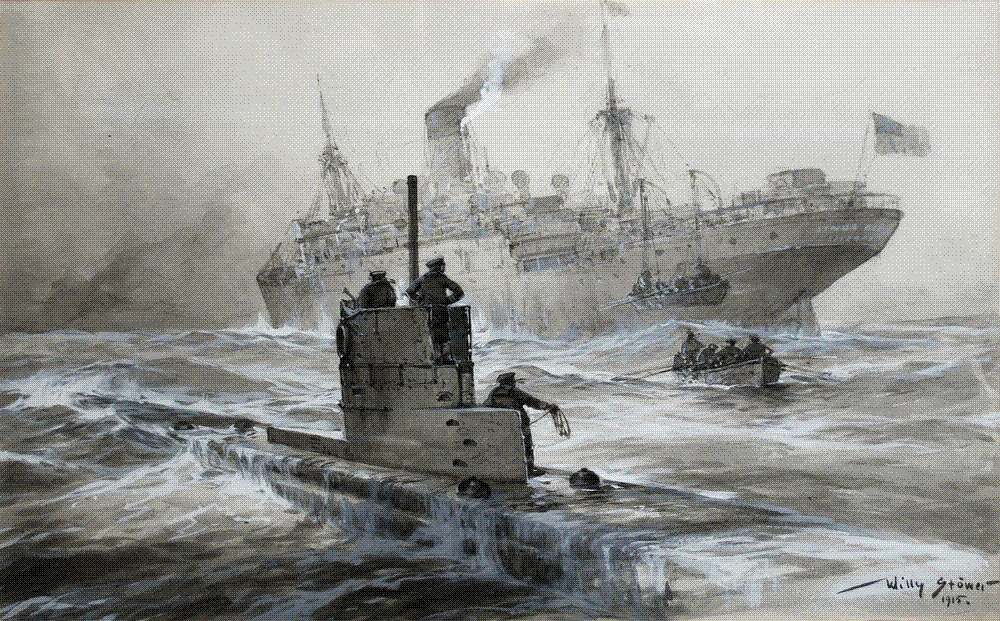
Xenophon, Hellenica, Book 1, chapter 1, section 22 (events of 410 BC); English translation by Carleton L. Brownson, Xenophon in Seven Volumes, vols. 1-2, Harvard University Press / William Heinemann, 1918-1921. Hosted by the Perseus Digital Library, Tufts University. → Woodrow Wilson tells Congress that submarines have made the sea lanes lawless, 2 April 1917 The new policy has swept every restriction aside. Vessels of every kind, whatever their flag, their character, their cargo, their destination, their errand, have been ruthlessly sent to the bottom without warning and without thought of help or mercy for those on board, the vessels of friendly neutrals along with those of belligerents. Even hospital ships and ships carrying relief to the sorely bereaved and stricken people of Belgium, though the latter were provided with safe conduct through the proscribed areas by the German Government itself and were distinguished by unmistakable marks of identity, have been sunk with the same reckless lack of compassion or of principle.
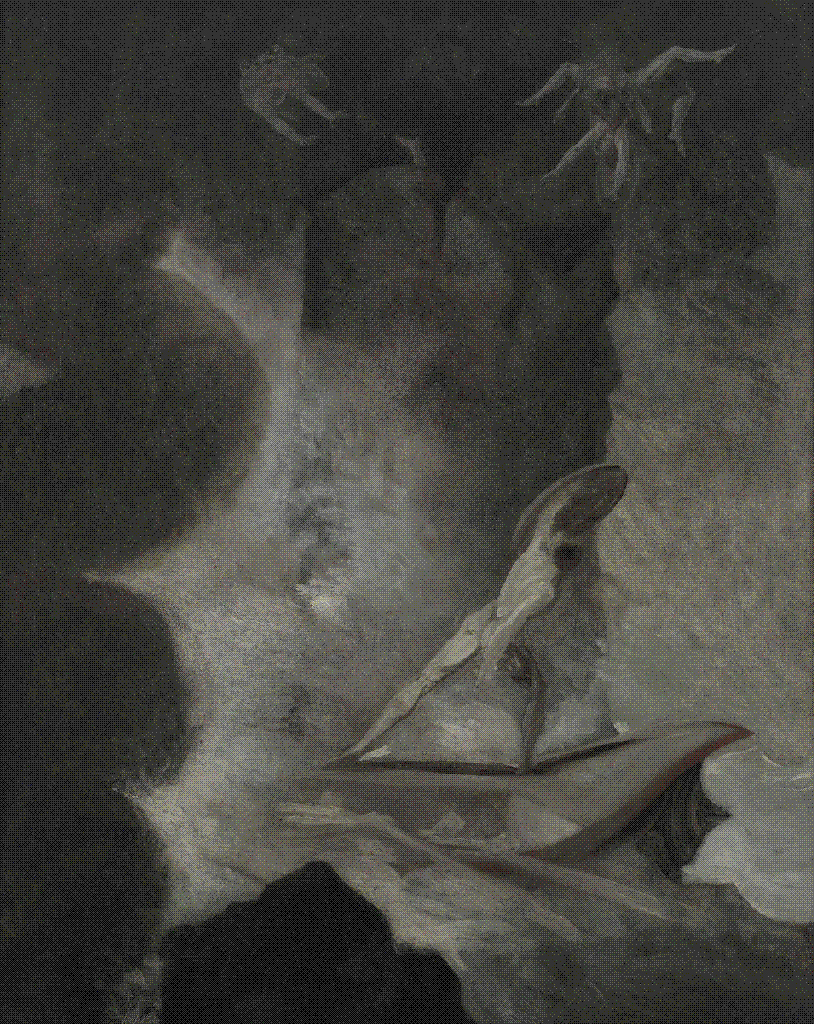
Woodrow Wilson, address to a joint session of Congress, 2 April 1917. Printed in War Messages, 65th Cong., 1st Sess., Senate Doc. No. 5, Serial No. 7264 (Washington, D.C., 1917), pp. 3-8. Transcribed on Wikisource. → Odysseus takes his ship through the narrows and loses six men to the rock We then sailed on up the narrow strait with wailing. For on one side lay Scylla and on the other divine Charybdis terribly sucked down the salt water of the sea. Verily whenever she belched it forth, like a cauldron on a great fire she would seethe and bubble in utter turmoil, and high over head the spray would fall on the tops of both the cliffs. But as often as she sucked down the salt water of the sea, within she could all be seen in utter turmoil, and round about the rock roared terribly, while beneath the earth appeared black with sand; and pale fear seized my men.
Homer, Odyssey, Book 12, lines 234-243; The Odyssey with an English Translation by A. T. Murray, 2 vols., Harvard University Press / William Heinemann, 1919. Hosted by the Perseus Digital Library, Tufts University. → A Venetian merchant's friend cannot look at an hourglass without seeing a cargo ship go down I should not see the sandy hour-glass run / But I should think of shallows and of flats, / And see my wealthy Andrew dock'd in sand / Vailing her high-top lower than her ribs / To kiss her burial. Should I go to church / And see the holy edifice of stone, / And not bethink me straight of dangerous rocks, / Which touching but my gentle vessel's side / Would scatter all her spices on the stream, / Enrobe the roaring waters with my silks; / And, in a word, but even now worth this, / And now worth nothing?
William Shakespeare, The Merchant of Venice, Act I, Scene 1 (Salarino), first printed 1600; text from the Yale Shakespeare edition, ed. William Lyon Phelps (Yale University Press, 1923). Transcribed on Wikisource. → Kaulbach paints a whole navy destroyed inside a strait too narrow to turn in Kaulbach's vast history painting compresses the Battle of Salamis into a single choked channel: triremes rammed together prow to prow, oars snapped, men spilling into water already crowded with wreckage and bodies. On the cliff at the right the Persian king sits enthroned above the slaughter, watching a fleet that outnumbered its enemy be destroyed precisely because the water gave it nowhere to go. The painting is an argument about geography as a weapon - that in a narrow sea, size becomes a liability and a passage becomes a trap.
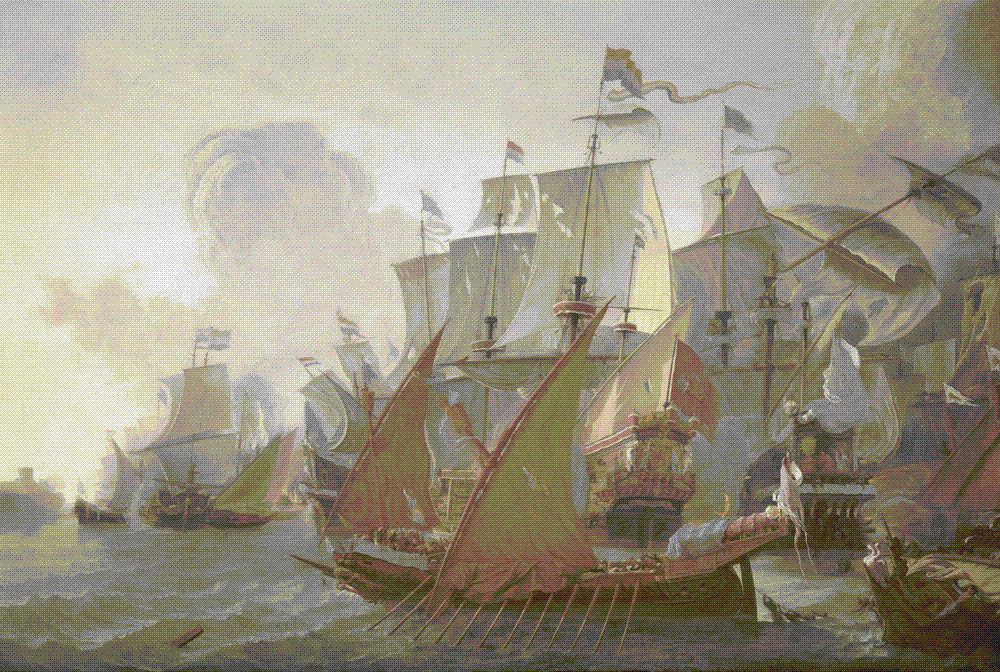
Wilhelm von Kaulbach, Die Seeschlacht bei Salamis (The Battle of Salamis), oil on canvas, 1868; Maximilianeum, Munich. Object page and high-resolution reproduction on Wikimedia Commons. → Berlioz writes eight minutes of music about a raider hunting merchant ships Berlioz's concert overture opens with a downward rush in the strings - a squall with no warning, over almost before it registers - and then drops into a long, becalmed cantilena for divided cellos and violas. When the fast music returns it never lets go: a hard, clipped corsair theme driven by off-beat accents and brass punctuation, closer to pursuit than to celebration. The score began life under other names, including La tour de Nice, before Berlioz settled on the pirate title, and it remains the most single-minded evocation in the orchestral repertoire of a small fast ship overhauling a slow rich one.
Hector Berlioz, Overture 'Le Corsaire', H 101 (Op. 21), composed 1844, revised 1851. Full scores and orchestral parts (public-domain nineteenth-century editions) on IMSLP / Petrucci Music Library. →