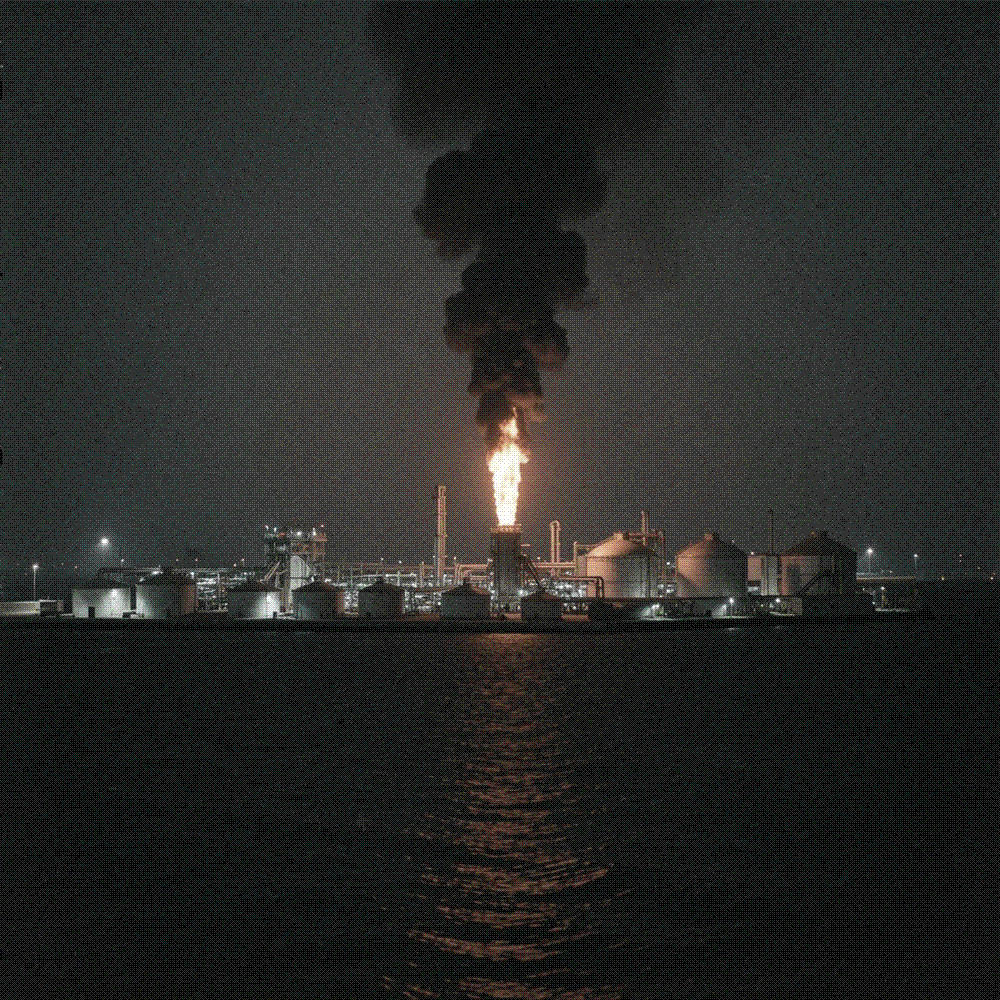
A coastal oil storage terminal at night, one tank burning with a tall column of flame and smoke reflected on dark water

AI-generated

ConflictReuters · Reuters · ReutersSep 25, 2026

France and Greece join the defence of Saudi Arabia as Houthi missiles keep reaching Riyadh and Yanbu

The week opened with Riyadh under air-raid alert for the first time since the Houthi escalation began, Aramco suspending some October crude deliveries to European refiners after a pipeline attack, Italy preparing naval protection for its shipping, and Yemenis fleeing the fighting inland. By Sunday the Houthis had fired ballistic missiles and drones at the capital itself, with flames reported near Riyadh's airport after a strike on a fuel depot; Saudi and Gulf stocks fell, Iran and the United States traded threats, and the group warned Riyadh against deepening its involvement in Yemen's war while saying it would not target American vessels in the Red Sea. Thousands of Yemenis crossed the Bab al-Mandab by boat to Djibouti, and Britain offered aerial refuelling. By Friday the war had acquired a coalition: Emmanuel Macron pledged French forces to protect the Red Sea oil route, a Greek-operated air defence system shot down a ballistic missile and a drone over Saudi territory, the Houthis claimed strikes on Riyadh and on Aramco facilities at Yanbu, and eighty countries at the United Nations demanded the reopening of the Strait of Hormuz.
Analogies

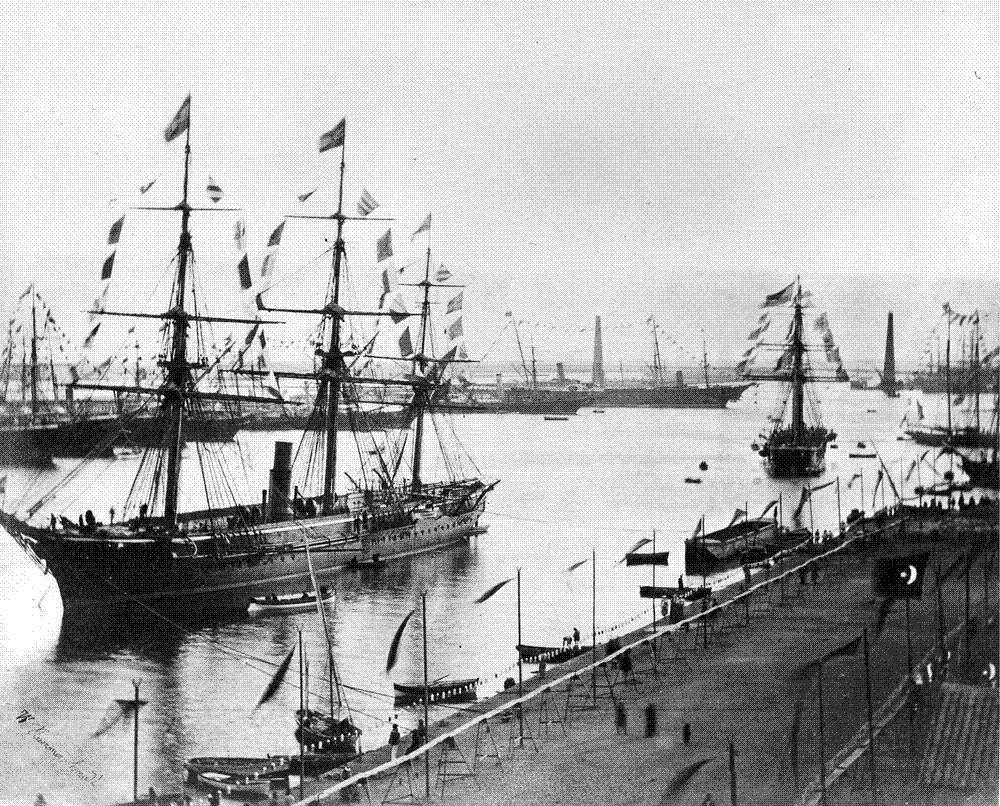
Nineteenth-century image of the opening of the Suez Canal, a procession of ships passing between desert banks

The 1888 Constantinople Convention tries to put a waterway permanently beyond the reach of any war

The Suez Maritime Canal shall always be free and open, in time of war as in time of peace, to every vessel of commerce or of war, without distinction of flag.
Convention Respecting the Free Navigation of the Suez Maritime Canal, signed at Constantinople, 29 October 1888, Article I. →
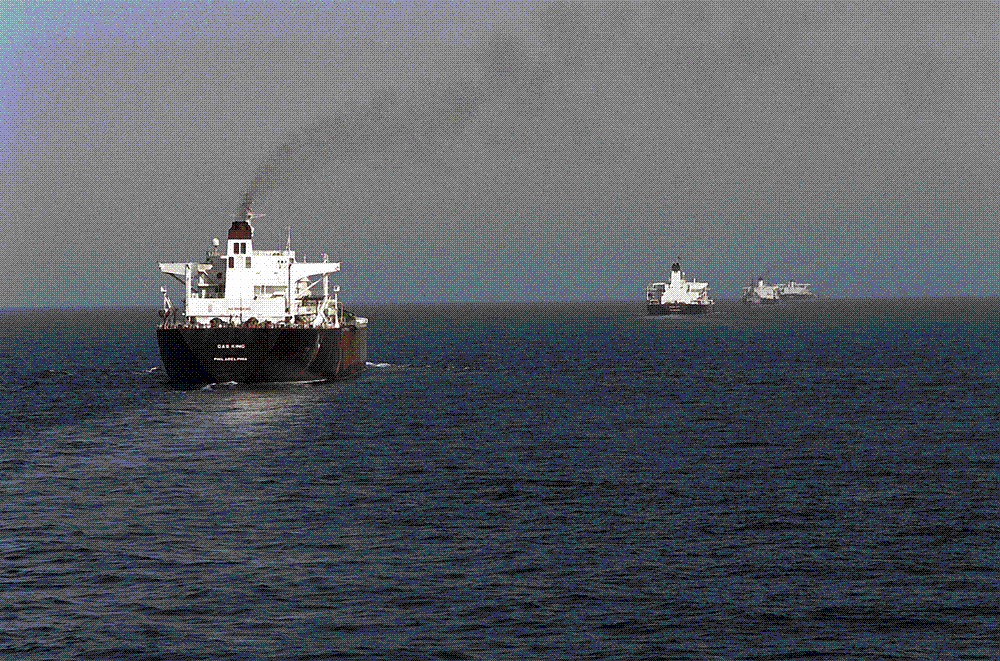
A large oil tanker under escort by a warship in the Persian Gulf during the 1987 reflagging operation

1987: Washington puts its flag on Kuwaiti tankers and tells the Senate that leaving the Gulf is not an option

This ill-conceived legislation could have disastrous effects for the U.S. commitment to the Persian Gulf and to our strategic interests in keeping those waters safe for navigation.
Ronald Reagan, 'Statement on United States Policy in the Persian Gulf', 1987; American Presidency Project, University of California, Santa Barbara. →

The Odyssey sends a ship through a strait where both sides are lethal and there is no way round

Then we entered the Straits in great fear of mind, for on the one hand was Scylla, and on the other dread Charybdis kept sucking up the salt water.
Homer, The Odyssey, book XII, trans. Samuel Butler (London: A. C. Fifield, 1900); Project Gutenberg ebook 1727. →
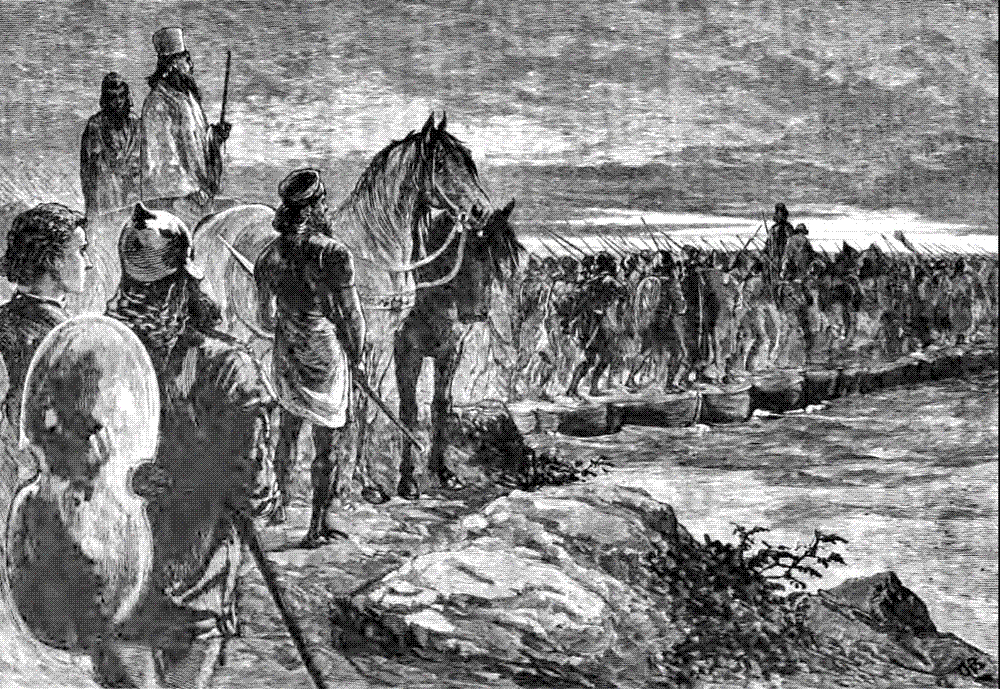
An engraving of Xerxes' army crossing the Hellespont on a bridge of boats

Xerxes has the Hellespont whipped for closing against him, and the strait is punished like a subject

Thou bitter water, thy master lays upon thee this penalty, because thou didst wrong him not having suffered any wrong from him: and Xerxes the king will pass over thee whether thou be willing or no
Herodotus, The History of Herodotus, book VII, trans. G. C. Macaulay (London: Macmillan, 1890); Project Gutenberg ebook 2456. →
A nineteenth-century painting of a fleet burning at night in a bay, masts alight and smoke lit orange over the water

Aivazovsky's 'The Battle of Chesma at Night' (1848) paints a fleet burning in a harbour it could not leave

The Ottoman fleet, crowded into the bay of Çeşme in June 1770, is shown at the moment the fireships reach it: hulls opening into orange light, masts going up like struck matches, the smoke lit from within and the sea itself the colour of the fire. Aivazovsky painted it nearly eighty years after the event, from the Russian side, as a set piece of annihilation in a confined anchorage — the specific terror of ships that cannot disperse.
Ivan Aivazovsky, The Battle of Chesma at Night, 1848, oil on canvas, 193 × 183 cm; Aivazovsky National Art Gallery, Feodosia. →
Thirteenth-century Arabic manuscript painting of a crowded wooden ship at sea, with fish shown beneath the hull

Al-Wasiti's Maqamat of 1237 draws the ship that made the Red Sea and the Indian Ocean one economy

A sewn-plank dhow rides a stylised sea, crowded stem to stern with passengers and crew in turbans, a helmsman at the steering oar and fish beneath the hull. It illustrates a comic tale, but it is also a document: a thirteenth-century Baghdad painter's record of the vessel that carried grain, cloth and pilgrims between Basra, Aden and the ports of India, on the sea lane that runs past Bab al-Mandab and Hormuz and has never stopped mattering.
Yahya ibn Mahmud al-Wasiti, illustration to al-Hariri's Maqamat, Baghdad, 1237, maqama 39 ('the ship'); Bibliothèque nationale de France, MS Arabe 5847, folio 119v. →