Wikimedia Commons
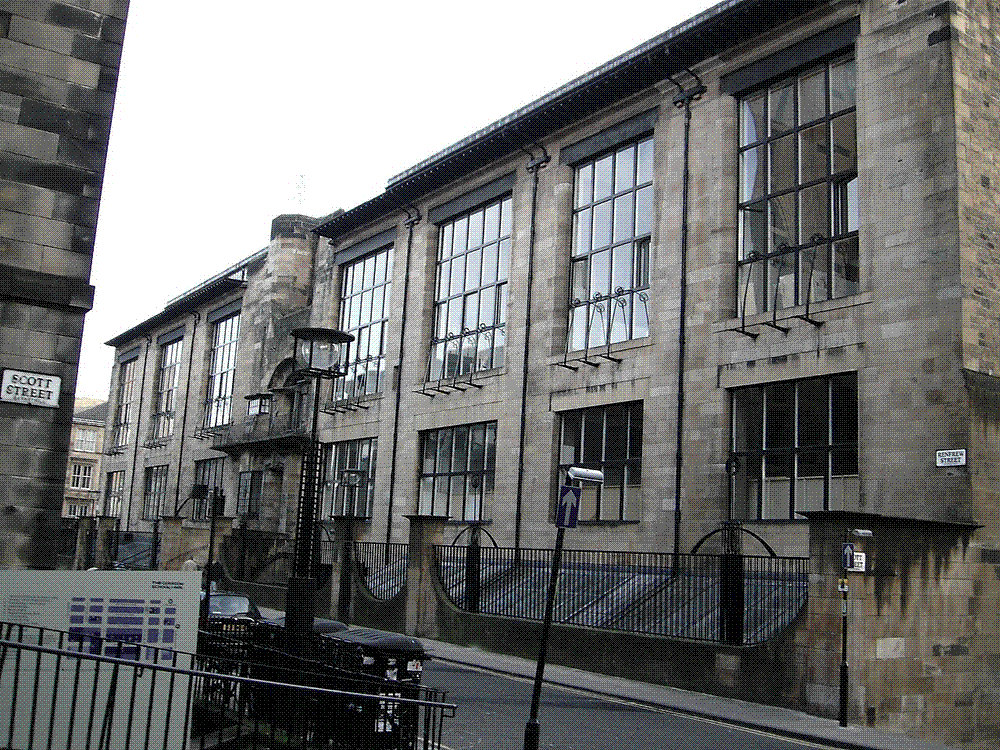
A Scottish architect launches a campaign for a full rebuild of Glasgow's fire-ravaged Mackintosh Building Architect Ruairidh Moir launched a public campaign for a faithful reconstruction of Charles Rennie Mackintosh's fire-gutted Glasgow School of Art, dubbed 'Scotland's Notre-Dame'. He called for an independent body to take over the project after the school said it could not afford the roughly £265 million rebuild alone. A petition urging Scottish and UK government support gathered thousands of signatures. Analogies The Great Fire of London devours Old St Paul's, 1666 — and Wren rebuilds it anew All Fleet street, the Old Bailey, Ludgate hill, Warwick lane, Newgate, Paul's chain, Watling street, now flaming, and most of it reduced to ashes; the stones of Paul's flew like grenados, the melting lead running down the streets in a stream, and the very pavements glowing with fiery redness, so as no horse, nor man, was able to tread on them, and the demolition had stopped all the passages, so that no help could be applied.
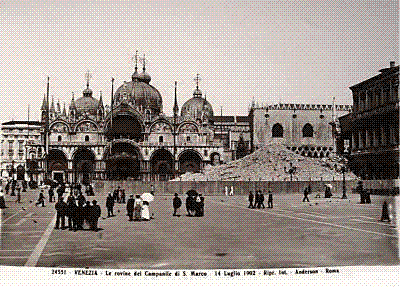
John Evelyn, 'The Diary of John Evelyn' (Vol. 2), entry for 4 September 1666, Project Gutenberg → Venice's Campanile of San Marco collapses in 1902 and is rebuilt 'as it was, where it was' When the thousand-year-old bell tower crumbled into a heap of rubble in Piazza San Marco — killing no one but the custodian's cat — Venice resolved almost at once to raise it again exactly as it had stood. Mayor Filippo Grimani's watchword, 'com'era, dov'era' (as it was, where it was), overruled voices who found the square handsomer without it or a replica devoid of historical value. The new campanile, rebuilt with surviving bricks and crowned by the one bell that outlived the fall, was consecrated in 1912, a millennium after the first foundations were laid.
St Mark's Campanile — collapse of 14 July 1902 and reconstruction (inaugurated 25 April 1912) on the principle 'com'era, dov'era', Wikipedia → The Phoenix reborn from its own ashes — Ovid's 'Metamorphoses' There is one bird which reproduces and renews itself: the Assyrians gave this bird his name—the Phoenix. He does not live either on grain or herbs, but only on small drops of frankincense and juices of amomum. ... As soon as he has strewn in this new nest the cassia bark and ears of sweet spikenard, and some bruised cinnamon with yellow myrrh, he lies down on it and refuses life among those dreamful odors.—And they say that from the body of the dying bird is reproduced a little Phoenix which is destined to live just as many years.
Ovid, 'Metamorphoses' Book XV, trans. Brookes More (1922), Theoi Classical Texts Library → Ruskin's warning: to 'restore' is 'the most total destruction which a building can suffer' Neither by the public, nor by those who have the care of public monuments, is the true meaning of the word restoration understood. It means the most total destruction which a building can suffer: a destruction out of which no remnants can be gathered; a destruction accompanied with false description of the thing destroyed. Do not let us deceive ourselves in this important matter; it is impossible, as impossible as to raise the dead, to restore anything that has ever been great or beautiful in architecture.
John Ruskin, 'The Seven Lamps of Architecture' (1849), ch. VI 'The Lamp of Memory', Project Gutenberg → Turner paints a beloved landmark ablaze: 'The Burning of the Houses of Lords and Commons' Turner stood among the crowds on the Thames the night the Palace of Westminster burned, and turned catastrophe into incandescence — a torrent of white-gold fire tearing into the sky while Westminster Bridge and the water below blaze in its reflection. The very stone of a national monument seems to dissolve into heat and light, spectators reduced to shadows at the river's edge. The painting fixes the terrible beauty of the moment a treasured building is lost, the same shock Glasgow felt watching the Mackintosh burn.
J.M.W. Turner, 'The Burning of the Houses of Lords and Commons, October 16, 1834' (1835), oil on canvas, Philadelphia Museum of Art → Stravinsky's 'Firebird' — a score of destruction giving way to radiant rebirth Stravinsky's 1910 ballet takes the Russian folk emblem of the fire-bird — kin to the phoenix — and drives its music from menace and the shattering of Kashchei's dark kingdom toward a slowly swelling hymn. In the Finale a single horn intones a quiet melody that gathers strength, instrument by instrument, until the whole orchestra blazes into a triumphant coda of bells and brass. It is the sound of something thought lost rising again, luminous and whole — the very hope a full rebuild of the Mackintosh would embody.
Igor Stravinsky, 'The Firebird' (L'Oiseau de feu), ballet, 1910, IMSLP (Petrucci Music Library) →