AI-generated
Netanyahu rejects Trump's 15-point Gaza plan, saying troops stay until Hamas disarms Israeli Prime Minister Benjamin Netanyahu publicly rejected the 15-point Gaza plan put forward by US President Trump, declaring on 11 August that Israeli forces would not withdraw until Hamas is 'genuinely disarmed' — and pairing the rejection with the announcement of a new operation on the Lebanese front. What followed was more revealing than the rejection itself: Washington declined to treat it as final, reading it as posturing ahead of Israeli elections, while Germany's foreign ministry argued the plan could still lead to Hamas's disarmament and an official of the plan's 'Board of Peace' insisted it remained operative. The week closed with the plan formally refused and practically alive — a patron's peace terms suspended between an ally's domestic politics and a negotiation that none of the parties can afford to pronounce dead. Analogies Fourteen Points, Dismembered at Versailles The program of the world's peace, therefore, is our program; and that program, the only possible program, as we see it, is this: 1. Open covenants of peace must be arrived at, after which there will surely be no private international action or rulings of any kind, but diplomacy shall proceed always frankly and in the public view.
Woodrow Wilson, Address to Congress ("Fourteen Points"), January 8, 1918 — Wikisource → Begin Rejects the Reagan Plan But it is the firm view of the United States that self-government by the Palestinians of the West Bank and Gaza in association with Jordan offers the best chance for a durable, just, and lasting peace.
Ronald Reagan, Address to the Nation on United States Policy for Peace in the Middle East, September 1, 1982 — Ronald Reagan Presidential Library → Digging Peace Out of the Pit 'Tis now, oh Greeks! the moment when freed of quarrels and fighting, we should rescue sweet Peace and draw her out of this pit, before some other pestle prevents us. Come, labourers, merchants, workmen, artisans, strangers, whether you be domiciled or not, islanders, come here, Greeks of all countries, come hurrying here with picks and levers and ropes!
Aristophanes, Peace (421 BC), anonymous translation — Project Gutenberg → The Naked, Poor, and Mangled Peace Why that the naked, poor, and mangled Peace,
Dear nurse of arts, plenties, and joyful births,
Should not in this best garden of the world,
Our fertile France, put up her lovely visage?
Alas, she hath from France too long been chas’d,
And all her husbandry doth lie on heaps,
Corrupting in it own fertility.
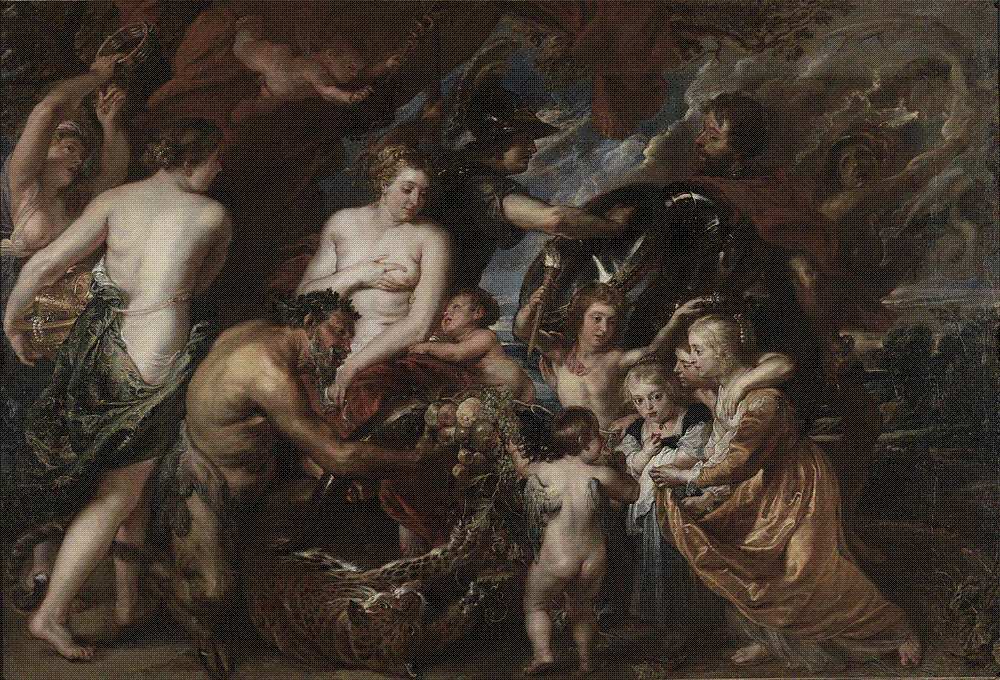
William Shakespeare, Henry V, Act 5, Scene 2 (Burgundy) — Project Gutenberg → Minerva Protects Pax from Mars Rubens painted this allegory while serving as a diplomat in London brokering peace between England and Spain, and presented it to Charles I. Pax, bathed in light, nourishes the infant Plutus while children reach for fruit spilling from a satyr's cornucopia; behind her, armored Minerva physically shoves the war god Mars back into the storm clouds. Peace here is not a settled state but a shoving match — the abundance in the foreground lasts only as long as someone keeps pushing war out of the frame.
Peter Paul Rubens, Minerva protects Pax from Mars ('Peace and War'), 1629-30 — National Gallery, London → Dona Nobis Pacem Composed in 1936 as Europe rearmed, Vaughan Williams's cantata opens with a lone soprano pleading the Mass's petition for peace over uneasy orchestral murmurs — a prayer immediately overrun when the Whitman setting Beat! Beat! Drums! sends war music smashing through church doors and schoolroom windows. The soprano's plea keeps returning between drums and dirges, a proposal for peace repeatedly shouted down by the parties it is addressed to, before the work forces its way to a fragile, unconvinced calm.
Ralph Vaughan Williams, Dona Nobis Pacem (1936) — IMSLP →