AI-generated
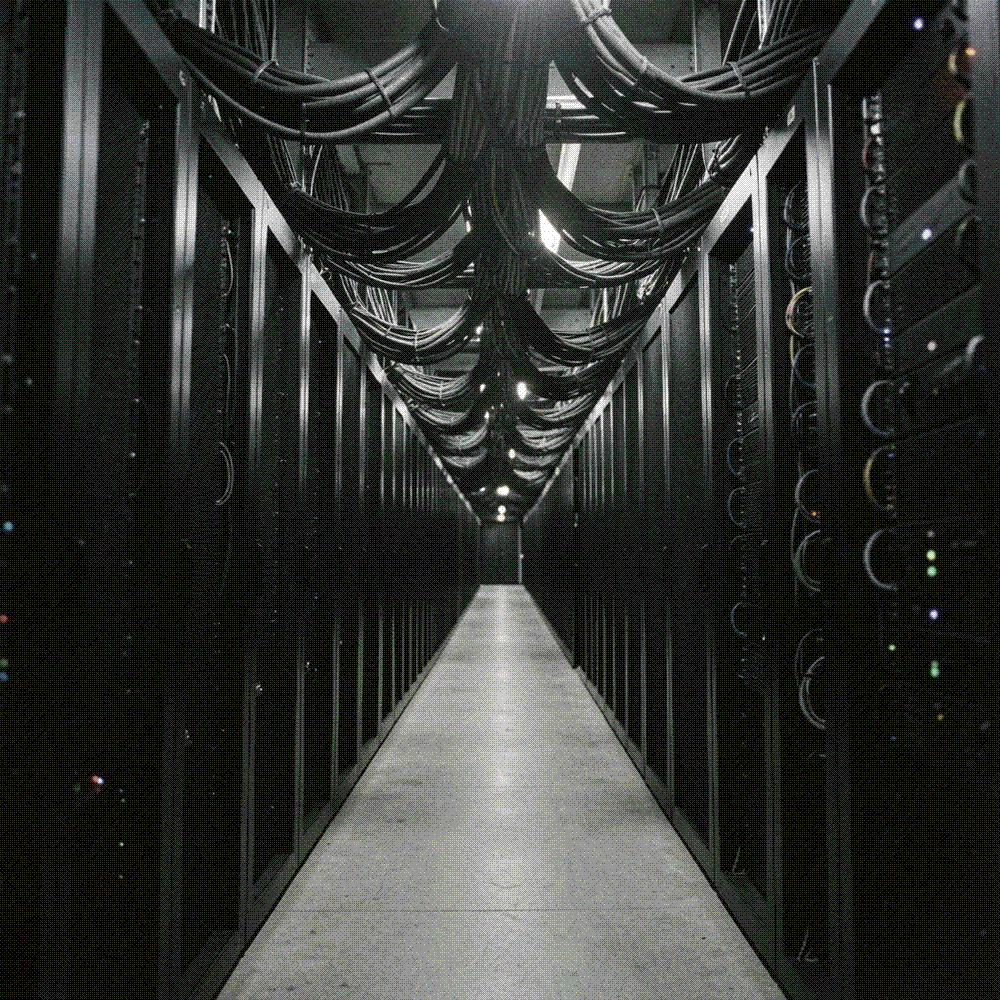
Nvidia and Wall Street line up $500 billion for AI data centers Nvidia announced on 11 August that it is partnering with major Wall Street investors to raise roughly $500 billion for AI data centers and infrastructure — a single number that put a scale on what the AI buildout has become. The week's surrounding stories read like the fine print. The US Energy Information Administration projected national power use will break records in 2026 and 2027 on AI demand; Dominion Energy was pushed deeper into costly power markets by Virginia's data-center boom; a company bought Pennsylvania land with its gas rights for a $55 million data-center site. And the financing itself came under new scrutiny: lenders questioning debt-financed projects as community opposition builds, even as the SEC exempted certain data-center bonds from securitization rules. Capital at this scale builds real things — turbines, transformers, concrete — whatever the returns turn out to be. The infrastructure is being poured now; the question of who pays for it if the promise thins is being deferred, at interest. Analogies The Railway Mania The extraordinary mania had seized on merchant and manufacturer with a power which defied control. It was condemned by parliament, and two-thirds of the members were dealers. It was condemned by the press, and editors were provisional committee men.
John Francis, A History of the English Railway: Its Social Relations and Revelations (1851) → Dark Fiber In the late 1990s, telecom firms borrowed hundreds of billions to lace continents and ocean floors with fiber-optic cable, wagering that internet traffic would double every hundred days. When the traffic failed to arrive on schedule, Global Crossing and WorldCom fell into two of the largest bankruptcies in American history — this is the filing in which WorldCom admitted that $3.8 billion of network costs had been dressed up as capital investment. Yet the dark fiber the mania left buried was real, and within a few years it carried streaming video and the cloud at prices the builders never lived to charge.
WorldCom, Inc., Form 8-K, June 25, 2002 (SEC EDGAR) → Floating the Company The object of Fisker, Montague, and Montague was not to make a railway to Vera Cruz, but to float a company. Paul thought that Mr. Fisker seemed to be indifferent whether the railway should ever be constructed or not. It was clearly his idea that fortunes were to be made out of the concern before a spadeful of earth had been moved. If brilliantly printed programmes might avail anything, with gorgeous maps, and beautiful little pictures of trains running into tunnels beneath snowy mountains and coming out of them on the margin of sunlit lakes, Mr. Fisker had certainly done much.
Anthony Trollope, The Way We Live Now (1875), ch. IX → The Iron-Hearted Power Presley saw again, in his imagination, the galloping monster, the terror of steel and steam, with its single eye, cyclopean, red, shooting from horizon to horizon; but saw it now as the symbol of a vast power, huge, terrible, flinging the echo of its thunder over all the reaches of the valley, leaving blood and destruction in its path; the leviathan, with tentacles of steel clutching into the soil, the soulless Force, the iron-hearted Power, the monster, the Colossus, the Octopus.
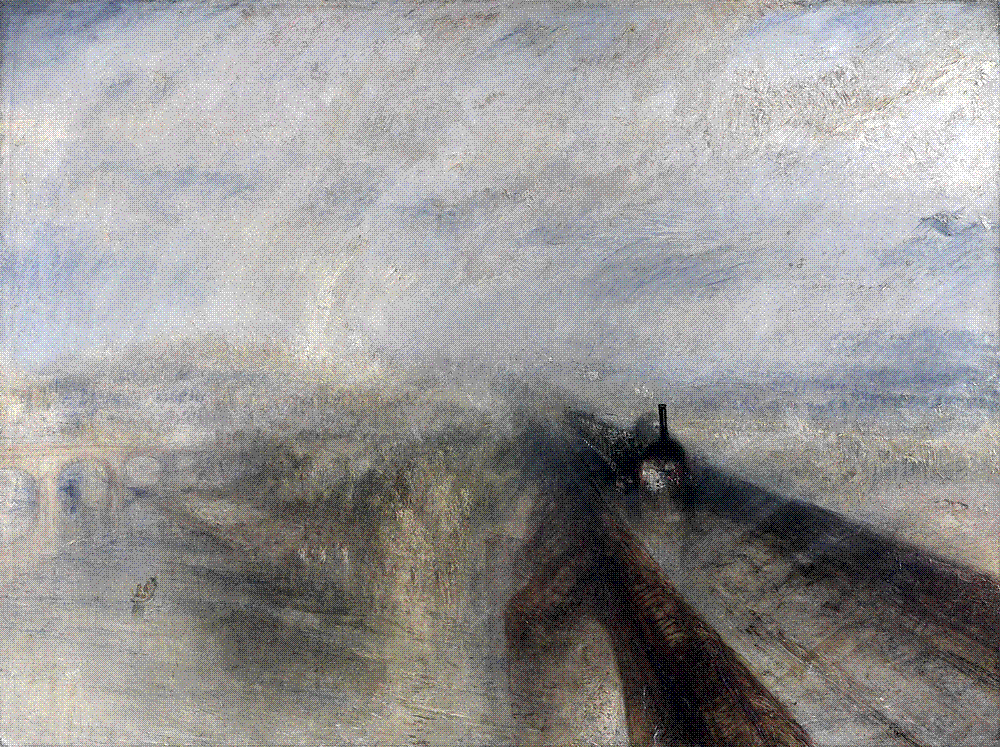
Frank Norris, The Octopus: A Story of California (1901), ch. I → Rain, Steam and Speed A Great Western locomotive bursts out of a rain-veiled Thames landscape, its black boiler the only solid thing in a world dissolved into golden mist, while a hare sprints ahead of the engine on the track — speed itself, about to be overtaken. Turner painted it in 1844, at the crest of the railway share frenzy, when capital no one could account for was pouring into embankments, viaducts and iron. The bubble burst within two years, but the bridge the train is crossing — Brunel's flat brick arches at Maidenhead — still carries trains today: the mania dissolved like the weather, and the infrastructure stayed.
J. M. W. Turner, Rain, Steam and Speed — The Great Western Railway (1844), National Gallery, London → Pacific 231 Honegger's 1923 orchestral movement renders a 300-ton Pacific-class express locomotive from standstill to full stride: pistons gathering, rhythmic figures accelerating in notated increments even as the underlying pulse broadens, until the whole orchestra is a machine at speed — then brakes shrieking it back to rest. Premiered in Paris in 1924 under Koussevitzky, it became a scandalous hit, the sound of a decade that worshipped horsepower and heavy plant as the sublime. It is what a civilization sounds like when it falls in love with its own infrastructure.
Arthur Honegger, Pacific 231, H. 53 (1923), IMSLP →