AI-generated
A suicide bombing in northwestern Pakistan kills at least 14 people, officials say A suicide bomber struck in northwestern Pakistan, killing at least 14 people and wounding many others, officials said, with reports placing the blast at an anti-militant political gathering near a police station in the Khyber Pakhtunkhwa region. No group immediately claimed responsibility. The area has seen a resurgence of militant attacks in recent years. Analogies Josephus on the Sicarii, the festival dagger-men of Jerusalem When the country was purged of these, there sprang up another sort of robbers in Jerusalem, which were called Sicarii, who slew men in the day time, and in the midst of the city; this they did chiefly at the festivals, when they mingled themselves among the multitude, and concealed daggers under their garments, with which they stabbed those that were their enemies; and when any fell down dead, the murderers became a part of those that had indignation against them; by which means they appeared persons of such reputation, that they could by no means be discovered.
Flavius Josephus, The Wars of the Jews, Book II, ch. 13, trans. William Whiston, Project Gutenberg. → Emile Henry defends the Cafe Terminus bombing at his trial The bourgeoisie did not distinguish among the anarchists. Vaillant, a man on his own, threw a bomb; nine-tenths of the comrades did not even know him. But that meant nothing; the persecution was a mass one, and anyone with the slightest anarchist links was hunted down. And since you hold a whole party responsible for the actions of a single man, and strike indiscriminately, we also strike indiscriminately.
Emile Henry, Defence Speech, Paris, 27 April 1894, Marxists Internet Archive. → Samson pulls the temple down on himself and the crowd (Judges 16, King James Version) And Samson took hold of the two middle pillars upon which the house stood, and on which it was borne up, of the one with his right hand, and of the other with his left. And Samson said, Let me die with the Philistines. And he bowed himself with all his might; and the house fell upon the lords, and upon all the people that were therein. So the dead which he slew at his death were more than they which he slew in his life.
The Holy Bible, King James Version, Judges 16:29-30, Christian Classics Ethereal Library (CCEL). → Milton, Samson Agonistes: the pillars and the burst of thunder This utter'd, straining all his nerves he bow'd,
As with the force of winds and waters pent,
When Mountains tremble, those two massie Pillars
With horrible convulsion to and fro,
He tugg'd, he shook, till down they came and drew
The whole roof after them, with burst of thunder
Upon the heads of all who sate beneath,
Lords, Ladies, Captains, Councellors, or Priests,
Thir choice nobility and flower, not only
Of this but each Philistian City round
Met from all parts to solemnize this Feast.
Samson with these immixt, inevitably
Pulld down the same destruction on himself;
John Milton, Samson Agonistes (1671), in The Poetical Works of John Milton, ed. H. C. Beeching, Project Gutenberg eBook #1745. → Francisco de Goya, The Third of May 1808 (1814) A firing squad of faceless soldiers levels its muskets at a knot of terrified civilians herded together in the dark. One man in a white shirt flings his arms wide above a heap of the already-dead, his eyes blown open in the instant before the volley. A lantern on the ground throws harsh light on the huddle, freezing an entire crowd at the edge of sudden, mechanical death.
Francisco de Goya, The Third of May 1808 in Madrid, 1814, oil on canvas, Museo Nacional del Prado, Madrid. → The assassination of Tsar Alexander II by bomb (1881) A contemporary newsprint engraving of the Catherine Canal embankment in the seconds after the second bomb. Smoke and snow churn together as figures are hurled to the ground amid scattered debris and the wreckage of the imperial coach. Bystanders and soldiers scramble at the margins, caught in the blast a lone conspirator has just set off in the crowded street.
Gustav Broling, engraving of the assassination of Alexander II, Illustrirte Zeitung, Bd. 76 (Leipzig, 1881), p. 262. → 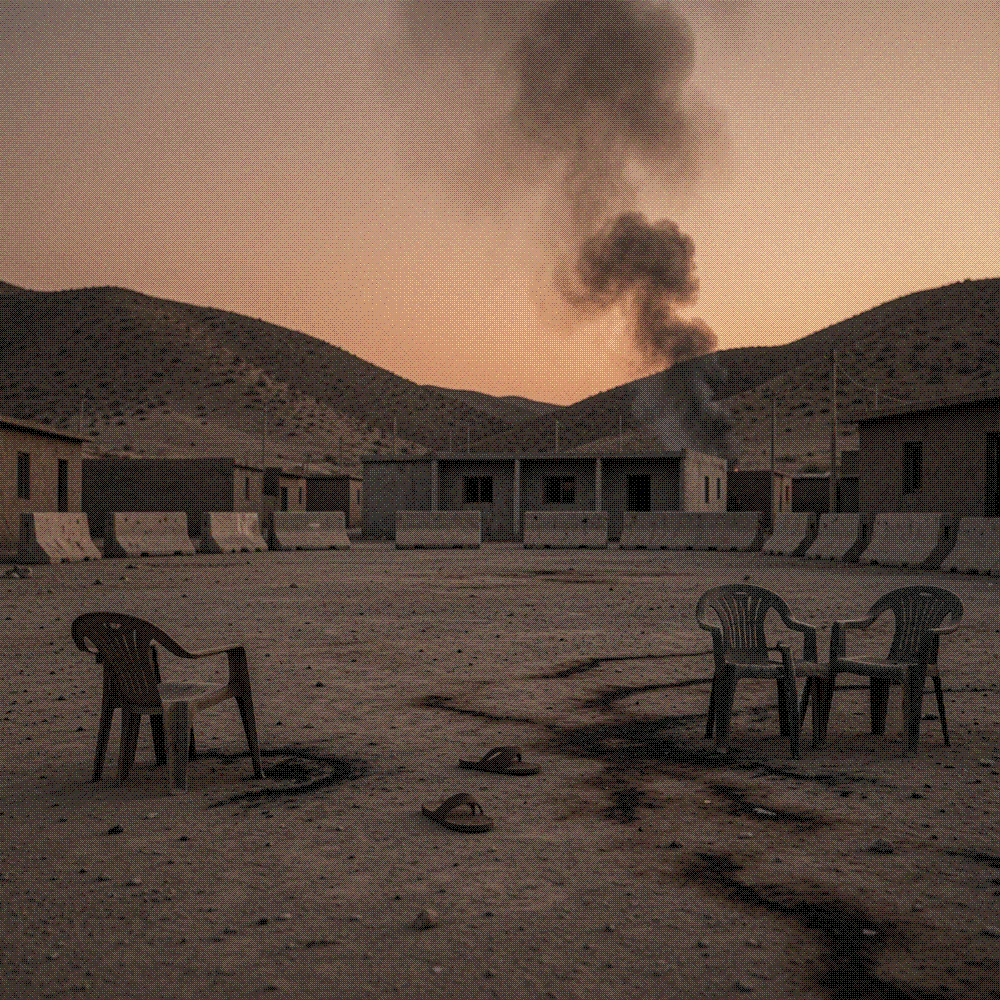

.jpg)