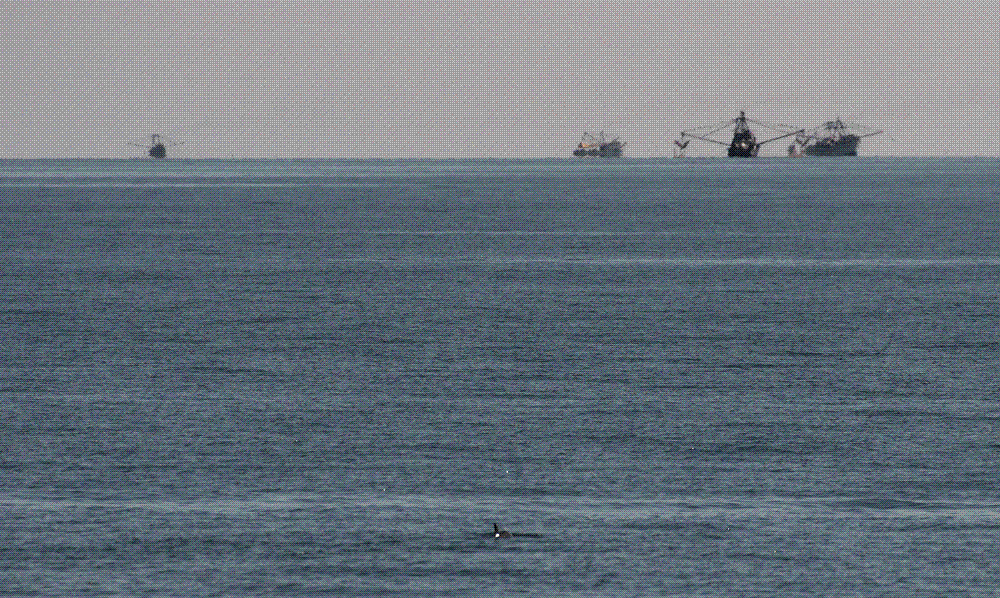
A vaquita, the world's most endangered marine mammal, surfacing in the northern Gulf of California.

Paula Olson, NOAA via Wikimedia Commons

ClimateReuters · APAug 4, 2026

The Bezos Earth Fund and Re:wild commit $200 million to pull 100 critically endangered species back from extinction in 30 countries

The Phoenix Species Project splits the money evenly between the Bezos Earth Fund and Re:wild, the conservation group co-founded by the actor Leonardo DiCaprio and the biologist Wes Sechrest, with further support from Age of Union and the Todd Graves Family Foundation. The 100 species span mammals, amphibians, reptiles, birds, fish, invertebrates and plants, and each is promised five years of sustained funding rather than short grant cycles. The organisers call it the largest single philanthropic effort aimed at recovering critically endangered species.
Analogies

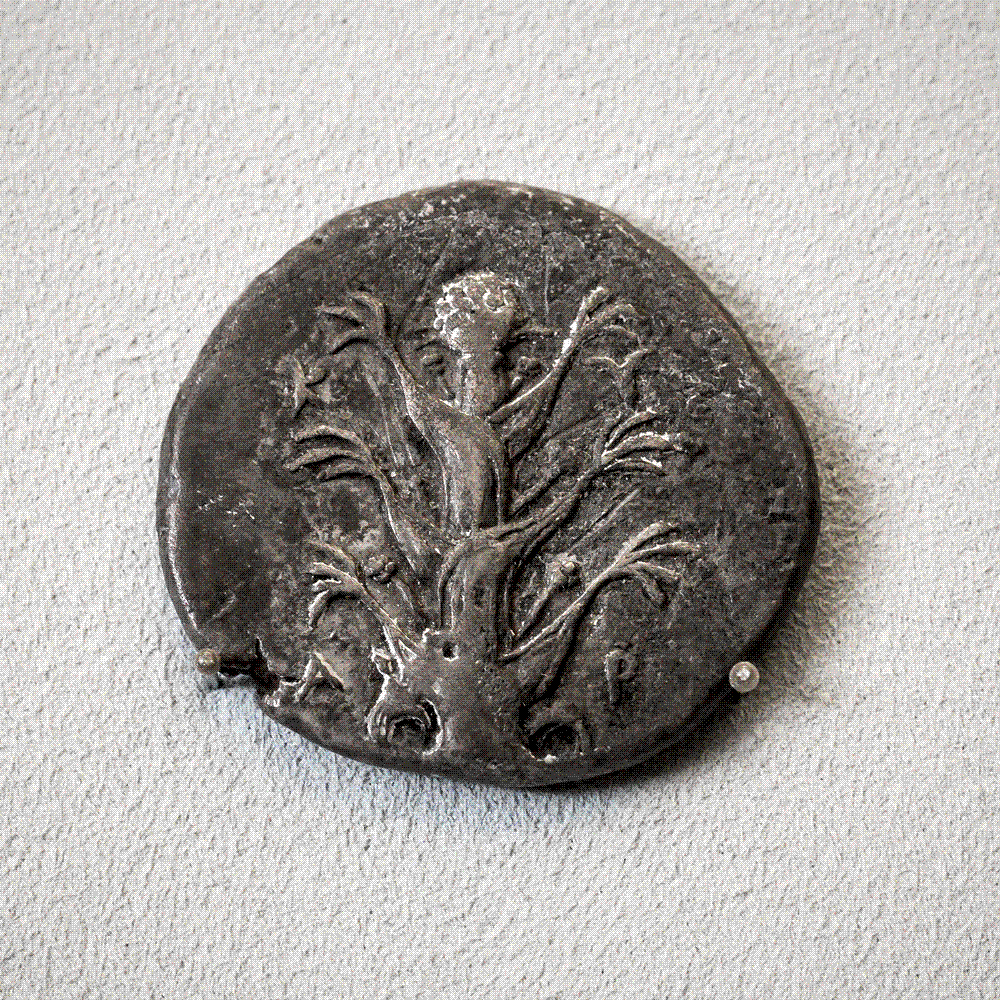
Silver tetradrachm of Kyrene, c. 435-330 BC, showing the silphium plant on the obverse and the head of Zeus Ammon on the reverse; Berlin Münzkabinett

Pliny the Elder reports that the last stalk of silphium, the plant whose sap once sold for its weight in silver, was found in Cyrenaica and sent as a curiosity to the Emperor Nero (Natural History, published c. AD 77)

Next to these, laserpitium claims our notice, a very remarkable plant, known to the Greeks by the name of "silphion," and originally a native of the province of Cyrenaica. The juice of this plant is called "laser," and it is greatly in vogue for medicinal as well as other purposes, being sold at the same rate as silver. For these many years past, however, it has not been found in Cyrenaica, as the farmers of the revenue who hold the lands there on lease, have a notion that it is more profitable to depasture flocks of sheep upon them. Within the memory of the present generation, a single stalk is all that has ever been found there, and that was sent as a curiosity to the Emperor Nero.
Pliny the Elder, Natural History, Book XIX, chapter 15 ("Laserpitium, Laser, and Maspetum"), trans. John Bostock and H. T. Riley (London: Taylor and Francis, 1855); Perseus Digital Library, Tufts University.
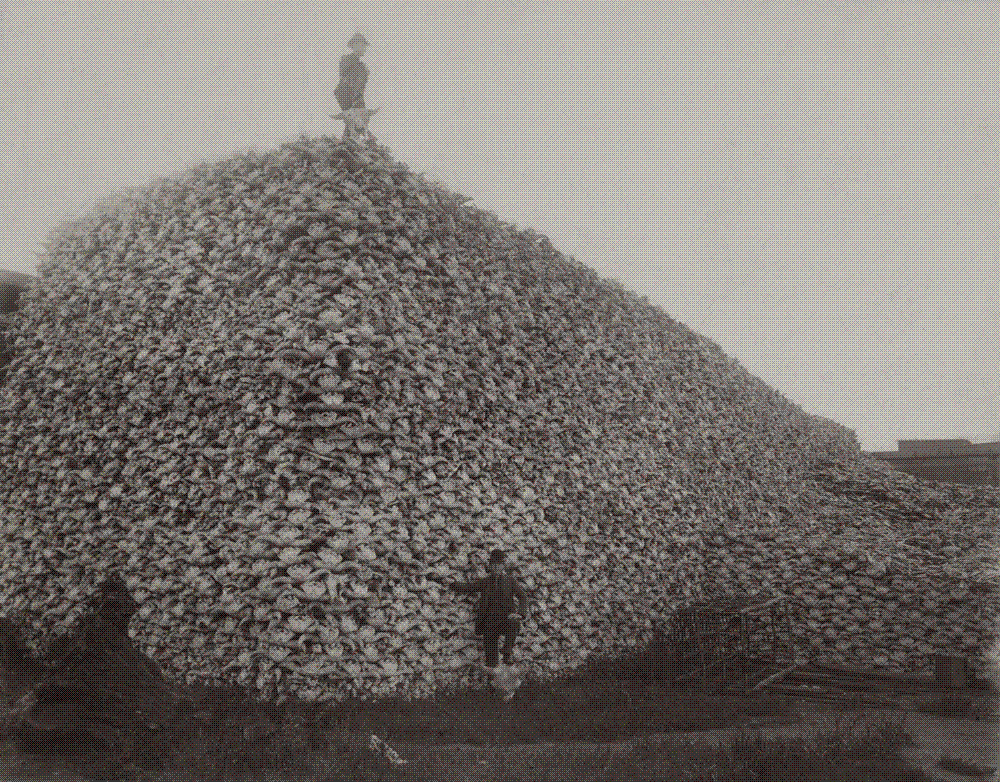
Photograph taken in 1892 of a man standing on a mountain of American bison skulls awaiting grinding for fertiliser at the Michigan Carbon Works, Rougeville, Michigan

William T. Hornaday's 1889 Smithsonian report on the extermination of the American bison, which called for the surviving animals to be bought, gathered and bred in a new National Zoological Park funded with $200,000

The Fiftieth Congress, at its last session, responded to the call made upon it, and voted $200,000 for the establishment of a National Zoological Park in the District of Columbia on a grand scale. One of the leading purposes it is destined to serve is the preservation and breeding in comfortable, and so far as space is concerned, luxurious captivity of a number of fine specimens of every species of American quadruped now threatened with extermination.
William T. Hornaday, The Extermination of the American Bison, with a Sketch of Its Discovery and Life History (Washington: Smithsonian Institution, Report of the National Museum, 1889), Part II, section VII, "Preservation of the Species from Absolute Extinction"; Project Gutenberg eBook no. 17748.
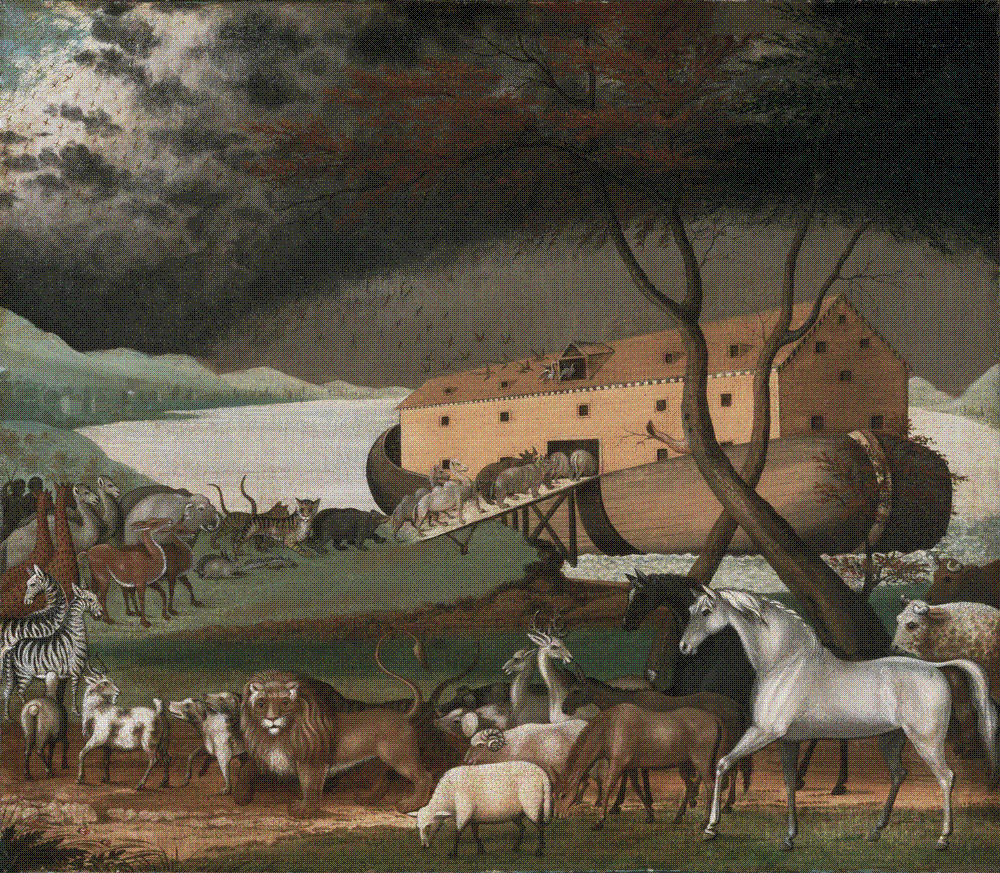
Edward Hicks, Noah's Ark, 1846, oil on canvas, showing pairs of animals filing toward the ark; Philadelphia Museum of Art

The instruction to Noah in the Book of Genesis to bring two of every living creature into the ark and to lay up food enough to keep them alive through the flood

And of every living creature of all flesh, thou shalt bring two of a sort into the ark, that they may live with thee: of the male sex, and the female. Of fowls according to their kind, and of beasts in their kind, and of every thing that creepeth on the earth according to its kind: two of every sort shall go in with thee, that they may live. Thou shalt take unto thee of all food that may be eaten, and thou shalt lay it up with thee: and it shall be food for thee and them.
Genesis 6:19-21, The Holy Bible, Douay-Rheims translation (Challoner revision); Wikisource.
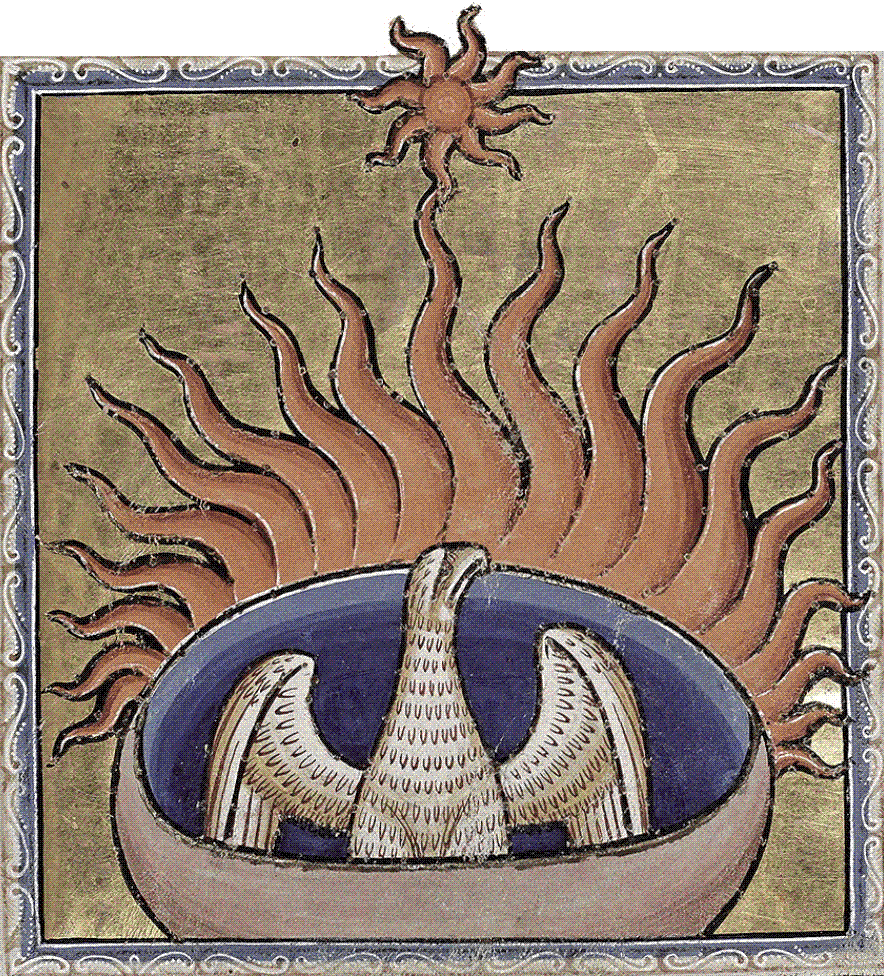
Illuminated miniature of the phoenix rising in flames beneath the sun, from the Aberdeen Bestiary, c. 1200, Aberdeen University Library MS 24

Ovid's account of the phoenix, the single bird that renews itself by dying in a nest of cinnamon and myrrh, from Book XV of the Metamorphoses (c. AD 8)

Now these I named derive their origin from other living forms. There is one bird which reproduces and renews itself: the Assyrians gave this bird his name—the Phoenix. He does not live either on grain or herbs, but only on small drops of frankincense and juices of amomum. When this bird completes a full five centuries of life straightway with talons and with shining beak he builds a nest among palm branches, where they join to form the palm tree's waving top. As soon as he has strewn in this new nest the cassia bark and ears of sweet spikenard, and some bruised cinnamon with yellow myrrh, he lies down on it and refuses life among those dreamful odors.—And they say that from the body of the dying bird is reproduced a little Phoenix which is destined to live just as many years.
Ovid, Metamorphoses, Book XV, lines 391-407 (the speech of Pythagoras), trans. Brookes More (Boston: Cornhill Publishing Co., 1922); Perseus Digital Library, Tufts University.
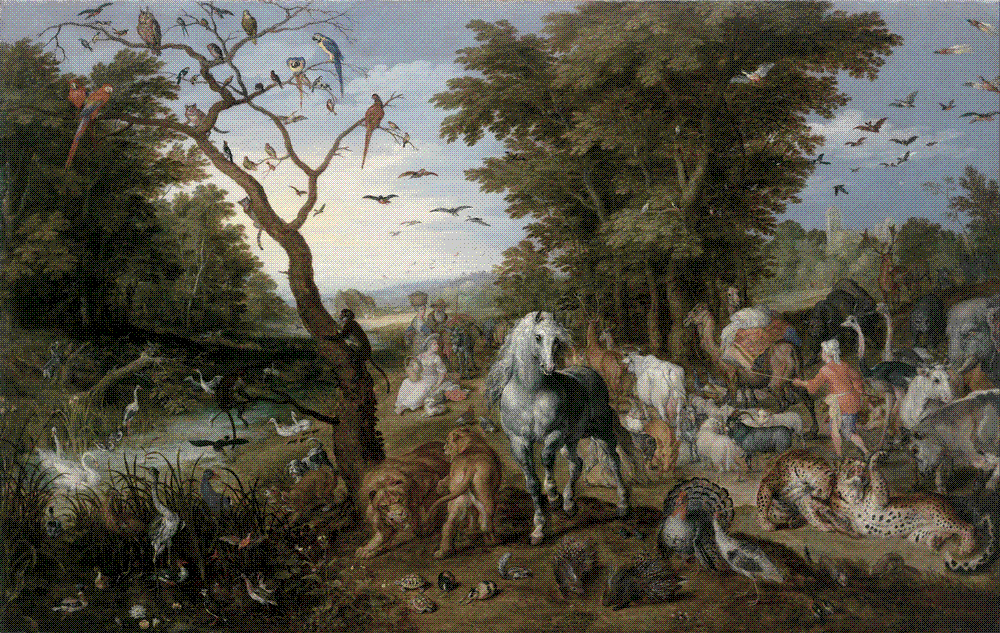
Jan Brueghel the Elder, The Entry of the Animals into Noah's Ark, 1613, oil on panel; birds, big cats, horses and livestock gathered in a wooded landscape as Noah leads them toward the ark

Jan Brueghel the Elder's painting The Entry of the Animals into Noah's Ark (1613), an inventory in oil of every creature then known to Europe

Brueghel crowds a single small panel with the whole of creation on the move: macaws and parrots perched in a dead tree, lions and leopards stretched out on the grass, ostriches, camels, porcupines, swans and guinea pigs pressing toward the small ark on the horizon. Painted in Antwerp at the height of the age of exploration, it is a picture of biological plenty assembled by a wealthy court painter for wealthy collectors, with the flood already implied in the darkening sky. Several of the birds and beasts he set down from life in the archducal menagerie were species Europe had known for barely a generation.
Jan Brueghel the Elder (Flemish, 1568-1625), The Entry of the Animals into Noah's Ark, 1613, oil on panel, 54.6 × 83.8 cm, J. Paul Getty Museum, Los Angeles, accession no. 92.PB.82.
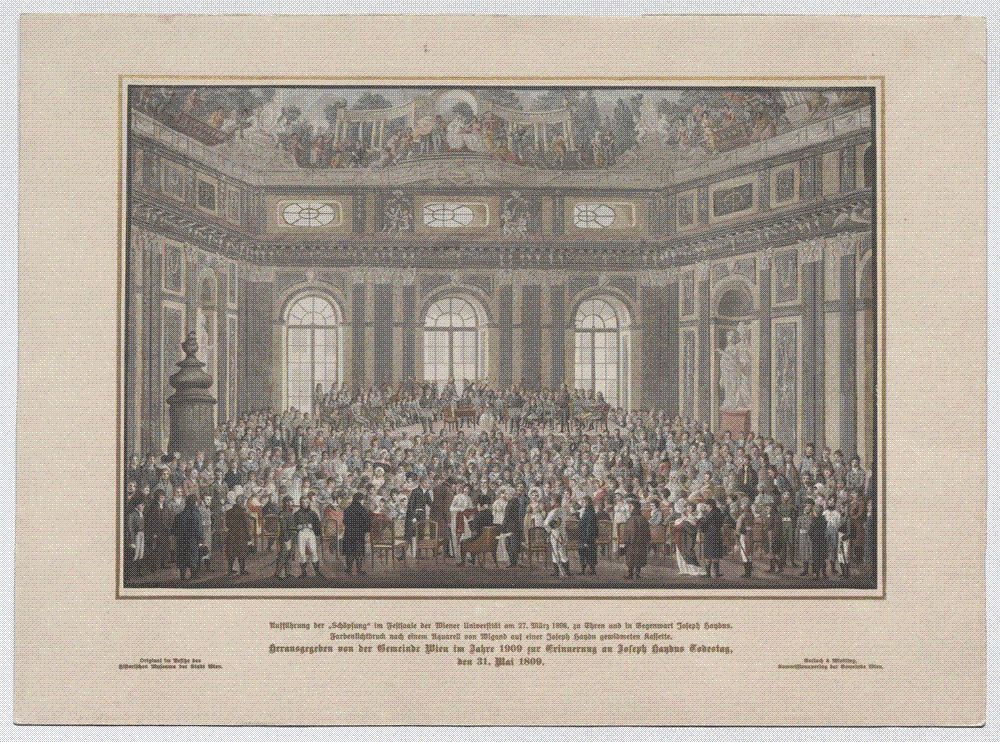
Balthasar Wigand's gouache of the performance of Haydn's The Creation in the hall of the University of Vienna on 27 March 1808, with the aged Haydn seated in the foreground

Joseph Haydn's oratorio Die Schöpfung (The Creation), Hob. XXI:2, first performed in Vienna in 1798-99, which sets the making of every living kind to music

Haydn's Part II is a musical bestiary: the orchestra roars for the lion, bounds for the tiger and stag, drags its lowest notes along the ground for the worm, and lifts into birdsong for the eagle, the lark and the cooing doves, before the chorus blesses everything that lives and bids it be fruitful and multiply. The oratorio was itself a work of patronage, commissioned and underwritten by a syndicate of Viennese noblemen, and Haydn conducted charity performances of it for the rest of his life. At the last of them, in March 1808, the frail composer was carried into the hall in an armchair to hear his catalogue of creatures sung back to him.
Joseph Haydn, Die Schöpfung (The Creation), Hob. XXI:2, libretto by Gottfried van Swieten after Genesis, Milton and the Psalms; full score and parts, IMSLP / Petrucci Music Library.