BBC
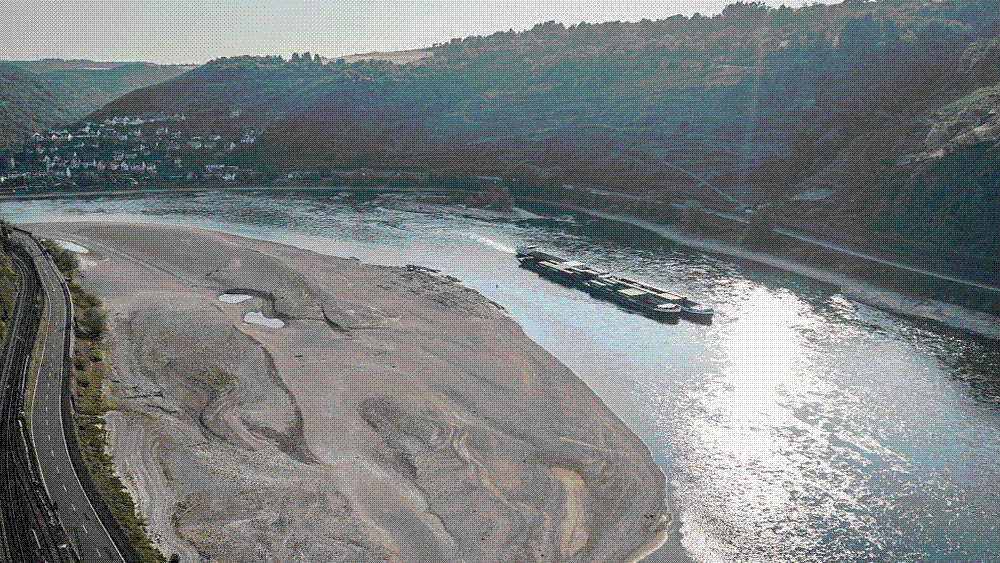
Climate BBC · AP · Aug 3, 2026 The Rhine falls to record-low water levels as a severe drought grips rivers across Europe Water levels on the Rhine dropped to record lows as a hot, dry summer parched rivers across Europe, with the Danube and Po also shrinking. The low water has curtailed cargo shipping and cut hydroelectric output, officials said. Drought warnings stretched from Britain to the Balkans as wildfires burned in France and Greece. Analogies The Famine Stela of Sehel Island Carved onto a granite boulder overlooking the Nile at the First Cataract, this inscription speaks in the voice of the pharaoh Djoser, recalling seven years in which the god Hapy — the annual flood — failed to arrive: the grain shriveled, the granaries stood empty, and the whole land starved until the king appealed to the ram-god Khnum at the river's supposed source to loose the waters again. It is humanity's oldest surviving account of a nation brought to ruin by a great river running low, and a reminder that in the ancient world a shrunken river meant not inconvenience but famine.
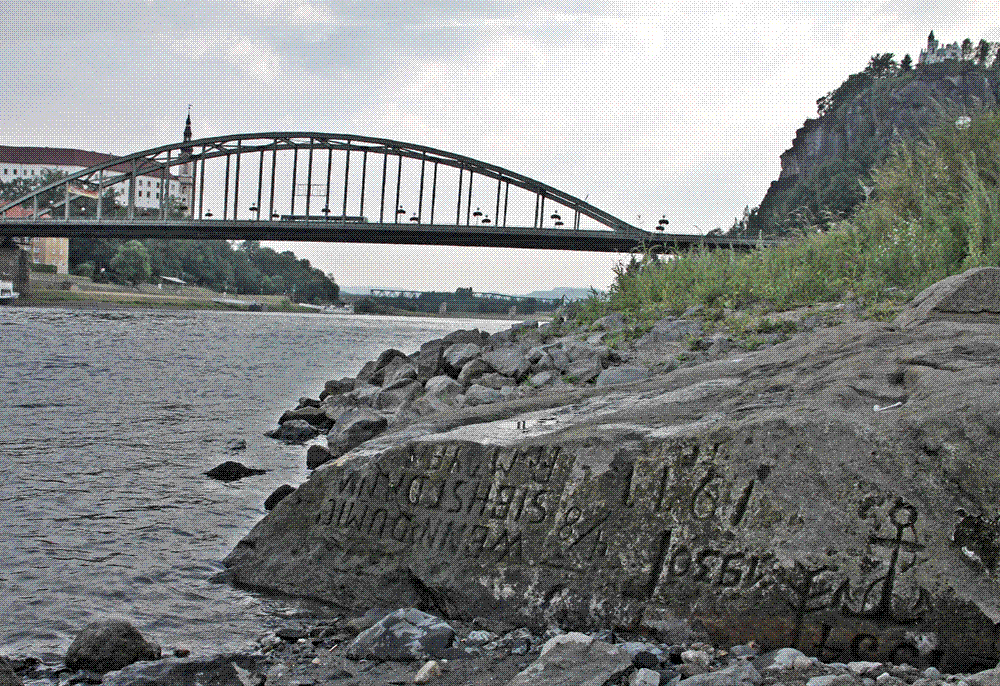
The Famine Stela, Sehel Island near Aswan, Egypt (carved in the Ptolemaic period, c. 3rd–2nd c. BCE, purporting to record the reign of King Djoser of the 3rd Dynasty); English translation by Miriam Lichtheim, Ancient Egyptian Literature, vol. 3 (1980), via Attalus.org → The Elbe Hunger Stone at Děčín "Wenn du mich siehst, dann weine" — "If you see me, weep." This warning is cut into a boulder that lies submerged in the Elbe and reappears only in the driest years, when the water sinks to famine-low levels; the Děčín stone's oldest legible date is 1616. Generations of Central Europeans carved such marks so that anyone who saw the same rock bared again by drought would know hard times — failed harvests and hunger — were on the way. When the great European droughts of recent summers exposed these stones once more, an early-modern message crossed four centuries intact.
Hunger stone, Elbe River at Děčín, Czech Republic; the boulder's oldest legible carving dates to 1616. Documented via Wikipedia / Wikimedia Commons → Ovid, Metamorphoses, Book II (The Fall of Phaethon) Caister's streams amid. In terror Nile / Fled to the farthest earth, and sunk his head, / Yet undiscover'd!--void the seven-fold stream, / His mouth seven dry and dusty vales disclos'd. / Now Hebrus dries, and Strymon, Thracian floods: / And streams Hesperian, Rhine; and Rhone; and Po; / And Tiber, destin'd all the world to rule.
Ovid, The Metamorphoses of Publius Ovidius Naso in English Blank Verse, Book the Second, translated by J. J. Howard (London, 1807), Project Gutenberg → T. S. Eliot, The Waste Land (Part V) Here is no water but only rock / Rock and no water and the sandy road / The road winding above among the mountains / Which are mountains of rock without water / If there were water we should stop and drink / Amongst the rock one cannot stop or think / Sweat is dry and feet are in the sand ... Dead mountain mouth of carious teeth that cannot spit ... There is not even silence in the mountains / But dry sterile thunder without rain
T. S. Eliot, The Waste Land (1922), Part V, 'What the Thunder Said', Project Gutenberg → Elijah in the Wilderness Leighton paints the prophet Elijah collapsed on sun-baked rock during the three-year drought he had called down upon Israel (1 Kings 17–18), his sinewy, sun-darkened body sprawled in exhaustion while an angel stoops to offer bread and a cruse of water. The cracked tawny wilderness and the fallen man make visible what a killing drought does to the living — a land where the rains have simply stopped and even the strongest are laid low. It turns the abstraction of a rainless season into a single human body at the edge of endurance.
Frederic Leighton, Elijah in the Wilderness (1877–78), oil on canvas, Walker Art Gallery, Liverpool; Google Art Project via Wikimedia Commons → Haydn, The Seasons — 'Summer' In the 'Summer' part of Haydn's oratorio, the music depicts a countryside gasping beneath a merciless noon sun — sultry, shimmering air, languishing flocks, and fields drooping in the heat — before a great orchestral thunderstorm at last breaks the drought with rain. Composed in 1801 to Gottfried van Swieten's libretto, it is one of the most vivid portraits in all of music of parched land longing for water, and of the relief when the sky finally opens. The listener hears the very arc of a hot, dry summer and its overdue rescue.
Joseph Haydn, Die Jahreszeiten (The Seasons), Hob. XXI:3, Part 2 'Der Sommer' (first performed 1801), full and vocal scores at IMSLP →