AI-generated
Saudi Arabia, Turkey and Pakistan sign a mutual defense pact likened to NATO's Article 5 Three regional powers bound themselves together this week. Saudi Arabia, Turkey and Pakistan signed a mutual defense pact on 8 August under which an attack on any signatory is to be treated as an attack on all — language a Turkish official called 'technically the same' as NATO's Article 5. The days that followed were spent managing what the signature implied. Turkey insisted the pact was aimed at no one, Iran included; Pakistan called it 'purely defensive' and open to further members; Iran answered that it saw no reason for fear. The reassurances traced the pact's real significance: a nuclear-armed state, NATO's second-largest army and the Gulf's wealthiest kingdom have drawn a formal tripwire across the Middle East and South Asia at a moment when the region's alignments — from the Hormuz standoff to the Gaza negotiations — are being redrawn week by week. Whether it stabilizes or entangles now depends on where the first test comes from. Analogies The Baghdad Pact: The Last Time This Map Was Drawn Consistent with article 51 of the United Nations Charter the High Contracting Parties will co-operate for their security and defence. Such measures as they agree to take to give effect to this co-operation may form the subject of special agreements with each other.
Pact of Mutual Cooperation Between Iraq, Turkey, the United Kingdom, Pakistan, and Iran (Baghdad Pact), February 24, 1955 — The Avalon Project, Yale Law School → 1892: A Purely Defensive War, on Automatic France and Russia, being animated by a common desire to preserve peace, and having no other object than to meet the necessities of a defensive war, provoked by an attack of the forces of the Triple Alliance against either of them, have agreed upon the following provisions: 1. If France is attacked by Germany, or by Italy supported by Germany, Russia shall employ all her available forces to attack Germany. If Russia is attacked by Germany, or by Austria supported by Germany, France shall employ all her available forces to attack Germany. 2. In case the forces of the Triple Alliance, or of any one of the Powers belonging to it, should be mobilized, France and Russia, at the first news of this event and without previous agreement being necessary, shall mobilize immediately and simultaneously the whole of their forces, and shall transport them as far as possible to their frontiers.
The Franco-Russian Alliance Military Convention, August 18, 1892 — The Avalon Project, Yale Law School → Thucydides: The Defensive Alliance That Started the War It was to be a defensive, not an offensive alliance. It did not involve a breach of the treaty with Peloponnese: Athens could not be required to join Corcyra in any attack upon Corinth. But each of the contracting parties had a right to the other’s assistance against invasion, whether of his own territory or that of an ally. For it began now to be felt that the coming of the Peloponnesian war was only a question of time, and no one was willing to see a naval power of such magnitude as Corcyra sacrificed to Corinth
Thucydides, History of the Peloponnesian War, Book I, ch. 44 (trans. Richard Crawley) — Project Gutenberg → Machiavelli: Never Ally with the Stronger And here it is to be noted that a prince ought to take care never to make an alliance with one more powerful than himself for the purposes of attacking others, unless necessity compels him, as is said above; because if he conquers you are at his discretion, and princes ought to avoid as much as possible being at the discretion of any one. The Venetians joined with France against the Duke of Milan, and this alliance, which caused their ruin, could have been avoided.
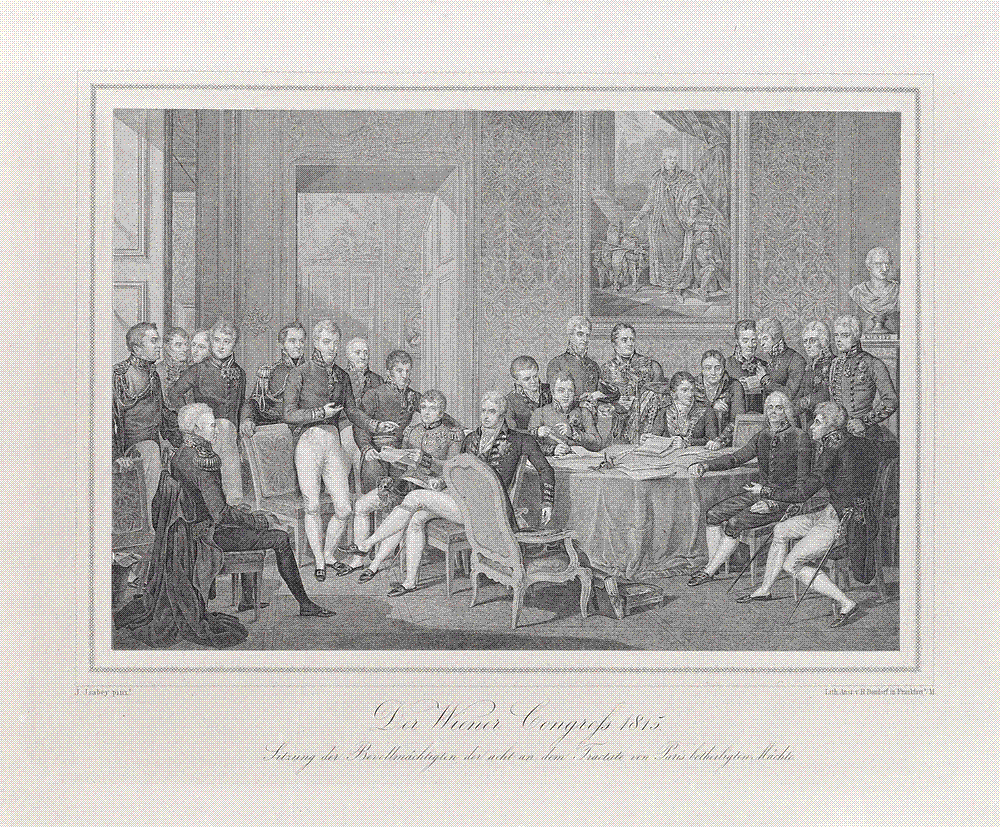
Niccolò Machiavelli, The Prince, Chapter XXI (trans. W. K. Marriott) — Project Gutenberg → Isabey's Congress of Vienna: Collective Security as a Seating Chart Isabey freezes the plenipotentiaries of the eight powers — Wellington, Metternich, Castlereagh, Talleyrand — around a single table, every figure keyed by number so the viewer can trace exactly who stands where. The composition is the treaty made visible: security is not an army but an arrangement of bodies in a room, a geometry of who sits beside whom. It is the founding image of the alliance conference — insurance drawn as a group portrait, before anyone learns which of these carefully placed gentlemen the tripwire will pull in first.
Print after Jean-Baptiste Isabey, Delegates at the Congress of Vienna, 1814–1815 — Rijksmuseum, Amsterdam (RP-P-OB-87.274) → Beethoven's Wellington's Victory: Coalition War Scored for Orchestra Beethoven stages an alliance war inside the concert hall: two orchestras face each other as armies, the British side announced by 'Rule Britannia,' the French by their own marching tune, with ratchets and drums firing musket volleys across the stage. Each nation is literally its anthem, and the battle is the collision of the two melodies until one is broken and the other swells into victory. Written to celebrate the coalition triumph at Vitoria, it is collective defense as spectacle — the bloc as a band, where once the downbeat falls, every instrument is committed to the fight.
Ludwig van Beethoven, Wellingtons Sieg, oder Die Schlacht bei Vittoria, Op. 91 (1813) — IMSLP (public domain) →