Wikimedia Commons
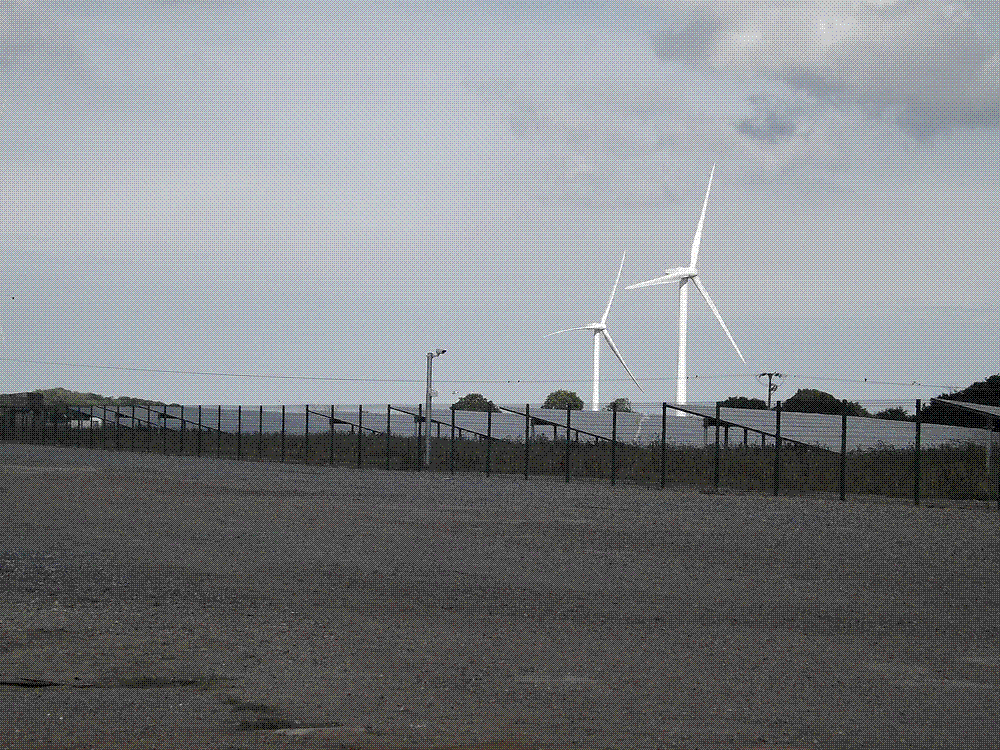
Shell agrees to sell its European onshore wind, solar and battery business, a roughly four-gigawatt portfolio, to France's TotalEnergies as it retreats from renewables Shell agreed to sell its European onshore renewables arm, with about four gigawatts of wind, solar and battery projects in operation and development across the UK, Italy, the Netherlands and Spain, to TotalEnergies. The deal, expected to close by year end pending regulatory approval, deepens Shell's pullback from low-carbon energy under chief executive Wael Sawan. TotalEnergies is expanding its renewables footprint even as European majors diverge on green strategy. Analogies The Low Countries Call the Air to Their Aid To drain the lakes they called the air to their aid. The lakes and marshes were surrounded with dykes, the dykes with canals and an army of windmills; these, putting the suction-pumps in motion, poured the waters into the canals, which conducted them into the rivers and to the sea. Thus vast areas of ground which were buried under water saw the light, and were transformed, as if by enchantment, into fertile plains covered with villages and traversed by roads and canals.
Edmondo De Amicis, Holland (Vol. 1 of 2), trans. Caroline Tilton (1880); Project Gutenberg eBook #27799. → Churchill Bets the Fleet on Oil On no one quality, on no one process, on no one country, on no one company, and no one route, and on no one oil field must we be dependent. Safety and certainty in oil lie in variety, and in variety alone.
Winston Churchill, First Lord of the Admiralty, speech on the Navy Estimates, House of Commons, 17 July 1913 (HC Deb 17 July 1913, vol 55, cc1465-584); UK Parliament Historic Hansard. → Tilting at Windmills At this point they came in sight of thirty or forty windmills that there are on that plain, and as soon as Don Quixote saw them he said to his squire, “Fortune is arranging matters for us better than we could have shaped our desires ourselves, for look there, friend Sancho Panza, where thirty or more monstrous giants present themselves, all of whom I mean to engage in battle and slay…” “What giants?” said Sancho Panza. … “Look, your worship,” said Sancho; “what we see there are not giants but windmills, and what seem to be their arms are the sails that turned by the wind make the millstone go.”
Miguel de Cervantes, Don Quixote, Part I, Chapter VIII, trans. John Ormsby (1885); Project Gutenberg eBook #996. → Ode to the West Wind Drive my dead thoughts over the universe
Like withered leaves to quicken a new birth!
And, by the incantation of this verse,
Scatter, as from an unextinguished hearth
Ashes and sparks, my words among mankind!
Be through my lips to unawakened earth
The trumpet of a prophecy! O, Wind,
If Winter comes, can Spring be far behind?
Percy Bysshe Shelley, “Ode to the West Wind” (1820), in The Complete Poetical Works of Percy Bysshe Shelley, ed. Thomas Hutchinson (1914); Wikisource. → The Windmill at Wijk bij Duurstede Ruisdael sets a single great tower windmill against a vast, storm-heavy Dutch sky, its sails motionless yet its bulk towering over the church and castle it dwarfs. Painted at the height of the Dutch Golden Age, the picture makes the wind machine a monument of national ingenuity and civic pride, a whole country's economy built on harnessing the moving air. It stands as the emblem of an era that embraced wind as the engine of its prosperity, the mirror image of a modern retreat from it.
Jacob van Ruisdael, The Windmill at Wijk bij Duurstede, c. 1668–1670, oil on canvas, Rijksmuseum, Amsterdam (SK-C-211). → Impression, Sunrise Monet's hazy dawn over the harbor of Le Havre reduces the sun to a single burning orange disc, its light rippling across grey-blue water among ghostly ships and cranes. The 1872 canvas gave Impressionism its name and turned the rising sun into a symbol of a new dawn in art. That the French master's most famous sunrise now doubles as an emblem of solar energy is fitting, as France's TotalEnergies is the buyer betting on the light Shell is walking away from.
Claude Monet, Impression, Sunrise (Impression, soleil levant), 1872, oil on canvas, Musée Marmottan Monet, Paris. →