BBC
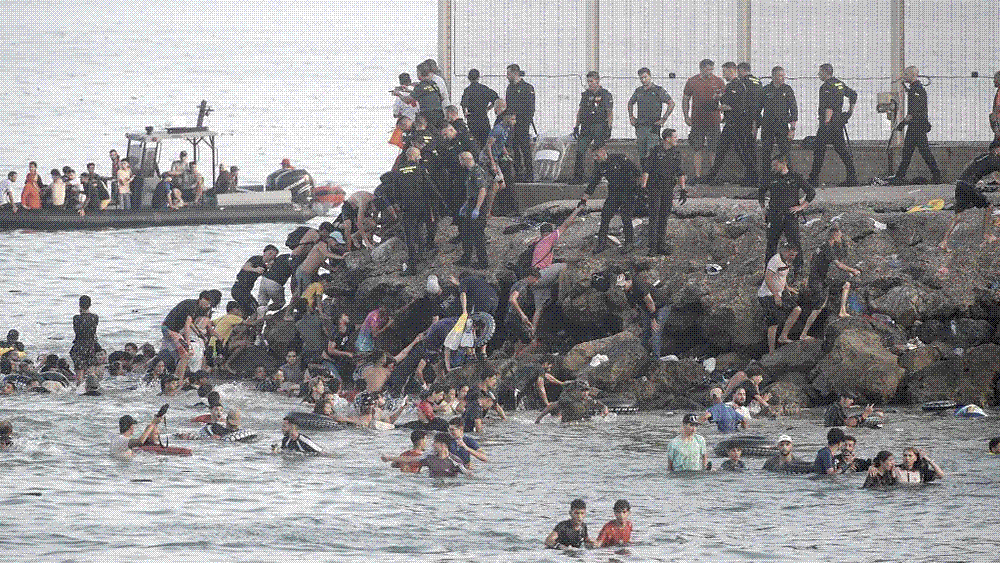
Politics AP · BBC · Aug 3, 2026 Hundreds of migrant children remain stranded in Spain's Ceuta as the EU calls for stronger external borders Hundreds of unaccompanied migrant children were left stranded in Spain's North African enclave of Ceuta after a mass border crossing overwhelmed local shelters. European Commission President Ursula von der Leyen called for stronger external borders ahead of an urgent meeting of EU interior ministers. Spain and Morocco traded blame over the surge. Analogies The Alhambra Decree: Spain expels its Jews across the sea (1492) we order all Jews and Jewesses of whatever age they may be … that by the end of the month of July next of the present year, they depart from all of these our said realms and lordships, along with their sons and daughters, menservants and maidservants, Jewish familiars, those who are great as well as the lesser folk, of whatever age they may be, and they shall not dare to return to those places.
Ferdinand and Isabella, Alhambra Decree (Edict of the Expulsion of the Jews of Spain), Granada, 31 March 1492; English translation hosted by Florida Atlantic University → The Kindertransport: unaccompanied children sent to safety (1938–1940) In the nine months between Kristallnacht and the outbreak of war, Britain admitted roughly 10,000 mostly Jewish children from Germany, Austria and Czechoslovakia—unaccompanied minors placed by desperate parents into the hands of strangers. They travelled by train and boat with identification tags around their necks; the first transport reached Harwich on 2 December 1938, and many of the children never saw their families again. Like the youngsters stranded in Ceuta, they arrived as children first and refugees second, dependent wholly on how the receiving country chose to answer the border.
United States Holocaust Memorial Museum, Holocaust Encyclopedia, 'Kindertransport, 1938–40' → 'The New Colossus': the gate that welcomes the wretched "Keep, ancient lands, your storied pomp!" cries she
With silent lips. "Give me your tired, your poor,
Your huddled masses yearning to breathe free,
The wretched refuse of your teeming shore.
Send these, the homeless, tempest-tost to me,
I lift my lamp beside the golden door!"
Emma Lazarus, 'The New Colossus' (sonnet, 1883), as reproduced by the U.S. National Park Service (Statue of Liberty National Monument) → The Aeneid: the exile driven from his shore by sea and land Arms, and the man I sing, who, forc'd by fate,
And haughty Juno's unrelenting hate,
Expell'd and exil'd, left the Trojan shore.
Long labours, both by sea and land, he bore
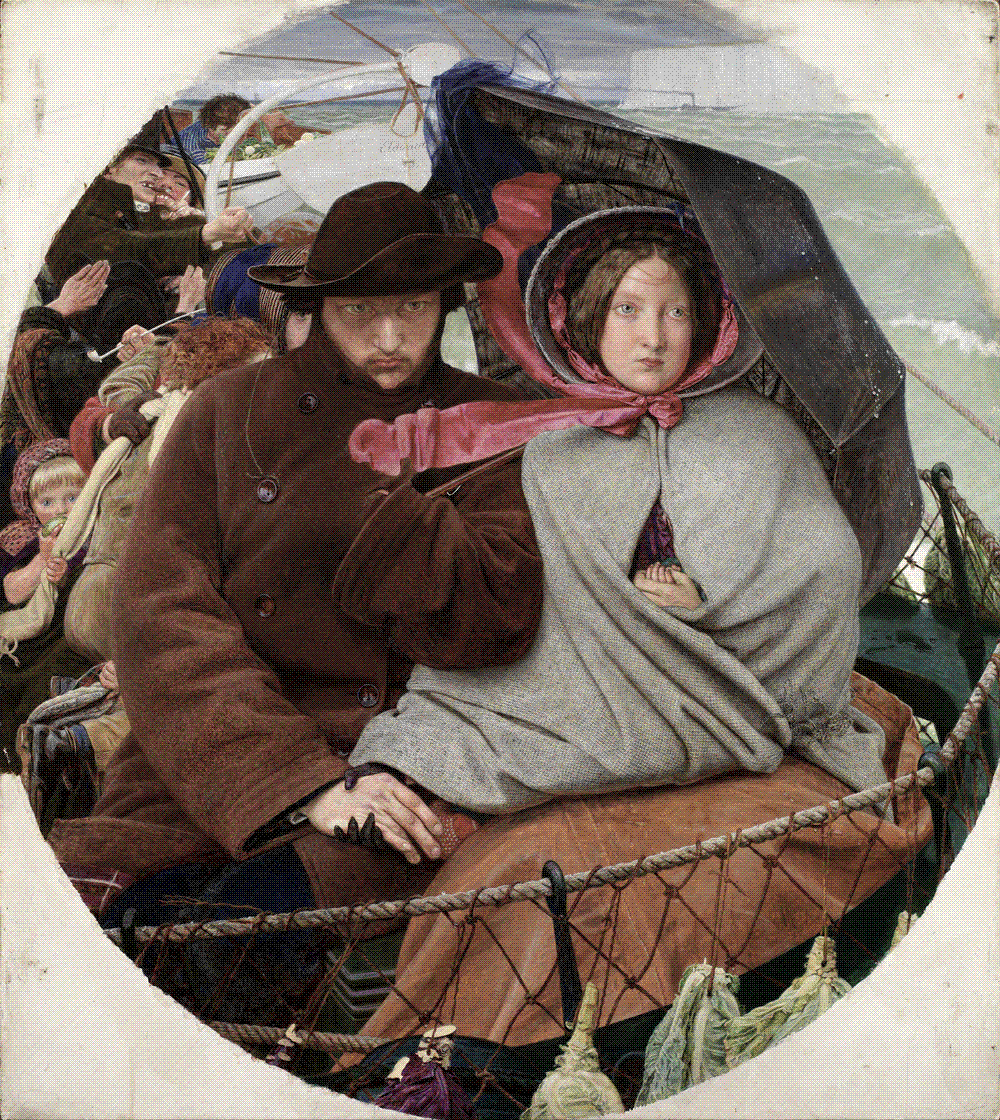
Virgil, Aeneid, Book I (trans. John Dryden), Project Gutenberg → 'The Last of England': a family departs its homeland by sea Brown paints emigration as intimate dread rather than adventure: a young couple, modelled on the artist and his wife, huddle on the deck of a departing ship, the white cliffs of England receding behind them under a grey sky. Her hand clasps a tiny fist barely visible beneath her cloak—their infant, carried into exile. The tight oval frame and their fixed, forward stares make the viewer feel the irreversibility of leaving one shore for an uncertain welcome on another.
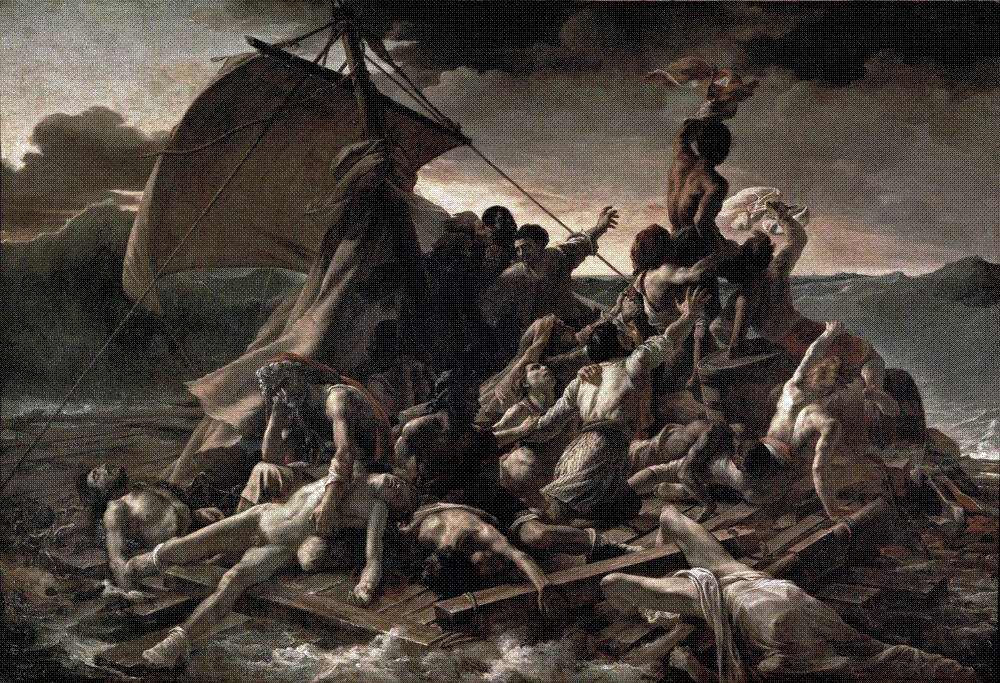
Ford Madox Brown, 'The Last of England', oil on panel, 1855, Birmingham Museum and Art Gallery → 'The Raft of the Medusa': the stranded straining toward rescue Géricault built his vast canvas from a real catastrophe: the 1816 wreck of the frigate Méduse, whose castaways were left to drift on a makeshift raft where only fifteen of some 150 survived twelve days at sea. He paints the instant of desperate hope—survivors, living and dead, piled in a pyramid of bodies as one waves a scrap of cloth at a ship barely visible on the horizon. Two centuries on, the image reads as a prophecy of the overloaded boats and stranded lives of the Mediterranean crossing.
Théodore Géricault, 'Le Radeau de la Méduse' (The Raft of the Medusa), oil on canvas, 1818–1819, Musée du Louvre, Paris (INV 4884) →