BBC
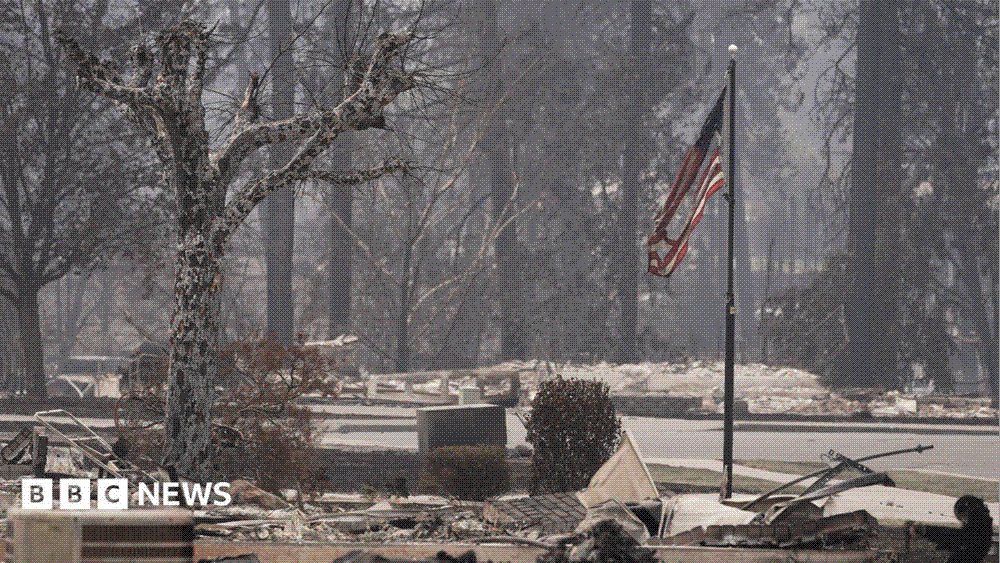
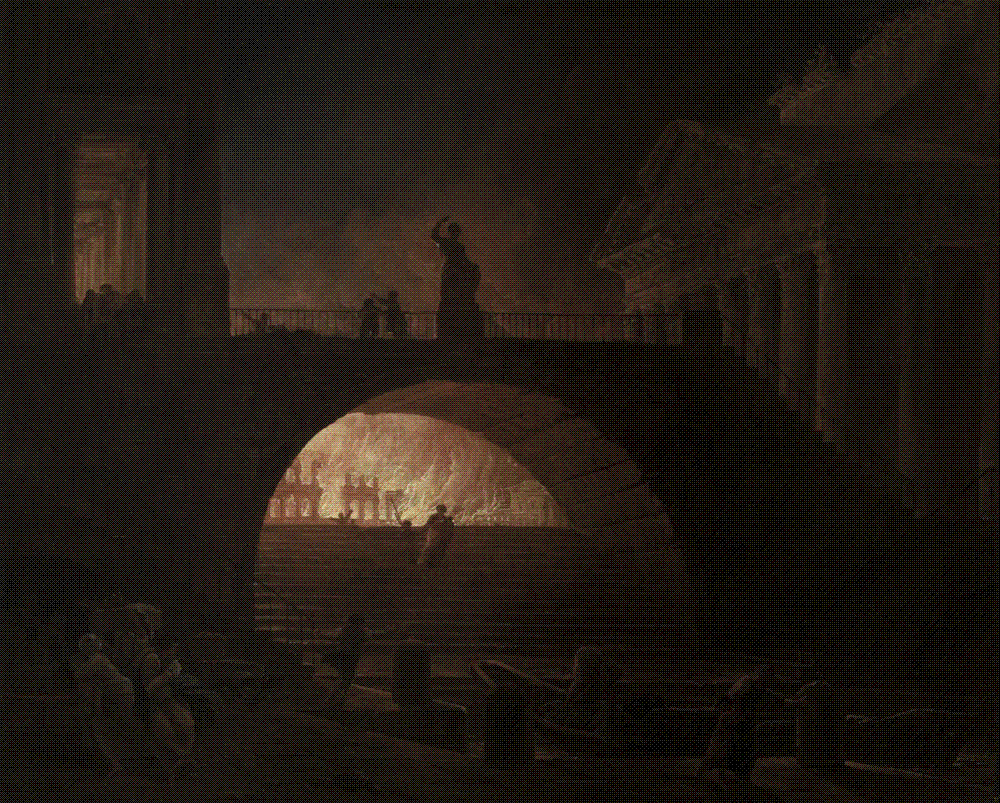
Climate BBC · AP · Aug 4, 2026 A man is arrested on suspicion of arson over the largest of three wildfires around Spokane that have destroyed more than 700 buildings Aaron Farinacci, 37, was allegedly seen kneeling near grass at the site of the Old Trails fire and later found carrying matches and a lighter, the Spokane County sheriff said; he is held on a $1 million bond. More than 60,000 people have evacuated Washington's second-largest city, and Governor Bob Ferguson called the fires "likely the worst natural disaster in Spokane history". Authorities are still trying to reach 14 people, and more than 900 firefighters have been assigned to blazes across the state. Analogies Rome burns for six days and the city cannot tell accident from arson A disaster followed, whether accidental or treacherously contrived by the emperor, is uncertain, as authors have given both accounts, worse, however, and more dreadful than any which have ever happened to this city by the violence of fire. … And no one dared to stop the mischief, because of incessant menaces from a number of persons who forbade the extinguishing of the flames, because again others openly hurled brands, and kept shouting that there was one who gave them authority, either seeking to plunder more freely, or obeying orders.
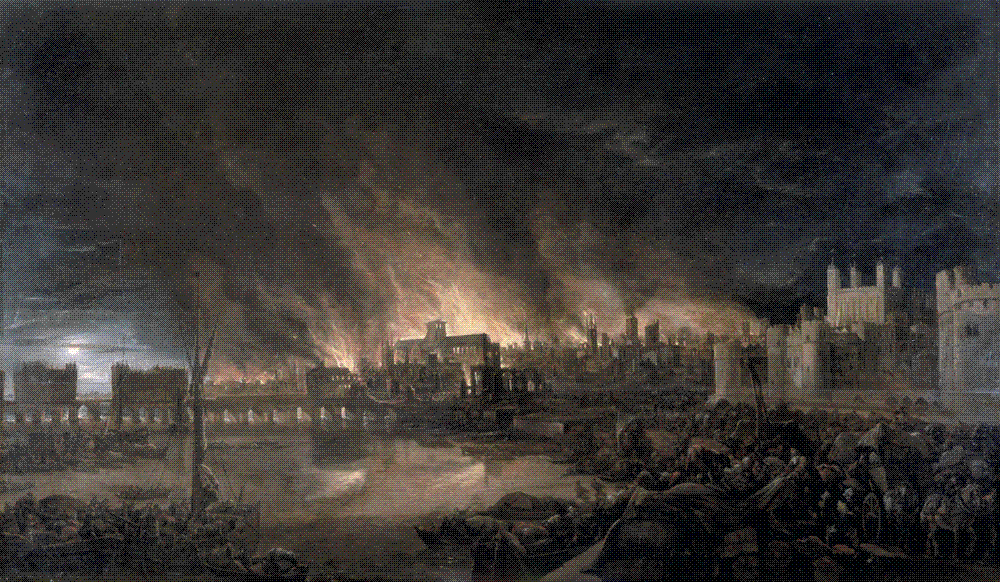
Tacitus, Annals 15.38 (AD 64 fire of Rome), trans. Alfred John Church and William Jackson Brodribb, rev. Sara Bryant, in Complete Works of Tacitus (New York: Random House, reprinted 1942); hosted by the Perseus Digital Library, Tufts University. → London, 1666: foreigners jailed on suspicion while the official account settles on 'unhappy chance' Divers Strangers, Dutch and French were during the Fire, apprehended, upon suspicion that they contributed mischievously to it, who are all Imprisoned and Informations prepared to make a severe inquisition thereupon by my Lord Chief Justice Keeling, assisted by some of the Lords of the Privy council, and some principal Members of the City notwithstanding which suspicions, the manner of the burning all along in a Train and so blown forwards in all its way by strong winds, makes us conclude, the whole was the effect of an unhappy chance, or to speak better, the heavy hand of God upon us for our sins
'A True Relation of that sad and deplorable Fire, that happened and brake out in London, the second of September 1666', printed broadside published by authority (York: Stephen Bulkley for Francis Mawbarne, 1666), also carried in The London Gazette of 10 September 1666. The National Archives, Kew, catalogue reference SP 29/170 f150; transcript hosted by The National Archives. → A provincial town burns and the governor declares the fire is in men's minds "It's all incendiarism! It's nihilism! If anything is burning, it's nihilism!" … "They will wipe away the tears of the people whose houses have been burnt, but they will burn down the town. It's all the work of four scoundrels, four and a half! Arrest the scoundrel! He worms himself into the honour of families. They made use of the governesses to burn down the houses." … "He is putting the fire out, your Excellency." "Not likely. The fire is in the minds of men and not in the roofs of houses."
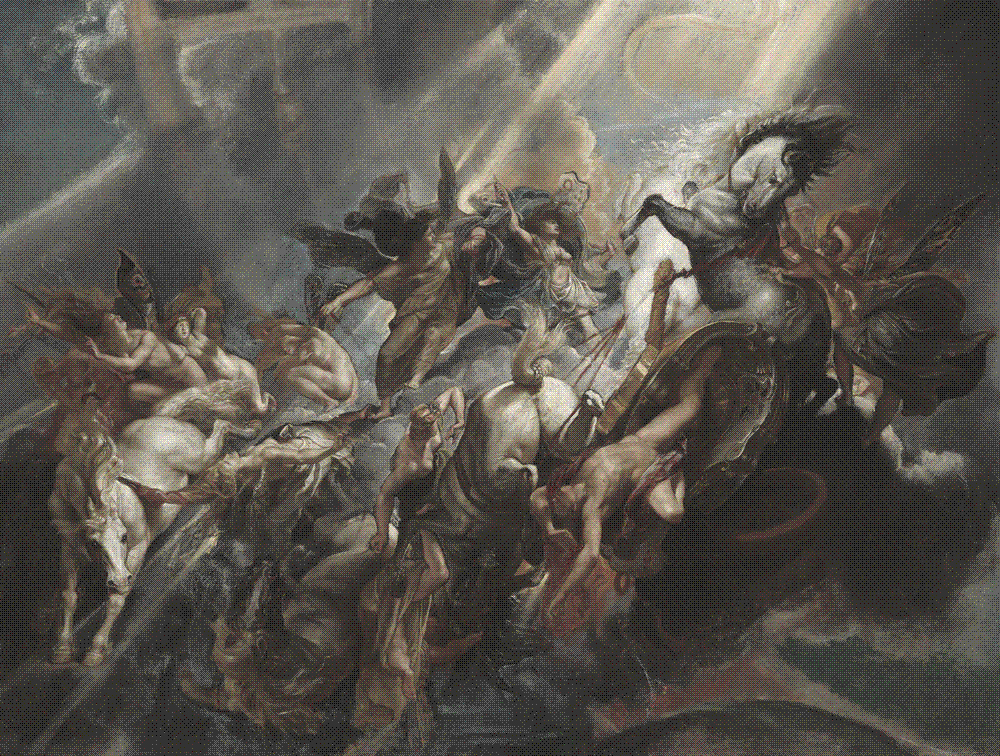
Fyodor Dostoevsky, The Possessed (Devils / Demons), Part III, Chapter II ('The End of the Fete'), first serialised 1871–72; trans. Constance Garnett (1916). Project Gutenberg eBook #8117. → Phaethon takes the reins and the whole earth catches: Ovid's account of a world set alight by one hand The grass is blighted; trees are burnt up with their leaves; the ripe brown crops give fuel for self destruction—Oh what small complaints! Great cities perish with their walls, and peopled nations are consumed to dust—the forests and the mountains are destroyed. … "How difficult to open my parched mouth, and speak these words! (the vapours choking her), behold my scorching hair, and see the clouds of ashes falling on my blinded eyes, and on my features! What a recompense for my fertility!"
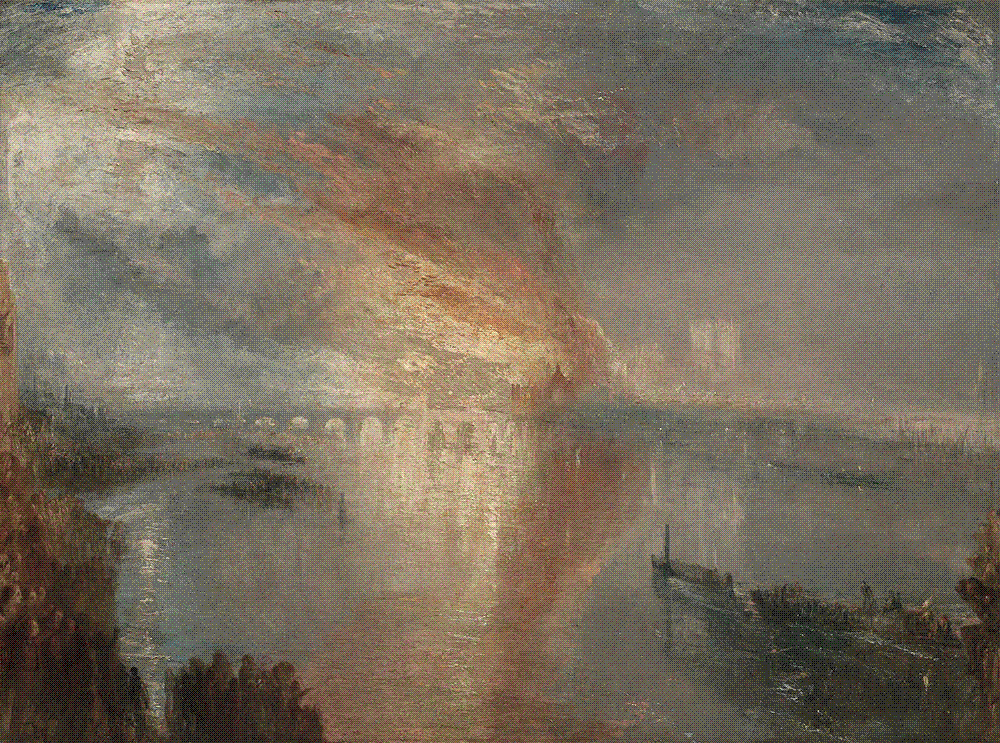
Ovid (P. Ovidius Naso), Metamorphoses, Book 2, lines 193–300 (the burning of the earth by Phaethon), trans. Brookes More (Boston: Cornhill Publishing Co., 1922); hosted by the Perseus Digital Library, Tufts University. → Turner paints a crowd watching its own government burn across the water Turner stood among the crowds on the Thames on the night of 16 October 1834 and made this canvas from the memory of it: a wall of white-hot flame swallowing the Palace of Westminster, the stone of the buildings dissolving into the same yellow air as the smoke. Westminster Bridge sags and warps under the heat at the right. The whole lower half of the picture is spectators — a dark packed mass of people on the far bank and in boats, faces lit by the fire they have come to watch, and can do nothing about. Turner deliberately exaggerated the height of the blaze; the painting is less a record of the event than of the crowd's helplessness before it.
Joseph Mallord William Turner (British, 1775–1851), 'The Burning of the Houses of Lords and Commons, 16 October 1834', 1835, oil on canvas, 92 × 123.2 cm. The Cleveland Museum of Art, Bequest of John L. Severance, accession no. 1942.647 (Open Access, public domain). → Verdi's Dies irae: the world dissolved in ash, and the ledger in which nothing hidden stays hidden Dies iræ! dies illa / Solvet sæclum in favilla / Teste David cum Sibylla! … Liber scriptus proferetur, / in quo totum continetur, / unde mundus judicetur. // Judex ergo cum sedebit, / quidquid latet apparebit: / nil inultum remanebit. — "Day of wrath! O day of mourning! / See fulfilled the prophets' warning, / Heaven and earth in ashes burning! … Lo! The book, exactly worded, / wherein all hath been recorded: / thence shall judgment be awarded. // When the Judge his seat attaineth, / and each hidden deed arraigneth, / nothing unavenged remaineth."
Giuseppe Verdi, Messa da Requiem (1874), 'Dies irae' sequence — full score (Milan: Ricordi), public domain, hosted at IMSLP/Petrucci Music Library. Text: the thirteenth-century sequence attributed to Thomas of Celano, as given in the Requiem Mass of the Roman Missal, with the 1849 English verse translation by William Josiah Irons as printed in the English Missal (1912), hosted at Wikisource (https://en.wikisource.org/wiki/Dies_Irae_(Irons,_1912)). →