Wikimedia Commons
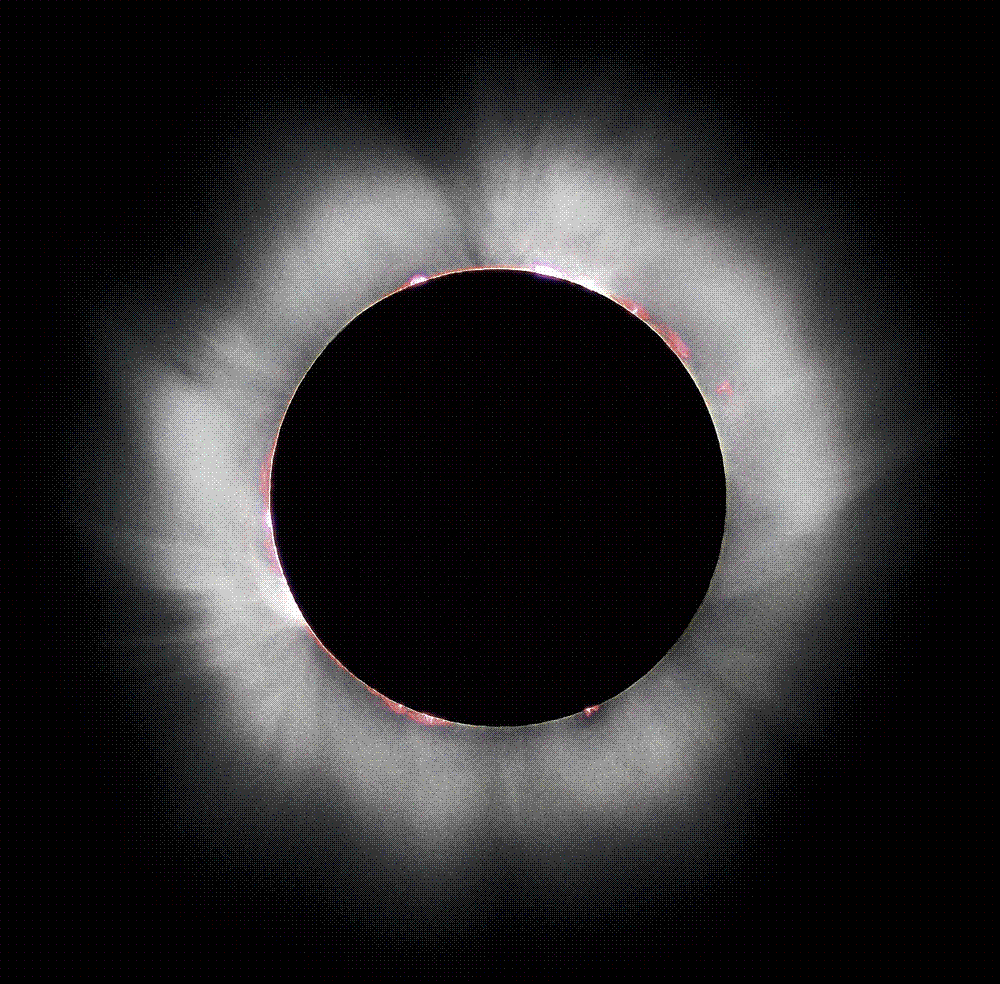
A total solar eclipse on 12 August will sweep across Spain, Iceland and Greenland, the first over mainland Europe since 1999 Astronomers say a total solar eclipse on 12 August will darken skies across Greenland, Iceland and northern Spain, the first total eclipse visible from mainland Europe since 1999. The moon will fully cover the sun for more than two minutes along a narrow path, drawing eclipse chasers to the region. Forecasters urged viewers to use certified filters to watch safely. Analogies The eclipse that stopped a war: Thales foretells the day turning to night in the sixth year a battle took place in which it happened, when the fight had begun, that suddenly the day became night. And this change of the day Thales the Milesian had foretold to the Ionians laying down as a limit this very year in which the change took place.
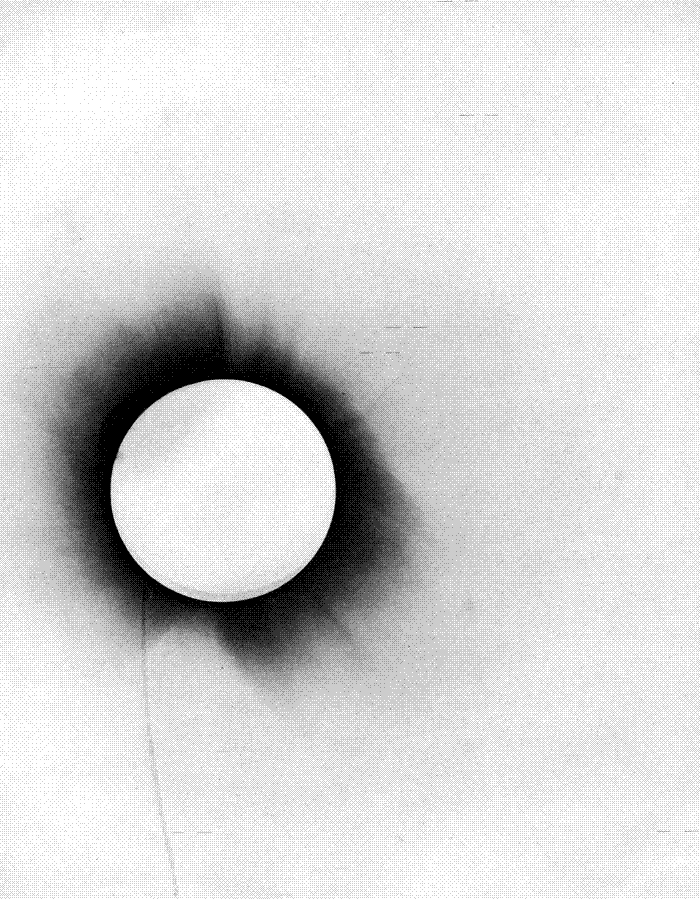
Herodotus, The History of Herodotus, Book I.74 (on the battle of the Medes and Lydians, 585 BC), trans. G. C. Macaulay, Project Gutenberg → Eddington's 1919 eclipse: 302 seconds that weighed light There is a marvellous spectacle above, and, as the photographs afterwards revealed, a wonderful prominence-flame is poised a hundred thousand miles above the surface of the sun. We have no time to snatch a glance at it. We are conscious only of the weird half-light of the landscape and the hush of nature, broken by the calls of the observers, and beat of the metronome ticking out the 302 seconds of totality.
Arthur Eddington, Space, Time and Gravitation: An Outline of the General Relativity Theory (1920), describing the total eclipse of 29 May 1919, Wikisource → The sun in dim eclipse, and monarchs perplexed with fear of change As when the sun new-risen / Looks through the horizontal misty air / Shorn of his beams, or, from behind the moon, / In dim eclipse, disastrous twilight sheds / On half the nations, and with fear of change / Perplexes monarchs.
John Milton, Paradise Lost, Book I, ll. 594–599 (1667), Project Gutenberg → Now nothing is unexpected: Zeus makes night at midday Nothing is unexpected, nothing is foresworn and / Nothing amazes now that father Zeus the Olympian / veiled the light to make it night at midday / even as sun was shining...
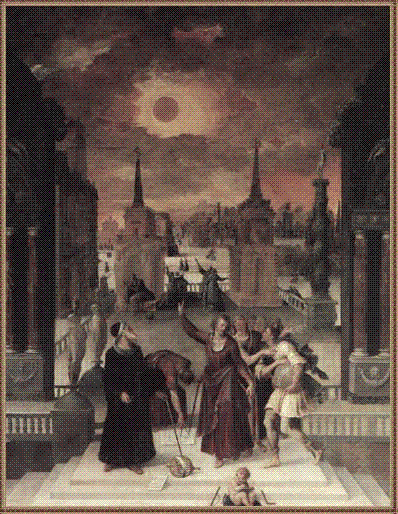
Archilochus, fragment 122 (on a solar eclipse, traditionally 648 BC), Greek text with English translation, Sententiae Antiquae → Astronomers Studying an Eclipse: antiquity's wonder seen through Renaissance eyes Richly robed scholars crowd a marble terrace strewn with armillary spheres, astrolabes and geometric instruments, arms flung upward toward a wan, cloud-veiled sun. Caron paints the ancient philosophers as courtiers of his own Valois France, turning the terror of a darkened sky into a theatre of learned curiosity — human reason craning to read the heavens even as the light fails.
Antoine Caron (French, 1521–1599), Astronomers Studying an Eclipse, oil on panel, c. 1571, J. Paul Getty Museum (acc. 85.PB.117) → 'Total eclipse! No sun, no moon!' — Samson's lament for the vanished light Total eclipse! No sun, no moon! All dark amidst the blaze of noon! Oh, glorious light! No cheering ray To glad my eyes with welcome day! Why thus depriv'd Thy prime decree? Sun, moon, and stars are dark to me!
George Frideric Handel, Samson (HWV 57, 1743), tenor aria 'Total eclipse,' libretto by Newburgh Hamilton after Milton's Samson Agonistes; text sheet, IPA Source →