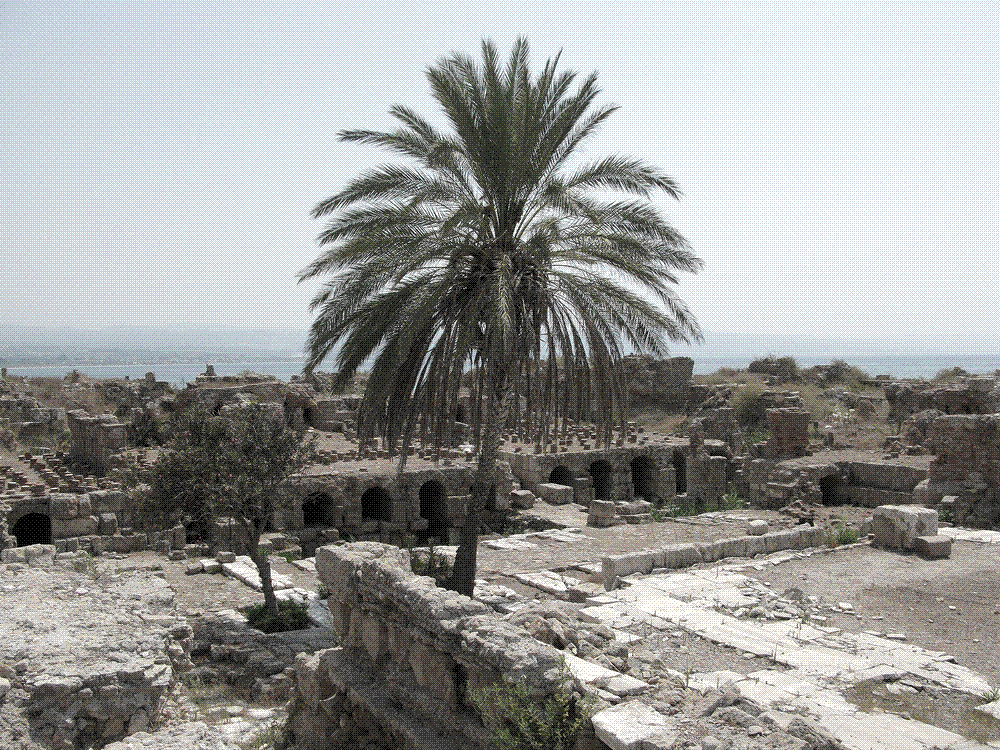
Roman ruins at Tyre in southern Lebanon: standing columns along a paved street near the sea

RomanDeckert / Wikimedia Commons, CC BY-SA 4.0

CultureAPSep 21, 2026

At Tyre, divers go back down to the sunken ruins that survived the strikes

The ancient harbour works and submerged structures off Tyre came through the recent military strikes in southern Lebanon intact, and this week divers resumed the slow work of exploring and recording them. It is a small story with a long tail. Tyre was the Phoenician city that seeded Carthage and Cadiz, sat on an island until Alexander built a causeway out to it in 332 BC, and has been continuously inhabited since; much of what is left of its two ancient harbours is now under water, silted, and known only in fragments. The archaeology is therefore unusually vulnerable — not to bombing alone but to the interruption of everything that keeps a site legible: survey seasons, funding, divers who know the ground, the local institutions that hold the records. That the ruins survived is a fact about ordnance. That people went back down this week is a fact about whether the place will still be understood in twenty years.
Analogies

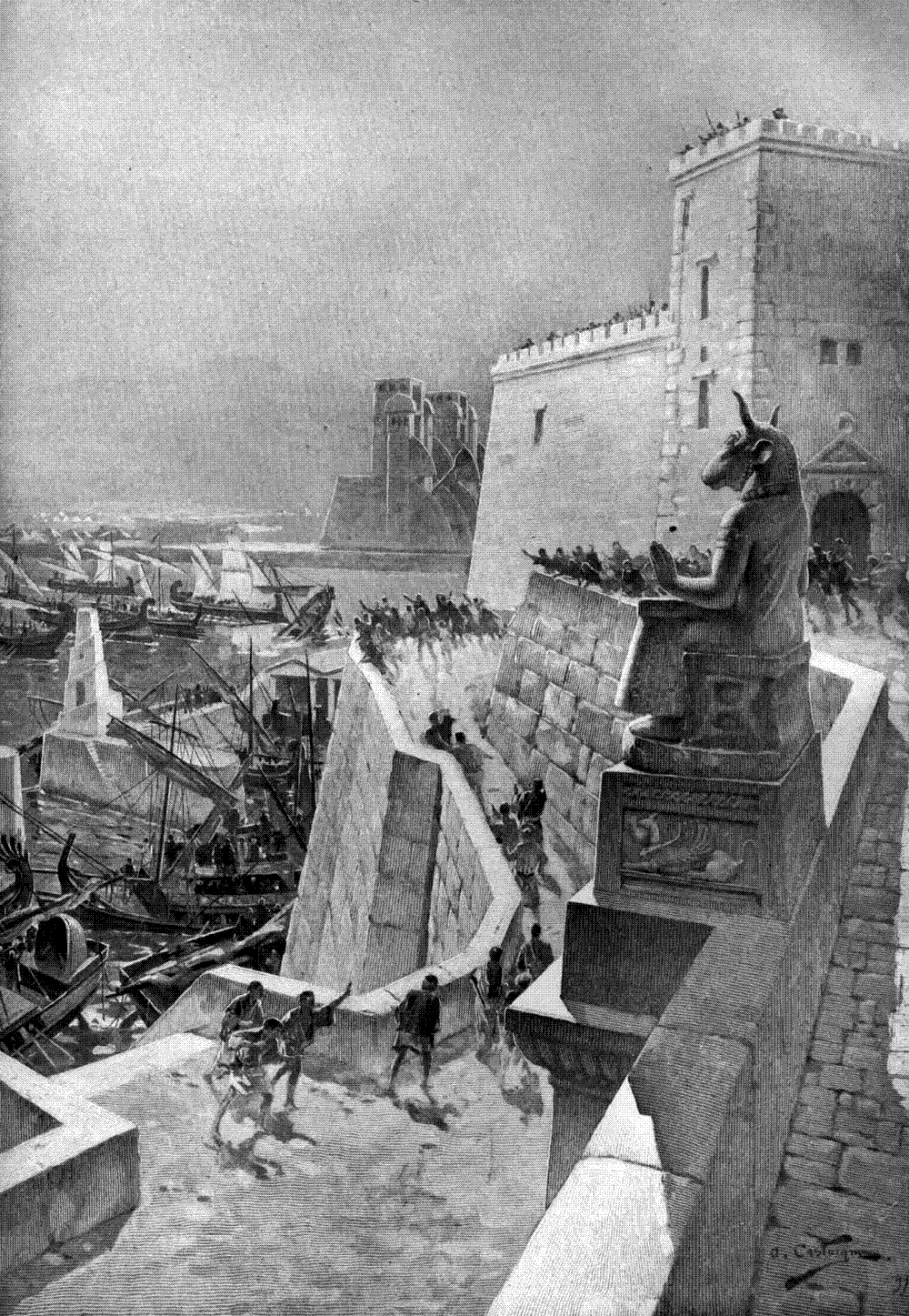
André Castaigne's illustration of a naval action during Alexander's siege of Tyre

332 BC: Alexander builds a causeway out to the island and changes the coastline permanently

But the latter erected two towers upon the mole, which they had now projected over a long stretch of sea, and upon these towers they placed engines of war.
Arrian, The Anabasis of Alexander, book II, trans. E. J. Chinnock (London: Hodder & Stoughton, 1884); Project Gutenberg ebook 46976. →
Roman colonnaded ruins at Tyre in southern Lebanon beside the sea

1911: the Britannica notes that Alexander's siege works are now simply part of the geography

a peninsula, which till the time of Alexander's siege was an island, without water or vegetation. The mole which he constructed has been widened by deposits of sand
'Tyre', Encyclopædia Britannica, 11th edition, vol. 27 (Cambridge University Press, 1911). →

Ezekiel addresses Tyre at the height of its shipping, and describes it as a vessel

O thou that art situate at the entry of the sea, which art a merchant of the people for many isles
The Book of Ezekiel, ch. 27, verses 3 and 25, King James Version (1611). →
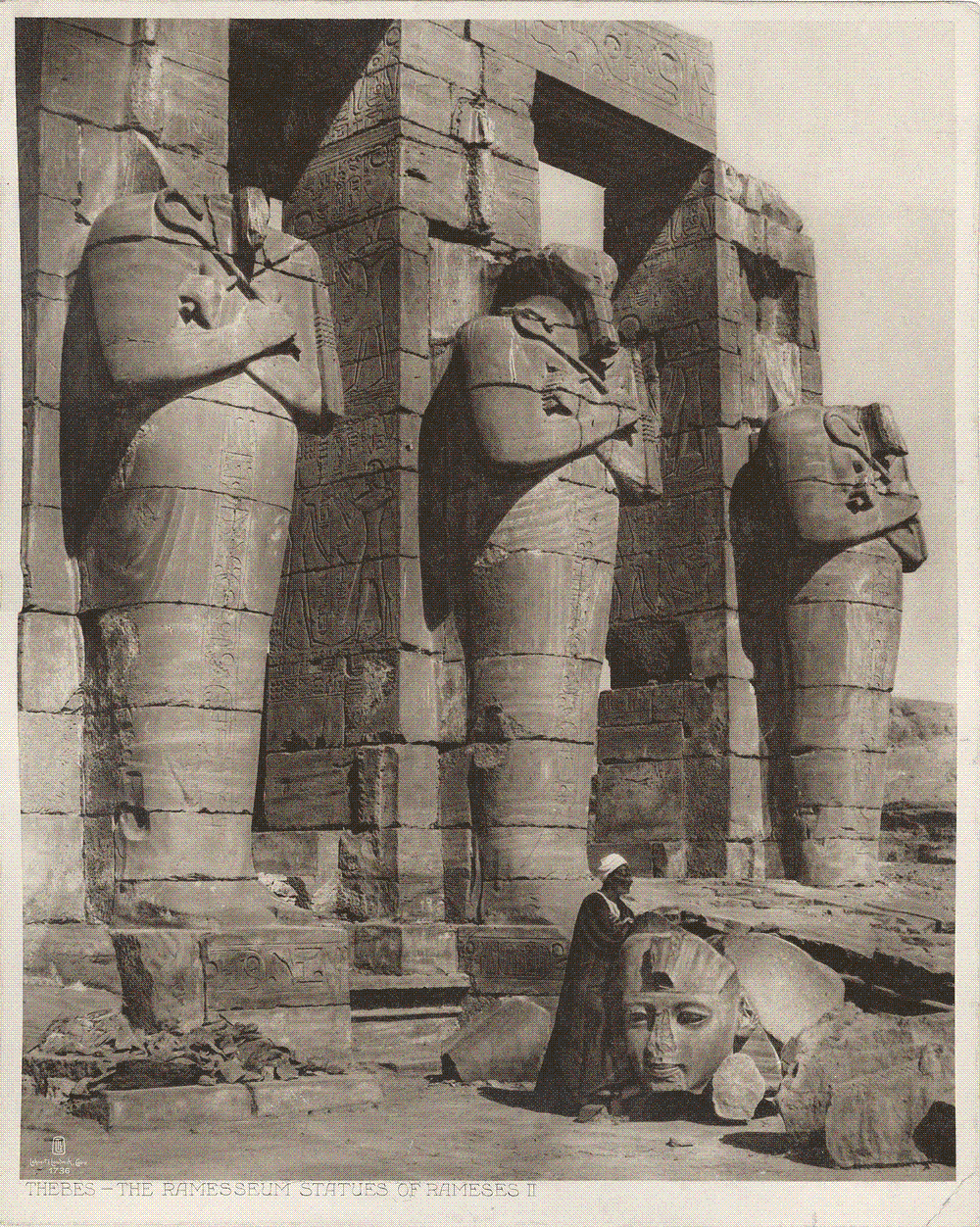
A nineteenth-century photograph of the Ramesseum at Thebes, with the fallen colossus of Ramesses II

Shelley's 'Ozymandias' (1818) is fourteen lines about what survives and what the survival means

No thing beside remains. Round the decay / Of that Colossal Wreck, boundless and bare, / The lone and level sands stretch far away.
Percy Bysshe Shelley, 'Ozymandias', first published under the pen name Glirastes in The Examiner, London, 11 January 1818. →
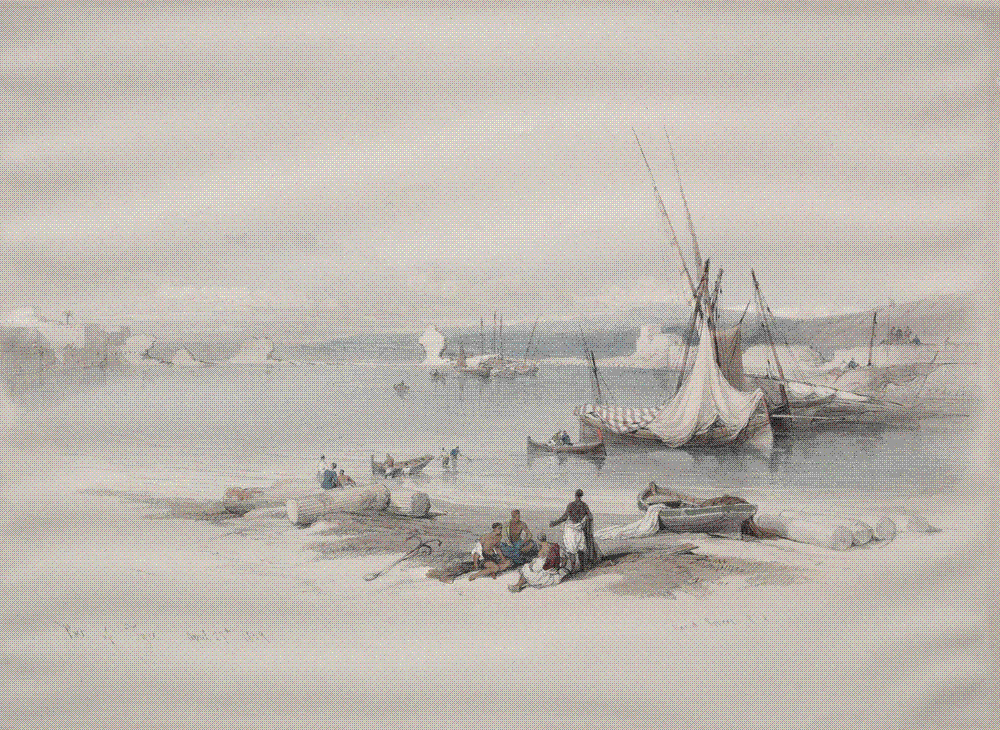
David Roberts's lithograph of Tyre: fishing boats and nets among fallen columns on the shore

David Roberts draws the ruins of Tyre in 1839, from the seaward side, with the columns already in the water

Roberts draws the site as a working shore rather than an antiquity: fishing boats hauled up, nets over broken granite columns, a low town on the isthmus behind, and the surf running over cut stone. He travelled the Levant with a sketchbook in 1838–39 and his lithographs became, for a European public, the standard image of these places — which is why they now double as a survey record of what was still visible above water in the 1830s.
David Roberts, 'Tyre', lithograph by Louis Haghe, from The Holy Land, Syria, Idumea, Arabia, Egypt and Nubia (London: F. G. Moon, 1842–49), after drawings made in 1838–39. →

Turner's 'Decline of the Carthaginian Empire' (1817) paints the fate of the city Tyre founded

A harbour dissolving in low orange light, colossal architecture on both banks, ships at anchor and figures on the quay giving up their children as hostages to Rome. Turner exhibited it as a pendant to his rising Carthage, and the pair were his own favourite works; he wanted to be buried wrapped in one of them. Carthage was founded from Tyre. The picture is about what happens to a maritime city after the sea stops being its advantage.
J. M. W. Turner, The Decline of the Carthaginian Empire, exhibited 1817, oil on canvas; Tate, London, N00499. →