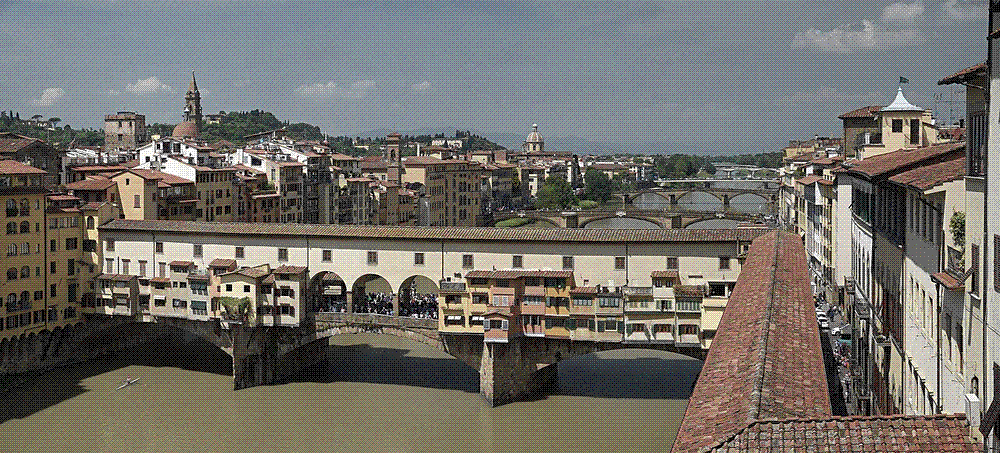
The Ponte Vecchio spanning the Arno in Florence, seen from a window of the Uffizi Gallery.

Ввласенко / Wikimedia Commons, CC BY-SA 3.0

ArtArtforumSep 24, 2026

A sudden cloudburst sends water pouring into the Uffizi and the Palazzo Pitti

A fast-moving cloudburst dropped nearly two inches of rain on Florence in an hour on 18 September, sending water cascading into the Uffizi Gallery and the historic Palazzo Pitti across the Arno and raising concern for the masterworks housed inside. The two museums hold one of the densest concentrations of Renaissance painting in the world, and the city has lived with the memory of water since November 1966, when the Arno burst its banks and flooded the historic centre, damaging thousands of works of art and books.

Analogies

Giovanni Villani's chronicle records the flood of October 1269, when the Arno turned Florence into a lake and tore down the Santa Trinita bridge

In the said year 1269, on the night of the first of October, there was so great a flood of rain and waters from heaven, raining down continually for two nights and one day, that all the rivers of Italy increased more than had ever been known before; and the river of Arno overflowed its borders so beyond measure that a great part of the city of Florence became a lake, and this was by reason of much wood which the rivers brought down, which was caught and lay across at the foot of the Santa Trinita Bridge in such wise, that the water of the river was so stopped up that it spread through the city, whence many persons were drowned and many houses ruined.
Giovanni Villani, Nuova Cronica, Book VII, ch. 34, trans. Rose E. Selfe, ed. Philip H. Wicksteed, Villani's Chronicle (London: Archibald Constable, 1906); Project Gutenberg ebook 33022. →

Leonardo da Vinci's instructions for painting a deluge: water bursting its banks and bringing the walls of the city down

which, having already burst its banks, will rush on in monstrous waves; and the greatest will strike upon and destroy the walls of the cities and farmhouses in the valley. Then the ruins of the high buildings in these cities will throw up a great dust, rising up in shape like smoke or wreathed clouds against the falling rain;
Leonardo da Vinci, 'Description of the Deluge', Windsor manuscripts, in The Notebooks of Leonardo da Vinci, ed. and trans. Jean Paul Richter (1888); Project Gutenberg ebook 5000. →
Amelia Curran's 1819 portrait of Percy Bysshe Shelley, young, with an open white collar

Shelley's note to 'Ode to the West Wind' (1819): the poem was written in a wood by the Arno as the autumn storm came in

This poem was conceived and chiefly written in a wood that skirts the Arno, near Florence, and on a day when that tempestuous wind, whose temperature is at once mild and animating, was collecting the vapours which pour down the autumnal rains. They began, as I foresaw, at sunset with a violent tempest of hail and rain, attended by that magnificent thunder and lightning peculiar to the Cisalpine regions.
Percy Bysshe Shelley, note to 'Ode to the West Wind', in Prometheus Unbound, with Other Poems (London: C. and J. Ollier, 1820); The Complete Poetical Works of Percy Bysshe Shelley, ed. Thomas Hutchinson (Oxford, 1914); Project Gutenberg ebook 4800. →
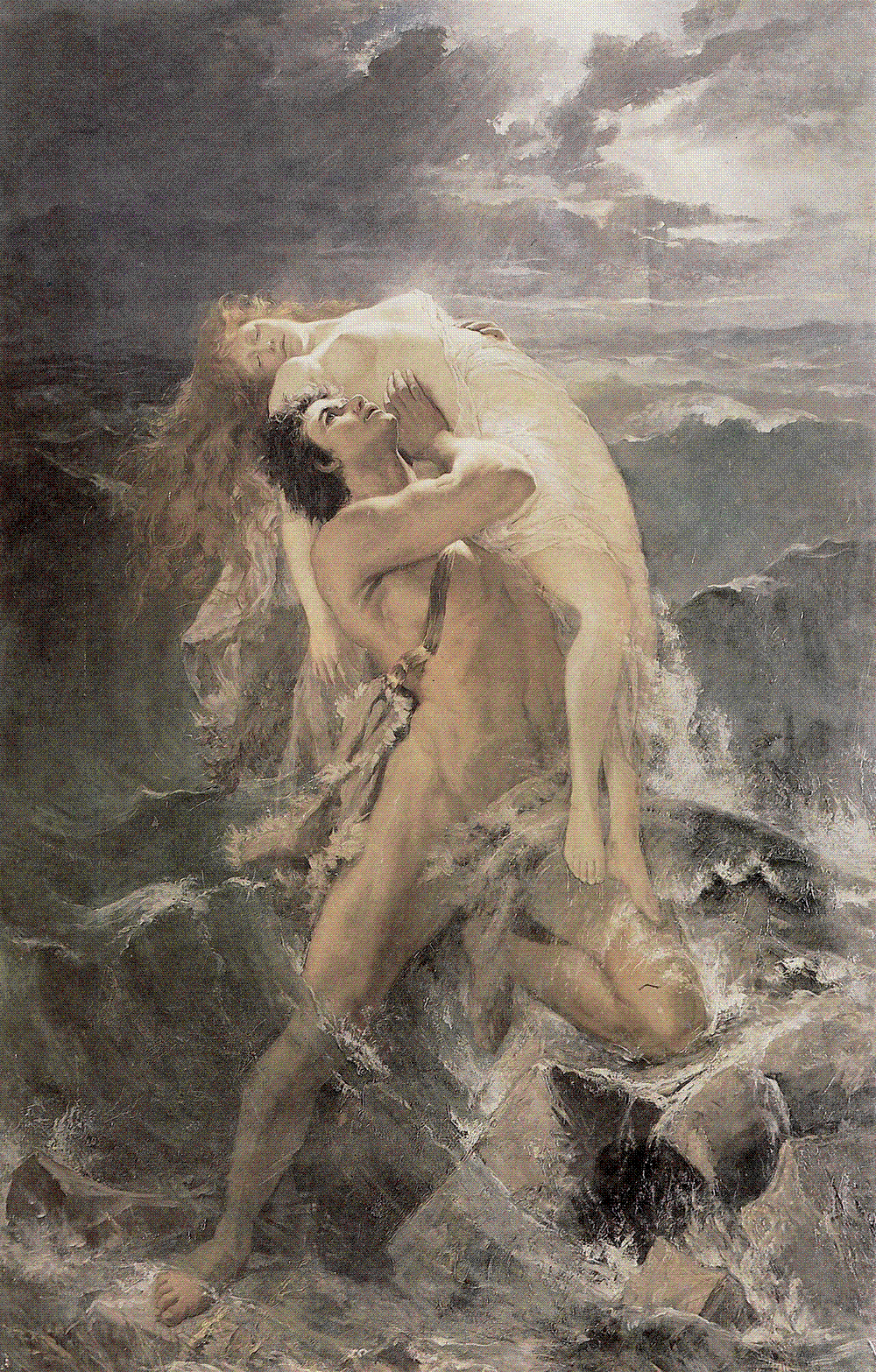
Paul Merwart's painting of the Flood: people clinging to rocks and to one another as the water rises

Ovid's flood in Book I of the 'Metamorphoses': the rivers carry off the temples and their sacred things, and sea and land lose their distinction

The rivers, breaking out, rush through the open plains, and bear away, together with the standing corn, the groves, flocks, men, houses, and temples, together with their sacred utensils. If any house remained, and, not thrown down, was able to resist ruin so vast, yet the waves, rising aloft, covered the roof of that house, and the towers tottered, overwhelmed beneath the stream. And now sea and land had no mark of distinction; everything now was ocean; and to that ocean shores were wanting.
Ovid, Metamorphoses, Book I, trans. Henry T. Riley (London: George Bell & Sons, 1893); Project Gutenberg ebook 21765. Riley's editorial brackets around supplied words are omitted. →
Leonardo's black-chalk drawing of a deluge: torrents of rain and spiralling waves overwhelming a landscape

Leonardo da Vinci's 'A Deluge' (c. 1517–18), one of the black-chalk flood drawings of his last years

In the last years of his life, in France, Leonardo drew a series of deluges in black chalk: storms and floods seen from far above, water curling into spirals and vortices that tear through mountains and towns. In this sheet in the Royal Collection the rain falls in sheets and the water rises in coiling masses that leave almost nothing recognisable. They are the work of a man who had spent decades studying how water moves, and who ended convinced that it would, in the end, have its way.
Leonardo da Vinci, A Deluge, c. 1517–18, black chalk, 16.2 × 20.3 cm; Royal Collection Trust, RCIN 912383. →
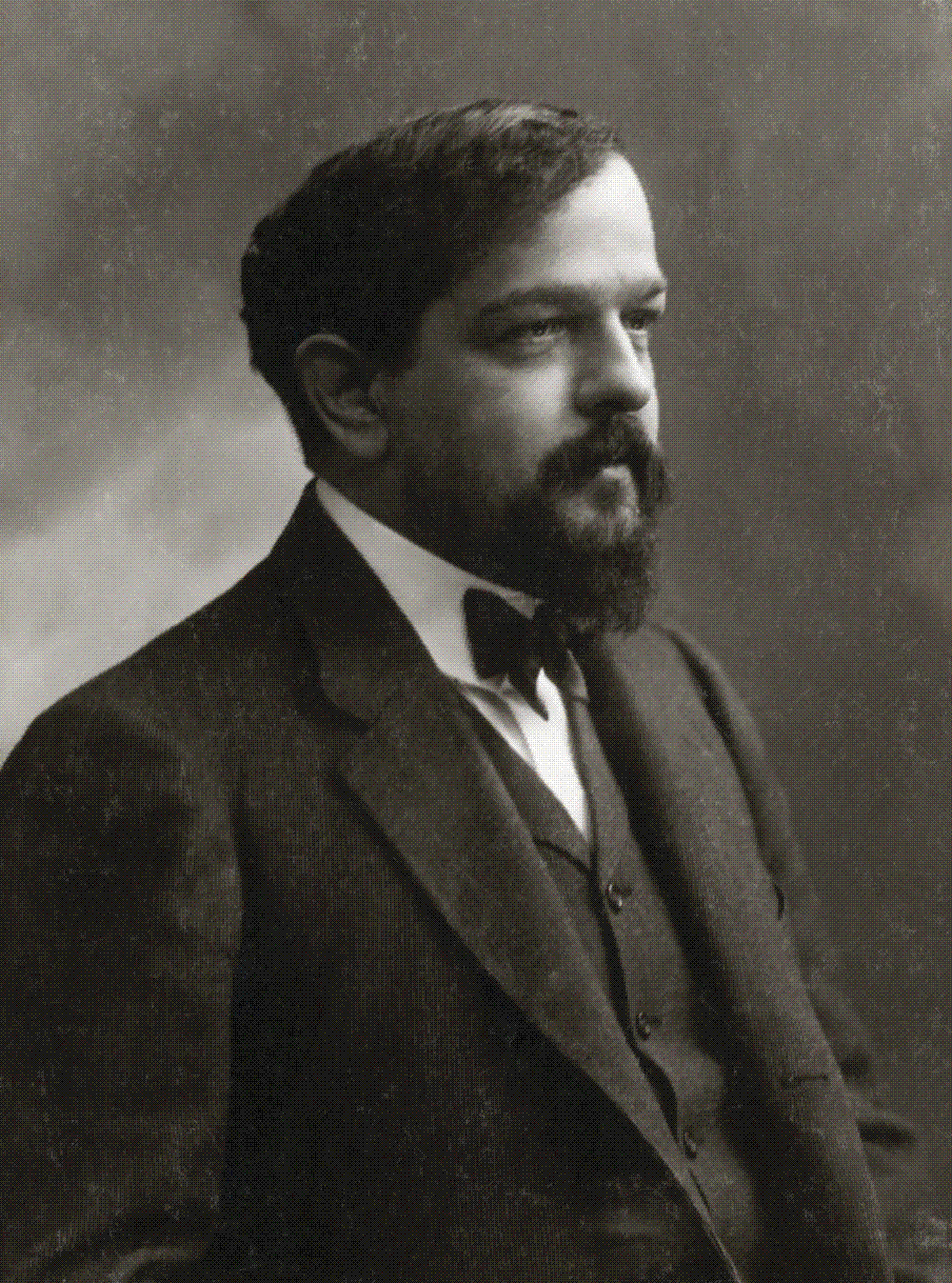
Félix Nadar's photograph of Claude Debussy around 1908, with a dark beard and swept-back hair

Claude Debussy's 'La cathédrale engloutie' ('The Sunken Cathedral', 1910)

The tenth of Debussy's first book of Preludes takes the Breton legend of the drowned city of Ys, whose cathedral rises from the sea on clear mornings and sinks again. Wide, bell-like chords emerge from the deep register of the piano, build to a full organ-like statement of the chant, and then sink back beneath the water. It is music about a treasure that belongs to the water now, and surfaces only when the sea allows.
Claude Debussy, Préludes, Book I, No. 10, 'La cathédrale engloutie', 1909–10 (Paris: Durand, 1910); score at the International Music Score Library Project (IMSLP). →