BBC
Ukrainian drones strike warehouses near Moscow, St Petersburg and Tver, killing five and injuring 10, Russian officials say Moscow region governor Andrei Vorobyov said an industrial site at Novoselki in Chekhov, about 69km south of the Kremlin, was hit overnight, with a warehouse catching fire and an electrical substation damaged. Local officials said depots of the retailer Wildberries, often called the Russian Amazon, were also struck in the St Petersburg and Tver regions; Kyiv says they supply the Russian military, which Moscow denies. Russia's defence ministry said it destroyed 320 drones, while Russian strikes on Mykolaiv and Sumy killed at least four people. Analogies 429 BC: the Peloponnesians plot a raid on Piraeus, the harbour Athens never thought to guard Cnemus, Brasidas, and the other Peloponnesian captains allowed themselves to be persuaded by the Megarians to make an attempt upon Piraeus, the port of Athens, which from her decided superiority at sea had been naturally left unguarded and open... There was no fleet on the look-out in the harbor, and no one had the least idea of the enemy attempting a surprise; while an open attack would, it was thought, never be deliberately ventured on or if in contemplation, would be speedily known at Athens.
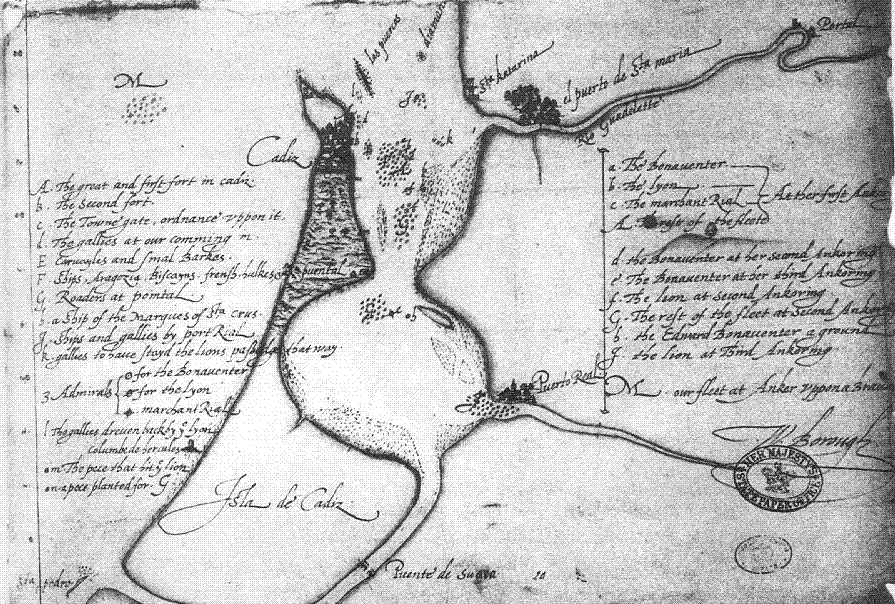
Thucydides, History of the Peloponnesian War, Book 2, ch. 93, trans. Richard Crawley (London: J. M. Dent; New York: E. P. Dutton, 1910); hosted by the Perseus Digital Library, Tufts University → 1587: Drake burns the King of Spain's stores at Cadiz and Cape Sagres Vpon this information our Generall with al speed possible, bending himselfe thither to cut off their said forces and prouisions, vpon the 19. of April entered with his Fleet into the Harbor of Cadiz... After whose departure wee shaped our course toward Cape Sacre, and in the way thither wee tooke at seuerall times of ships, barkes, and Carauels well neere an hundred, laden with hoopes, gally-oares, pipe-staues, and other prouisions of the king of Spaine, for the furnishing of his forces intended against England, al which we burned, hauing dealt fauourably with the men and sent them on shoare.
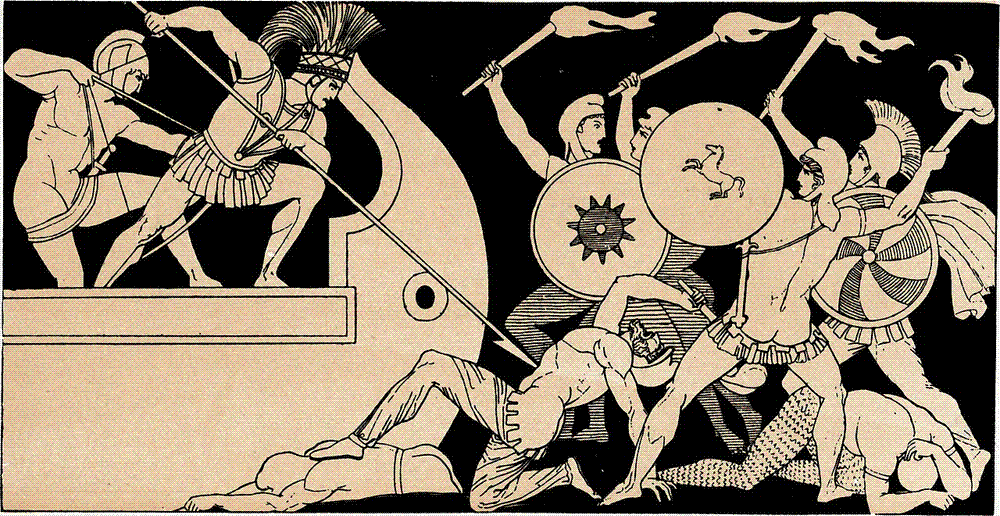
"A briefe relation of the notable seruice performed by Sir Francis Drake vpon the Spanish Fleete prepared in the Road of Cadiz... Performed in the yeere 1587", in Richard Hakluyt, The Principal Navigations, Voyages, Traffiques and Discoveries of the English Nation (1598-1600), Volume 07; Project Gutenberg eBook #9148 → Homer: the Trojans get fire to the Achaean ships, the army's only way home And now, tell me, O Muses that hold your mansions on Olympus, how fire was thrown upon the ships of the Achaeans... Therefore he drew back, and the Trojans flung fire upon the ship which was at once wrapped in flame. The fire was now flaring about the ship's stern, whereon Achilles smote his two thighs and said to Patroklos, "Up, noble horseman, for I see the glare of hostile fire at our fleet; up, lest they destroy our ships, and there be no way by which we may retreat."
Homer, Iliad, Book 16 (lines 101-129), rendered into English prose by Samuel Butler (London: Longmans, Green and Co., 1898); hosted by the Perseus Digital Library, Tufts University → Tolstoy: a Smolensk shopkeeper empties his flour store rather than leave it to the enemy As Alpátych was driving out of the gate he saw some ten soldiers in Ferapóntov's open shop, talking loudly and filling their bags and knapsacks with flour and sunflower seeds. Just then Ferapóntov returned and entered his shop. On seeing the soldiers he was about to shout at them, but suddenly stopped and, clutching at his hair, burst into sobs and laughter: "Loot everything, lads! Don't let those devils get it!" he cried, taking some bags of flour himself and throwing them into the street.
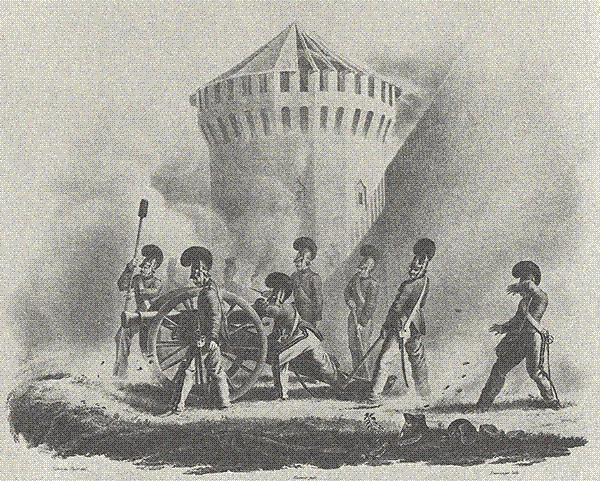
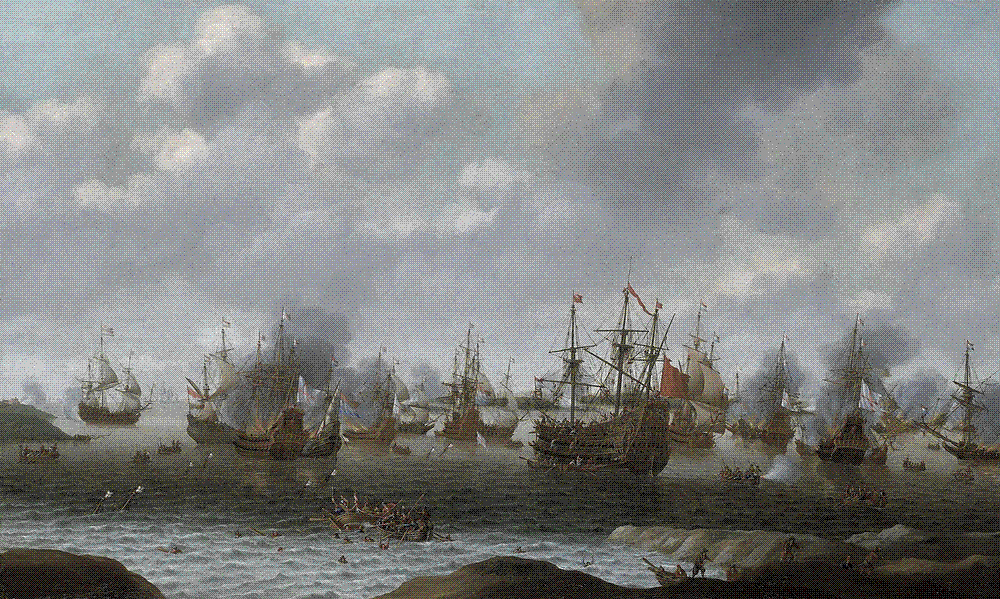
Leo Tolstoy, War and Peace (1869), Book Ten, ch. 4, trans. Louise and Aylmer Maude; Project Gutenberg eBook #2600 → 1667: the Dutch burn the English fleet at its moorings, a few miles from Chatham Dockyard Van Soest painted this within months of the raid itself, when a Dutch squadron broke the chain across the River Medway in June 1667 and fell on the laid-up English warships in the anchorage below Chatham Royal Dockyard, some thirty miles from London. The canvas is a long horizontal line of great ships burning at their moorings, their masts still standing in the smoke, with Dutch boats rowing coolly between them and men in the water in the foreground. On the shore at the right a handful of small figures simply stand and watch: the fleet that was meant to keep the war offshore is going up in flames in its own home river.
Pieter Cornelisz van Soest, "Dutch Attack on the Medway, June 1667", oil on canvas, c. 1667, 660 x 1092 mm, National Maritime Museum, Greenwich, London, object no. BHC0295 → Haydn's Mass in Time of War: kettledrums like distant guns break into a church far behind the front Haydn wrote this C major Mass in 1796, the year French armies drove deep into Austrian territory and the war stopped being something that happened elsewhere; it has been known ever since as the Missa in tempore belli, or in German the Paukenmesse, the kettledrum Mass. In the Agnus Dei the timpani enter almost alone, soft and insistent, like artillery heard from a great distance, and the trumpets answer them. The choir keeps pleading for peace over a sound that has no business in a church, and the movement ends by turning that intrusion into a defiant march.
Joseph Haydn, Mass in C major, Hob.XXII:9 ("Missa in tempore belli" / "Paukenmesse"), composed 1796, first performed 26 December 1796 at the Piarist Church of Maria Treu, Vienna; first published Leipzig: Breitkopf und Härtel, 1802. Full scores and parts hosted at the International Music Score Library Project (IMSLP) →